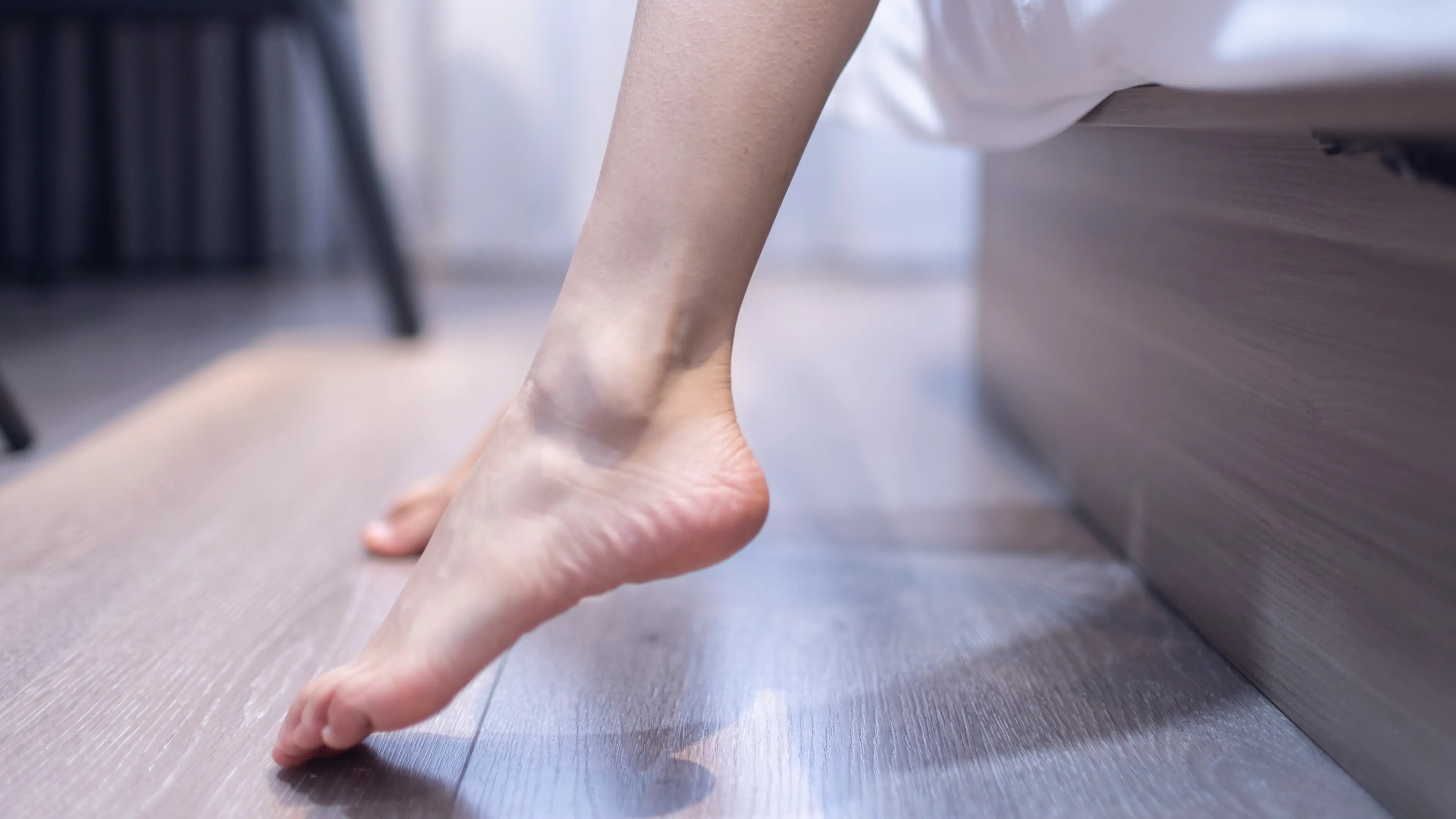
Doctor reveals reason why your feet hurt the moment you get out of bed in the morning

A doctor has spoken about a common condition which can leave patients wincing with pain in the morning.
If you're not a morning person then getting up can already be a frustrating part of the day, being dragged back into consciousness kicking and screaming, desperately trying to justify another five minutes in bed.
But even if you are the type who can leap out of bed at 7am fresh-faced and full of energy, then this health condition may put a dampener on your morning routine.
This is people who experience foot pain specifically first thing in the morning.
Advert
Marion Yau is a podiatrist, and says that she has had a lot of patients complaining about their feet hurting first thing in the morning.
While for some people this might just be a mild annoyance along with the general frustration of having to get up, for others it is a debilitating condition.

They might not look it, but feet are actually a very complicated part of our bodies, containing over 100 muscles, ligaments, and tendons, as well as 26 bones and 33 joints, basically, that's a lot of moving parts.
When it comes to foot pain in the morning, Yau shared one common root cause of the symptom, which is a condition called plantar fasciopathy.
It might seem counter-intuitive for your feet to hurt in the morning when you've been lying down for a long time, but Yau explained that there's actually a reasonable explanation for this.
"When you sleep, your foot naturally points downward, which keeps the plantar fascia in a shortened, contracted position for hours," she told Metro.
"By the time your alarm goes off, that tissue has tightened considerably.
"The moment you put your foot to the floor, the fascia is suddenly pulled from its shortened state into a full weight-bearing stretch and that’s what causes that sharp, 'stepping on glass' pain with your very first steps."

This isn't the only problem either, Yau explained, as there's also the issue of 'over-pronation'.
"Over-pronation, where the foot rolls inward excessively, is another common culprit, as it flattens the arch and stretches the fascia beyond its comfortable range," she explained.
There are also other potential problems, she said, which could even be 'something as simple as tight calf muscles'.
These would be because having limited flexibility on your ankle would create extra tension on a fascia each time you take a step.
Yau recommended some simple measures such as resting your feet, as well as choosing supportive footwear can help.
 Kit Roberts