Scientists propose futuristic new method to stop El Niño as temperature warning issued

Scientists are proposing a new method to prevent the damaging impacts of El Niño, as experts issue a warning over rising temperatures.
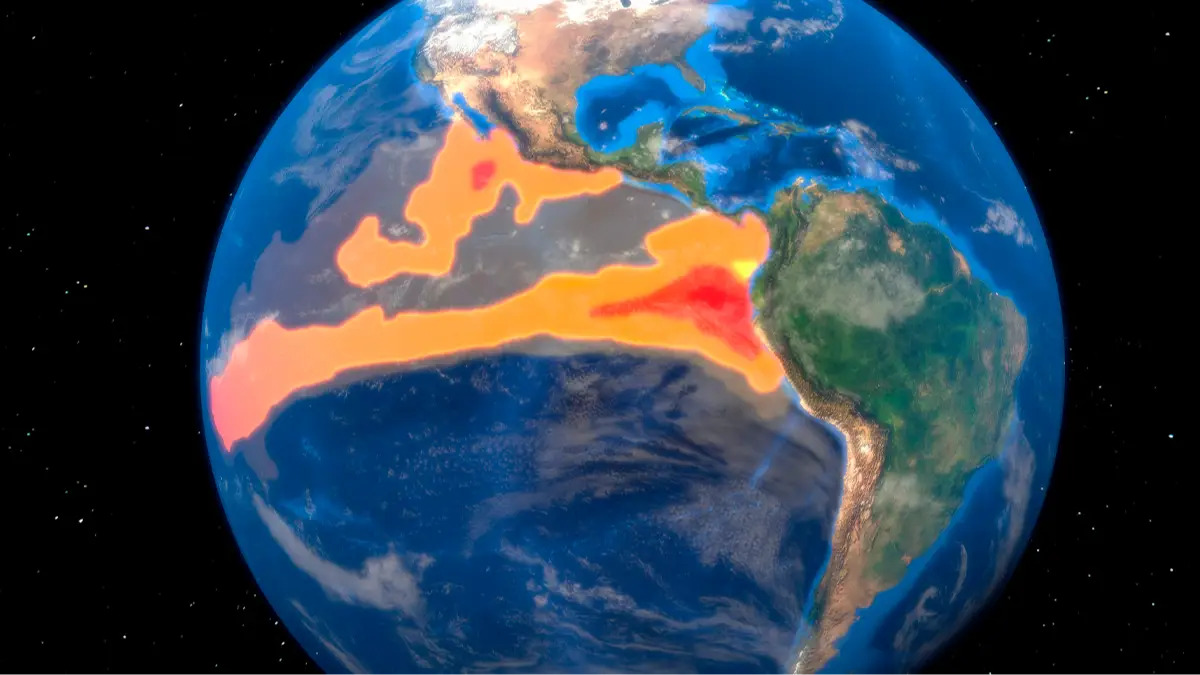
The National Oceanographic and Atmospheric Administration confirmed that the global phenomenon began last month and is expected to last until early 2027.
The climate pattern is driven by warmer-than-usual sea surface temperatures in the Pacific, which can trigger droughts in some parts of the world, while others will experience heavy rainfall.
Nations including Tanzania, Kenya, Ethiopia and Somalia are expected to see a rise in severe rainfall, while countries such as Malawi, Mozambique, Zimbabwe and Madagascar could well face devestating droughts.
Advert
Experts are working hard to stop the El Niño and they are said to be looking into 'brightening' clouds over the Pacific Ocean to achieve their goal.

A new study, which involved scientists at the University of California-San Diego, explained that 'marine cloud brightening' could weaken the El Niño as it begins its destruction.
Scientists are hopeful this will lesser the blow if deployed at the start of the global phenomenon and reduce the impact currently being created over the Pacific.
While the process of brightening has been touted as a possible solution to slower global warming, there are some concerns spoken about by experts.
Jessica Wan, lead author on the study, said: "One of the biggest social concerns around geoengineering is the fact that if we use it to reduce long-term climate risks, we have to deploy it continuously for an indefinite period of time.
"If we could target natural variability [such as an El Niño event], we could get some of the benefits of geoengineering without having to employ it indefinitely."
What is marine cloud brightening?
To put it simply, marine cloud brightening is designed to increase the amount of incoming solar radiation reflected back into space from clouds sitting over oceans.
The University of Cambridge alongside Centre for Climate Repair explains: "Increasing cloud albedo is achieved by increasing the number of cloud condensation nuclei (CCN) present within the clouds which leads to smaller cloud droplets and a whiter, brighter, appearance - a phenomenon known as the Twomey effect.
"Marine Cloud Brightening involves spraying small seawater droplets into the atmosphere which then evaporate, and the resulting salt crystals act as new CCNs when they reach the cloud boundary layer."
2027 set to be hotter than than 2026
Australia's Bureau of Meteorology (BoM) has claimed that the current El Niño could become the strongest on record and potentially lead to an extremely hot 2027.
Climatologist Dr Zhi-Weng Chua said: “There is a realistic chance that the peak anomaly of this event will rank in the top events, with a chance it could rank as the highest. It is remarkable, and it shows just how much heat there is in the ocean.”
“It’s perhaps not a surprise, given climate change and how oceans have been gathering heat in the last few decades.”
Topics: Climate Change, Weather, World News
 Callum Jones