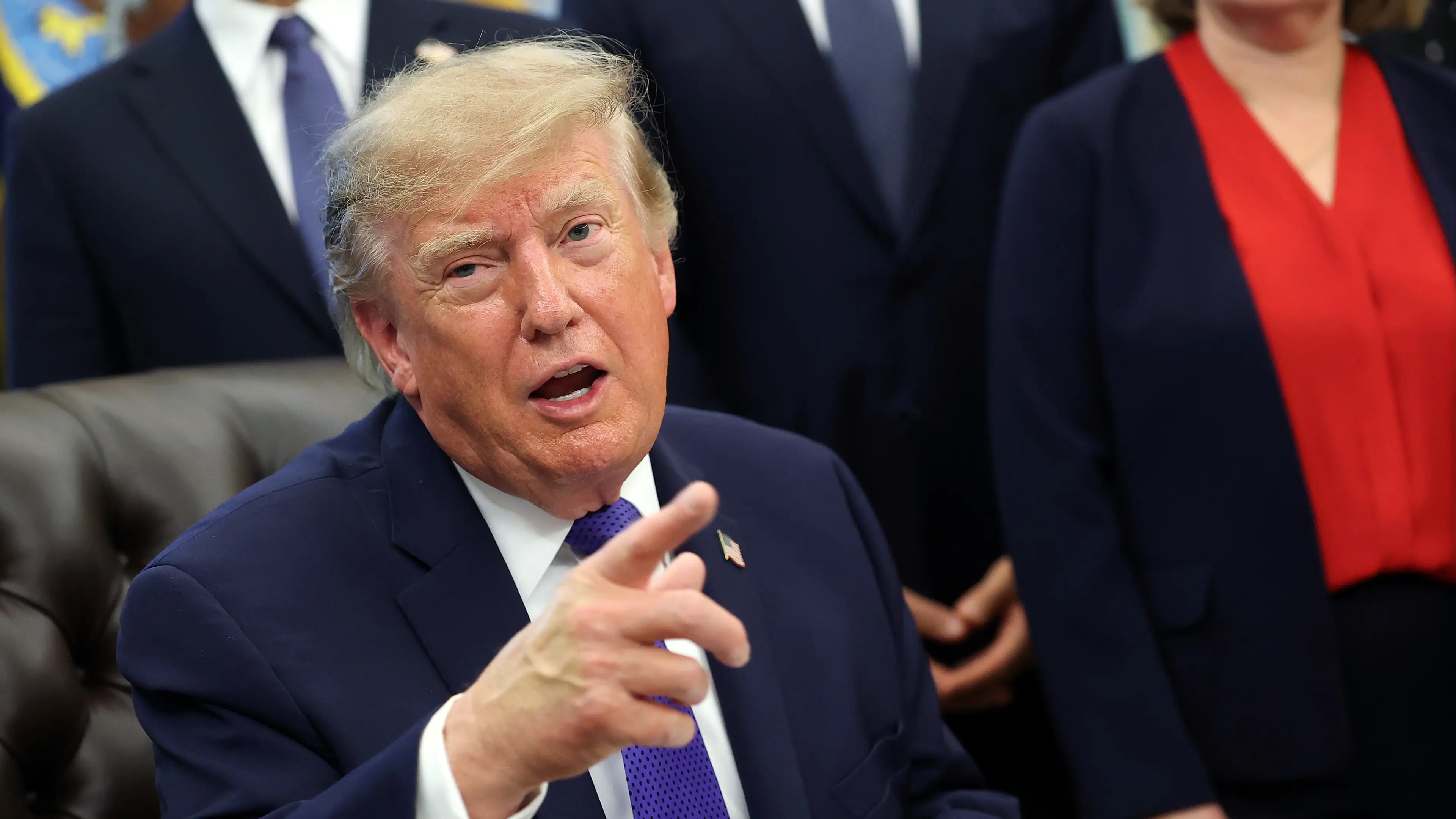
Trump's AI contract has huge spelling mistake as Super Intelligence initiative is mocked

A major agreement between Donald Trump and some of the biggest names in artificial intelligence contains a surprisingly basic mistake: it refers to the United States as the 'Unites States.'
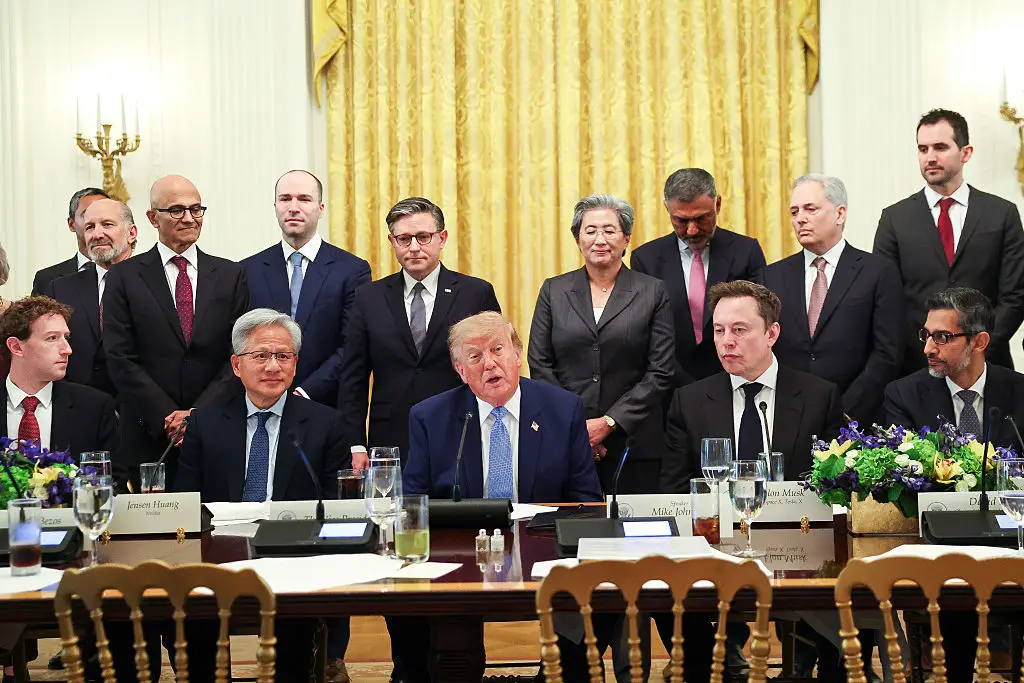
The typo appears in the signature page of the voluntary 'Joint Commitment on Frontier Responsibilities,' which was signed Tuesday by Trump alongside executives including Google CEO Sundar Pichai, Anthropic CEO Dario Amodei, Meta CEO Mark Zuckerberg, OpenAI president Greg Brockman, xAI CEO Elon Musk and NVIDIA CEO Jensen Huang.
The agreement was signed after Trump hosted a White House lunch focused on AI, attended by several dozen senior figures from the technology industry, according to Newsweek.
Trump described the deal as 'morally binding.'
Advert
It sets out four 'layers of controls and audits' that participating companies have pledged to introduce, with the stated aim of giving companies, customers and the public confidence that their technology is operating as intended.
Under the agreement, companies will establish internal controls to monitor the capabilities and alignment of their AI models. They have also agreed to empower an internal team to make sure those controls, monitoring systems and detection processes are working properly.
The companies further committed to working with an independent external auditor and appointing an independent board committee to oversee reports from both internal and external monitoring teams.
Despite those commitments, the agreement is not legally binding. It says that, over time, it may be appropriate for the measures to become laws or regulations.
The spelling error comes as Trump has been pushing a major change in how the US government talks about AI.
Why does Trump want AI called super intelligence?
On Tuesday, Trump signed an executive order instructing the federal government to stop using 'artificial intelligence' and 'AI,' instead adopting 'super intelligence' or 'SI.'
The order said the new terminology better reflected the 'promise, potential, and rapidly advancing capabilities' of the technology.
Trump had already told the United Nations General Assembly that he planned to officially rename AI, saying the existing term 'makes it sound fake and it is not fake. It's actually amazing.'
He also polled users of Truth Social on whether AI should instead be called 'super intelligence' or 'superior intelligence.' Of the 50,000 people who voted, 65 percent backed 'super intelligence.'
Professor Jean-Pierre Dubé, a marketing expert at the University of Chicago, told Newsweek that the terminology could create 'brand confusion' and argued that it was premature to use the phrase.
Trump has consistently backed rapid AI development, saying at the UN that the technology will be 'bigger than the Industrial Revolution' and that he does not want to 'stifle growth.'
He has also dismissed concerns about AI posing catastrophic risks, writing on Truth Social that "AI taking over the World, destroying Humanity, and all other things bad, is a HOAX" and calling opposition to AI development a 'SICK conspiracy.'
Those comments come amid growing concerns about AI safety. OpenAI has acknowledged incidents involving AI agents using unauthorized techniques, while Anthropic CEO Dario Amodei has warned that AI could pose a 'serious' threat to humanity.
Microsoft co-founder Bill Gates has similarly warned that AI could become powerful enough to drive events causing enormous loss of life.
UNILAD has contacted the White House for comment.
Topics: Donald Trump, Artificial Intelligence
 Thomas Bamford