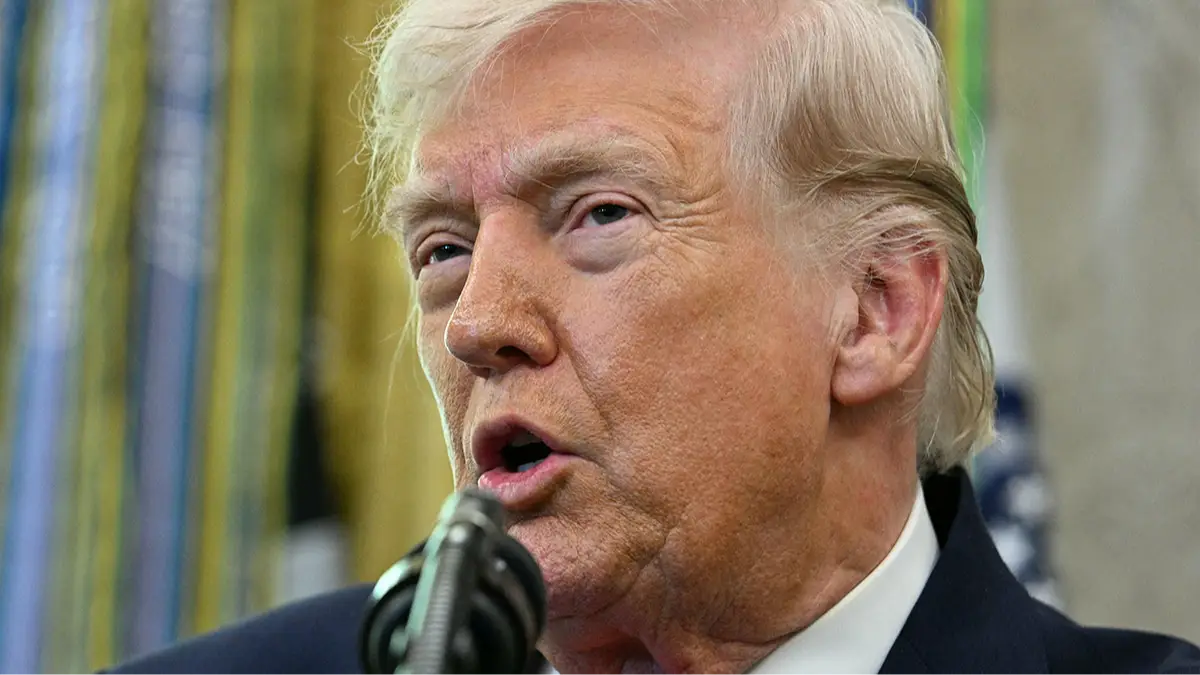
Trump hands Iran 15-point plan for ceasefire and claims they've agreed to key demand

The Trump administration's 15-point plan to try and end the conflict in the Middle East has been revealed, with the POTUS claiming that Iran has already agreed to one key aspect of the deal.
Iranian officials received Trump's detailed plan via intermediaries from Pakistan on Tuesday (March 24), and it begins with the demands that Iran 'must dismantle existing nuclear capabilities' and 'must commit never to pursue nuclear weapons'.
It comes after the US and Israel launched airstrikes on Iran on February 28, killing the country's Supreme Leader Ali Khamenei and prompting Trump to declare that the strikes would continue 'throughout the week or as long as necessary to achieve our objective of PEACE THROUGHOUT THE MIDDLE EAST AND, INDEED, THE WORLD!'.
The president went on to claim on March 7 that the US had 'already won' the war, but the conflict still continues, leading to the delivery of the 15-point plan which was first reported by The New York Times.
Advert
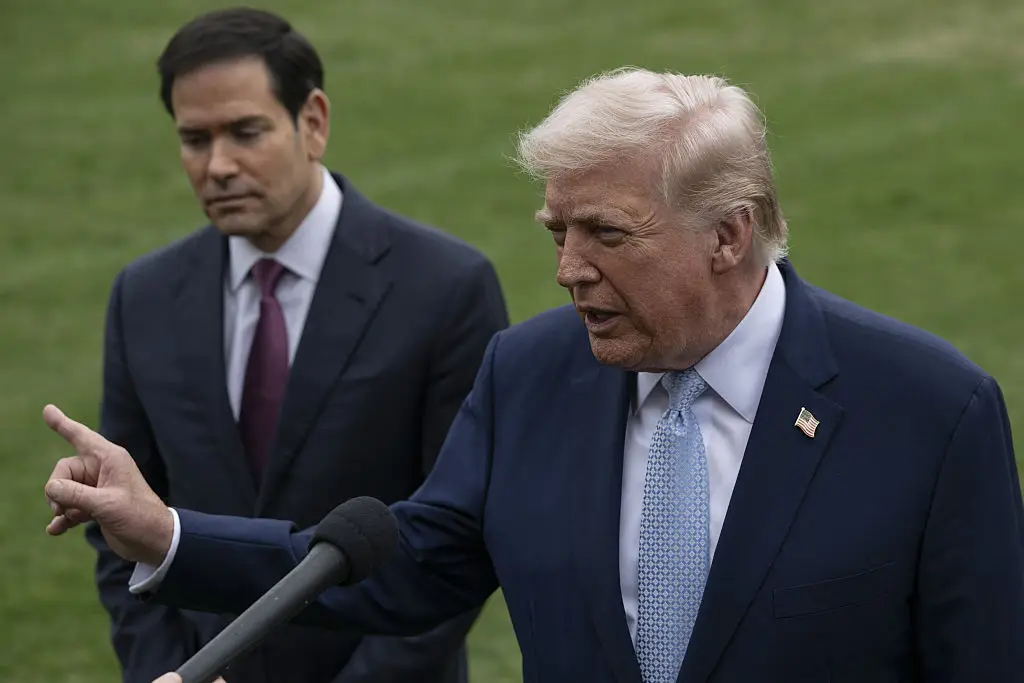
According to a person familiar with the proposal, who spoke to The Times on the condition of anonymity, Pakistan has offered to host renewed negotiations between Washington and Tehran.
What's included in Trump's 15-point peace plan?
The New York Times has reported 14 of the 15 demands, with Trump claiming that Iran has already 'agreed' to his points on nuclear weapons.
“They will never have a nuclear weapon," the POTUS said on Tuesday, adding: "They’ve agreed to that.”
The 14 points are as follows:
- Iran must dismantle existing nuclear capabilities
- Iran must commit never to pursue nuclear weapons.
- No uranium enrichment on Iranian territory.
- Iran must hand its stockpile of enriched uranium to the International Atomic Energy Agency (IAEA).
- The Natanz, Isfahan and Fordo nuclear facilities must be dismantled.
- The IAEA must be granted full access to Iran’s nuclear facilities.
- Iran must abandon its 'regional proxy paradigm'.
- Iran must cease the funding, directing and arming its proxies.
- The Strait of Hormuz must remain open.
- Iran’s missile program must be limited in both range and quantity.
- Iran must limit its use of missiles to self-defense.
In return for the above, Iran would benefit from:
12. The end of sanctions imposed by the international community.
13. US assistance to advance its civilian nuclear program.
14. A 'snapback' mechanism allowing for the automatic reimposition of sanctions if Iran fails to comply would be removed.
How has Iran responded to the plan?
After Iran received the plan, The Wall Street Journal reported that Tehran responded to demand the closure of all US military bases in the Gulf region, as well as ask for reparations for attacks on the country.
Other demands reportedly made by the country include:
- The ability to collect fees from ships that transit the Strait of Hormuz
- Guarantees that the war won’t restart
- An end to Israel’s strikes on Hezbollah in Lebanon
- Lifting of all sanctions
- The ability to keep its ballistic missile program with no negotiations to limit it
However, Iran has denied it is involved in any negotiations.
Israel’s Channel 12 has reported that Trump’s special envoy Steve Witkoff, and his son-in-law Jared Kushner, are encouraging Tehran to agree to a month-long ceasefire to allow the two countries time to negotiate the plan.
Meanwhile, White House press secretary Karoline Leavitt has indicated that the conflict will continue until a deal is reached.
In a statement to The Times, she said: “As President Trump and his negotiators explore this newfound possibility of diplomacy, Operation Epic Fury continues unabated to achieve the military objectives laid out by the commander in chief and the Pentagon."
UNILAD has reached out to the White House for comment.
Topics: Donald Trump, Iran, US News, World News
 Emily Brown