
Scientists calculate who will win the World Cup and there's a clear favorite

The FIFA World Cup is one week away, and with that, comes a lot of debate around who will take home the trophy – but science might have that answer in the bag.
On June 11, there will be thousands of people rushing to the US, with the hopes of seeing all 48 participating teams in the tournament play off for the big win.
With Canada, Mexico and the US taking on the month-long task of hosting the games, it’s bound it be a celebration like no other.
However, when it comes to teams, fans get a little passionate about who they think is going to come out on top.
Advert
Depending on who you support, you’re going to have differing opinions than others.
But researchers have come up with a list of who is most likely to win the World Cup.

According to experts from the University of Innsbruck, each participating soccer team has a different level of chance of winning to trophy, and fans of England, France, Spain, and Germany will be pleased to see their rankings as the highest likely winners of them all.
As the number one favorite team to win, Spain takes the spot.
The national team has been shown to have a 14.5 per cent chance of winning the tournament overall, while England comes in second at 12.4 per cent, then France (12.4 per cent) and Germany (11.2 per cent).
To come up with this list, the researchers looked at the teams and their past matches, the odds bookmakers have been handing out, as well as market value for the teams and player ratings.
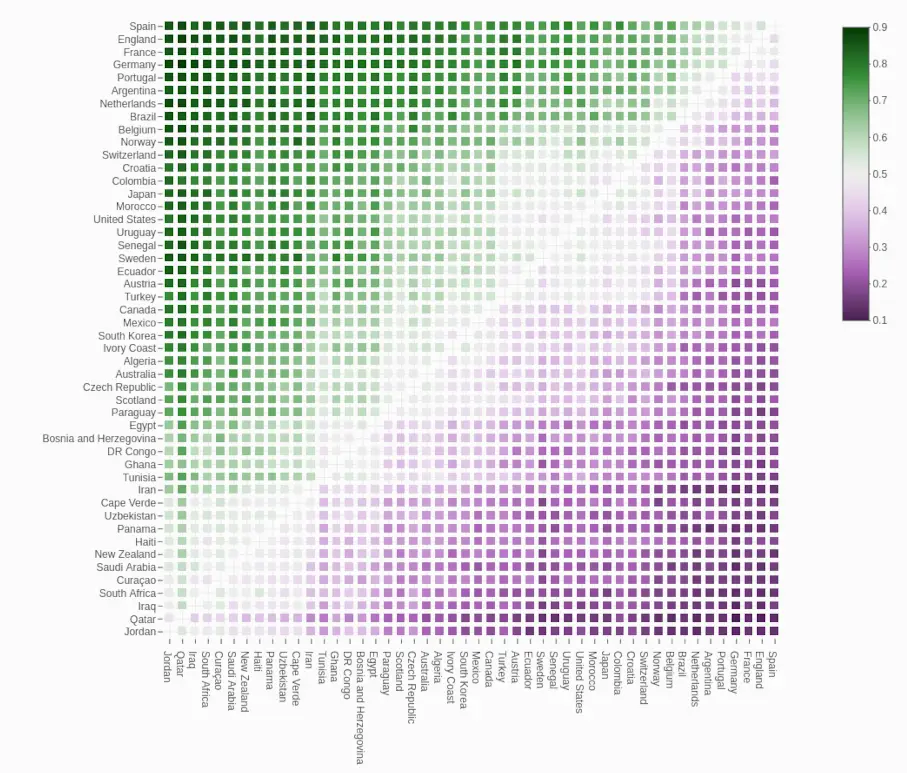
All of this then went into a machine learning soup, to create the most likely outcome.
"More specifically, the algorithm estimates the predicted number of goals for all possible matches between all 48 teams in the tournament,” the researchers explained.
All in all, it found that the teams who are apparently set to rank in the chance to win the Cup are shown to be:
Spain
England
France
Germany
Portugal
Argentina
Netherlands
Brazil
Belgium
Norway
However, the percentage is tight.
“The probability that the top favorite will actually win the tournament is usually no more than 20 per cent, which conversely also means that some other team wins with a probability of 80 per cent,” said co-author Andreas Groll of TU Dortmund University, adding: “As a statistician, I'm therefore more interested in whether, on average, many of the teams we predict to go far will actually do so.”
 Britt Jones