
Psychologist believes Lindsay Clancy may have exaggerated hallucination in court hearing

Warning: This article contains discussion of suicide, self-harm and child loss which some readers may find distressing.
A forensic psychologist testifying in the trial of Lindsay Clancy, the Massachusetts mother accused of killing her three children, has told the court that parts of her account of hearing voices may have been exaggerated or even fabricated.
According to reporting from NBC News covering the trial, Dr. Kirk Heilbrun, who diagnosed Clancy with bipolar II disorder, said there were 'about three points on which her account more closely resembled exaggerated or fabricated hallucinations' adding that 'one where it looked more genuine, and one that was kind of mixed.'
Clancy claims she heard a voice on January 24, 2023, instructing her to kill her three children before killing herself, a claim that sits at the center of her defense.
Advert

What did Lindsay Clancy say she heard before killing her children?
Clancy has said she repeatedly heard a voice telling her, “This is your last chance. You have to kill the kids so you can kill yourself.”
But Heilbrun pointed out inconsistencies in her retelling, noting she'd also described hearing phrases like 'the children will suffer without you' and 'you have to take the kids with you.'
Heilbrun explained that some elements of her account lined up with a genuine command hallucination, a type of psychosis symptom.
Clancy described the voice as coming from outside her own head rather than internally, which he said is consistent with real hallucinations.
However, she reported no accompanying delusions, despite these being present in around 88% of command hallucinations, according to Heilbrun.
He also noted that authentic hallucinations tend to be persistent rather than fleeting, yet Clancy said she only heard the voice for around 18 to 20 minutes, and never reported trying to make it stop, something Heilbrun called unusual.
The fact that the voice belonged to an unfamiliar man, rather than someone she recognized, was the one point he described as ambiguous rather than pointing clearly toward genuine illness or fabrication.
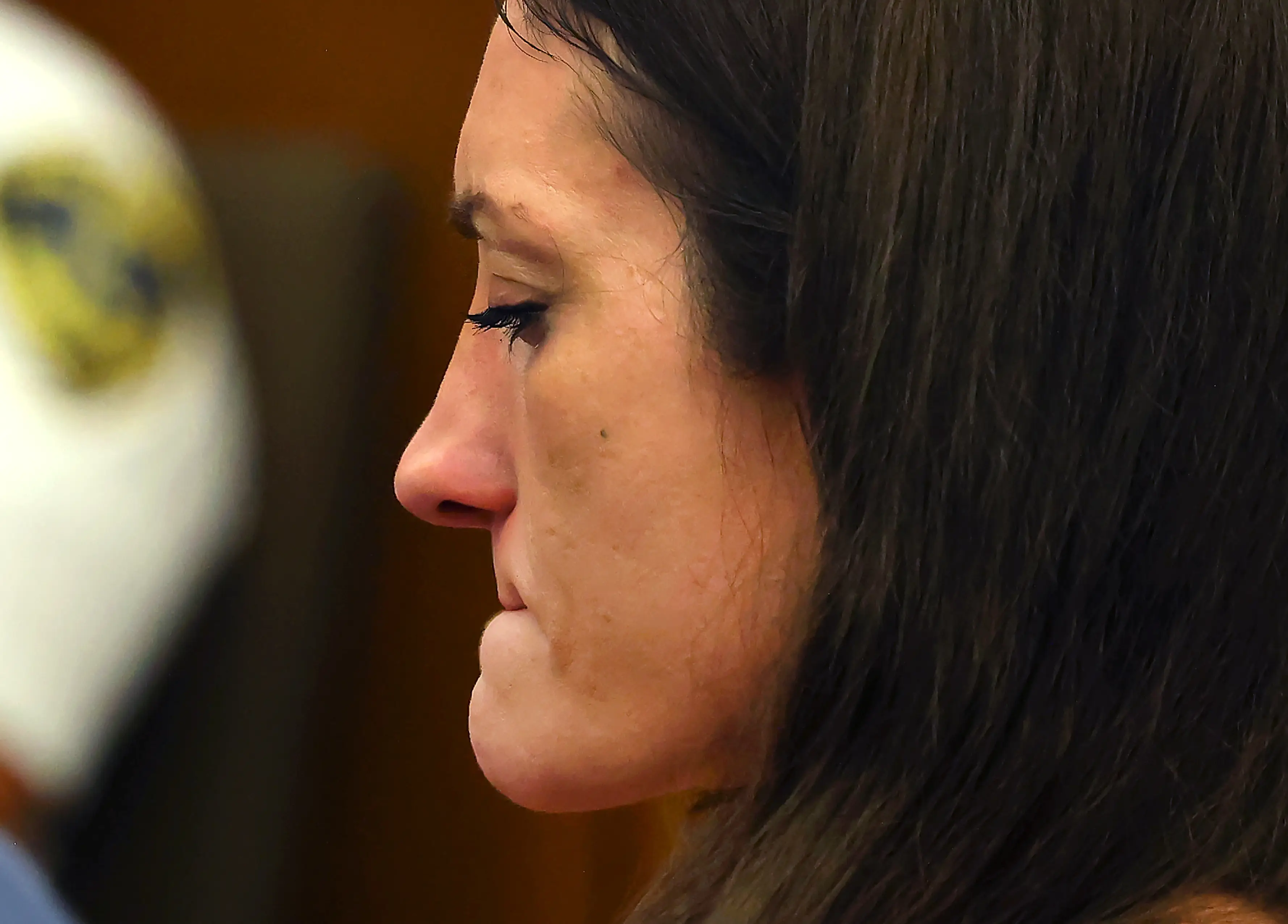
Why does the psychologist think Clancy could be exaggerating her symptoms?
Heilbrun told the court that Clancy has never reported experiencing an auditory hallucination before or after that single window of time on the day her children died.
"To put it mildly, that would be a very, very unusual pattern or manifestation of how this kind of thing comes about," he said, adding he becomes cautious when a symptom appears "only during the course of committing an offense," since it can be a 'convenient' way to avoid responsibility.
Still, Heilbrun offered the court two possible explanations for what happened. The first was acute psychosis driven by command hallucinations.
The second was that Clancy was in the midst of a serious suicide attempt and didn't want her children to be separated from her or left to suffer afterward.
Illustrating the second theory, he used a hypothetical comparison involving someone learning the Holocaust was coming and deciding whether to take their children's lives along with their own rather than let them face it.
Heilbrun also revealed that Clancy has been kept on a one-to-one suicide risk, the highest level of monitoring, for three years, and remains at risk today.
He described her as 'bright' but said that likely makes her prone to underreporting in terms of what's really wrong with her.'
Topics: Lindsay Clancy, True crime, Mental Health
 Thomas Bamford