unilad homepage
unilad homepage
  • News
    • UK News
    • US News
    • World News
    • Crime
    • Health
    • Money
    • Sport
    • Travel
  • Music
  • Technology
  • Film and TV
    • News
    • DC Comics
    • Disney
    • Marvel
    • Netflix
  • Celebrity
  • Politics
  • Advertise
  • Terms
  • Privacy & Cookies
  • LADbible Group
  • LADbible
  • SPORTbible
  • GAMINGbible
  • Tyla
  • UNILAD Tech
  • FOODbible
  • License Our Content
  • About Us & Contact
  • Jobs
  • Latest
  • Archive
  • Topics A-Z
  • Authors
Facebook
Instagram
X
Threads
TikTok
YouTube
Submit Your Content
Frozen wolf turns out to be 44,000 years old prompting scientists to check its gut for ancient viruses
Home>News>Animals
Published 16:09 30 Jun 2024 GMT+1

Frozen wolf turns out to be 44,000 years old prompting scientists to check its gut for ancient viruses

Scientists say bacteria could have survived thousands of years in the frozen wolf's gut

Mia Williams

Mia Williams

google discoverFollow us on Google Discover
Featured Image Credit: North-Eastern Federal University/jitendrajadhav/Getty Images

Topics: Animals, Science

Mia Williams
Mia Williams

Mia is an NCTJ-trained journalist at UNILAD with a BA (Hons) in Multimedia Journalism, reporting across breaking news, US politics, entertainment, health, lifestyle, and more. Before joining as a journalist in 2026, she freelanced across the LADbible Group titles for over three years. She is also a documentary producer, having created independent films, and worked as a researcher on series including Stacey Dooley Sleeps Over USA.

X

@miawillsjourno

Advert

Advert

Advert

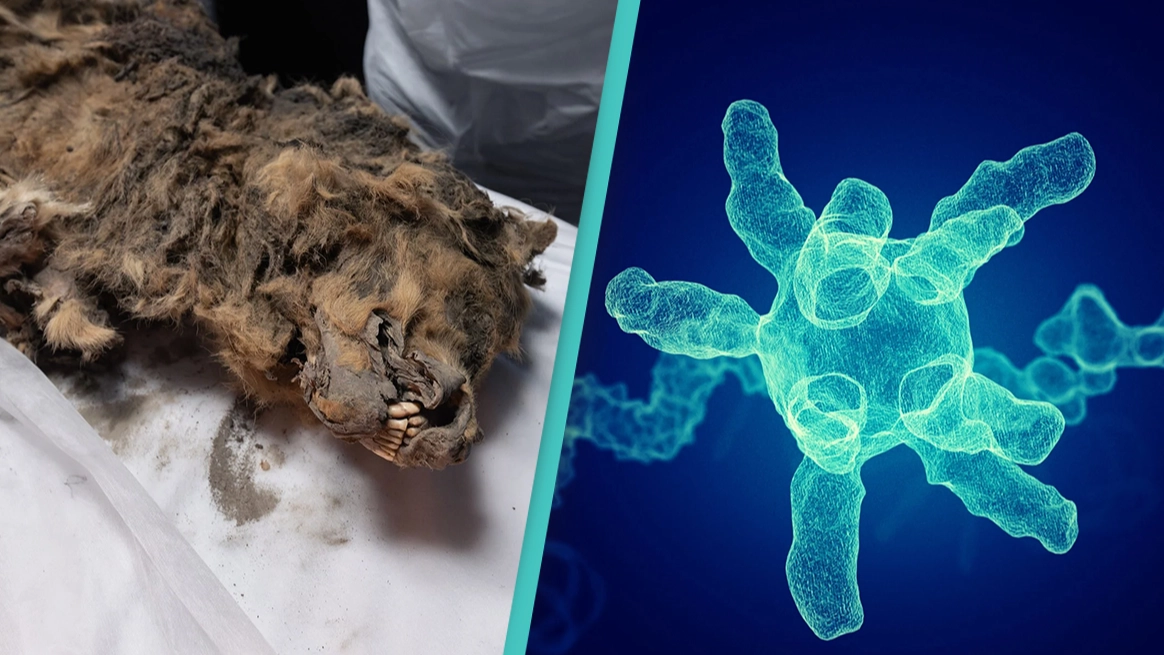
A ‘remarkable’ wolf that has been frozen for 44,000 years could lead scientists to the development of future medicines.

This 44,000-year-old wolf looks pretty good for its age - but it has been frozen for the vast majority of those years.

But it seems as though the wolf is going to be very useful to scientists, who say that it could give an indication as to what its lifestyle and diet were like during the Pleistocene era.

By studying the frozen wolf, researchers are hoping to learn more about ancient bacteria and how the wolf is related to modern animals.

Advert
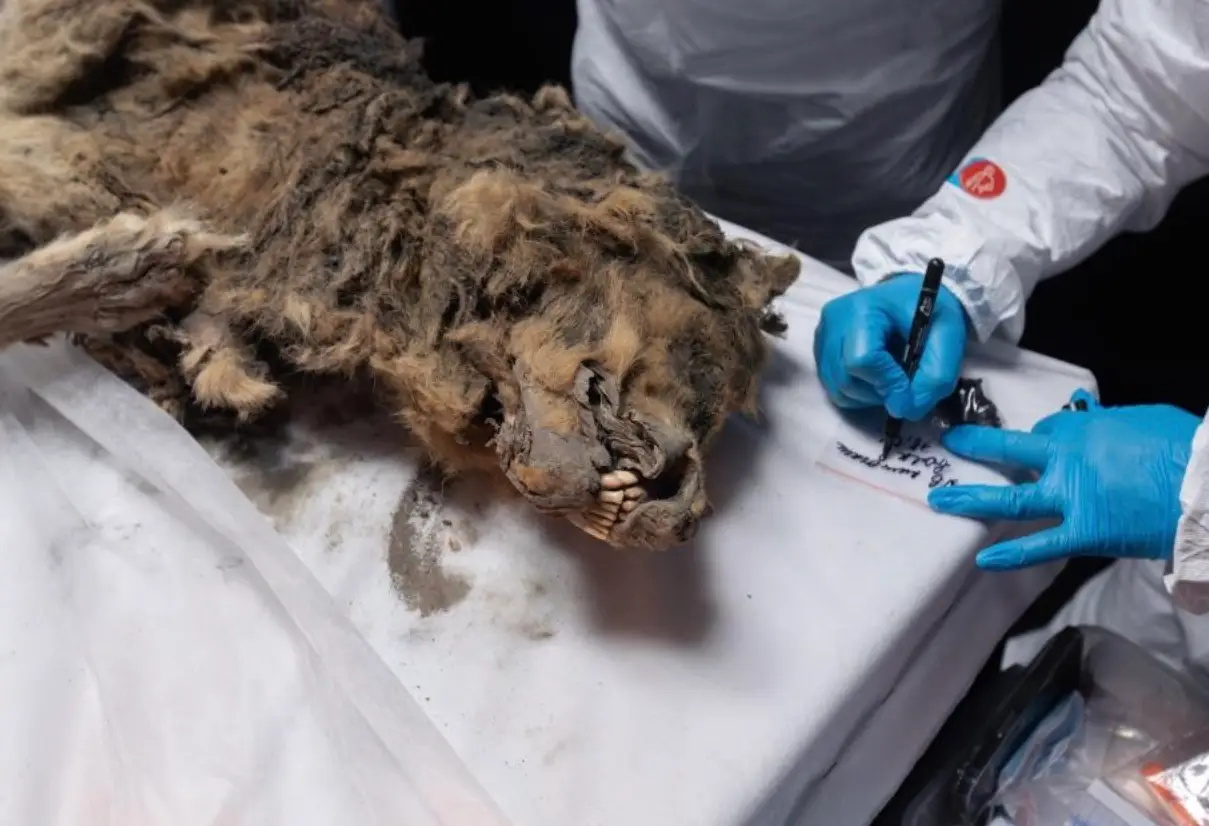
The wolf has been frozen for 44,000 years. (North-Eastern Federal University)

The wolf was found back in 2021, when residents of Yakutia in eastern Russia found the wolf in thick permafrost.

Researchers at North-Eastern Federal University in Yakutsk are now studying the ancient animal to see what they can learn.

Surprisingly after over 400 centuries, the wolf’s teeth and much of its fur are still intact, as are some of its organs.

Robert Losey, an anthropologist at the University of Alberta, told Business Insider: “It's shocking, actually.

“It's the only complete adult Pleistocene wolf that's ever been found, so that in itself is really remarkable and completely unique.”

There’s so much that researchers can take from the ground-breaking discovery - including its genetics, lifestyle, diet, and even what kind of ancient bacteria and viruses it had.
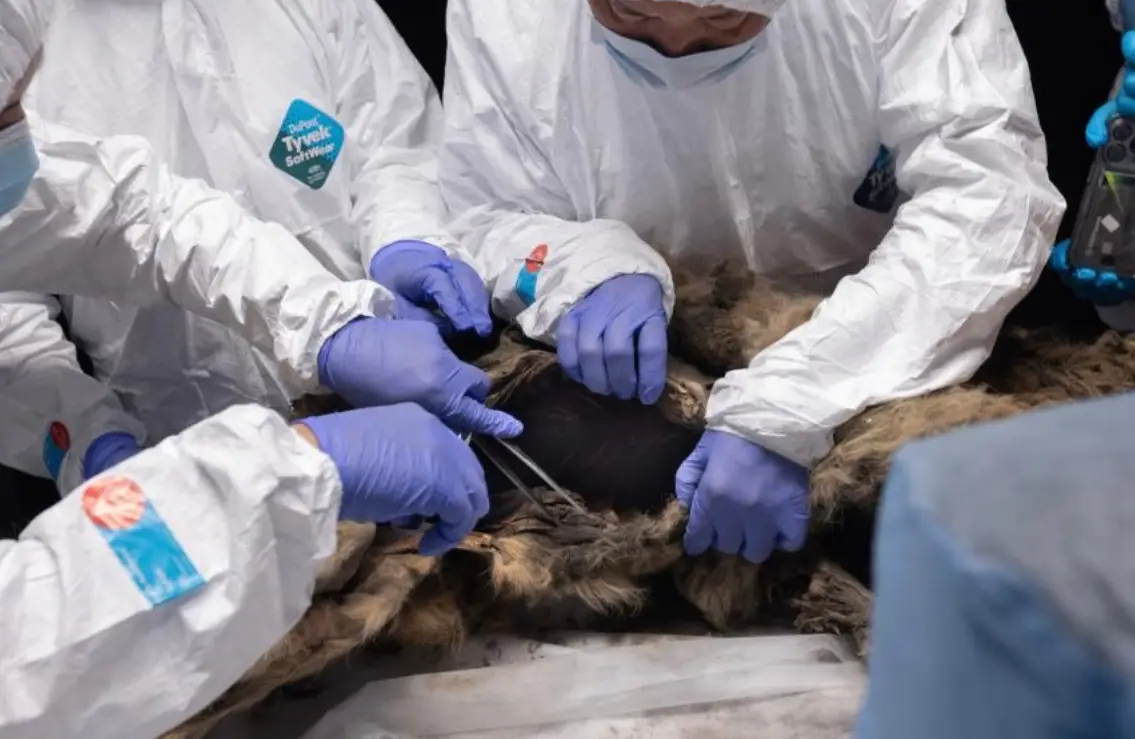
The discovery could lead to a medical breakthrough. (North-Eastern Federal University)

Artemy Goncharov, a researcher at the Institute of Experimental Medicine, added: “Living bacteria can survive for thousands of years, which are a kind of witnesses of those ancient times.”

After discovering that the wolf was an adult male, they concluded that it would have hunted mammoths such as woolly rhinoceroses, extinct horses, bison, and reindeer.

Even more shocking, is that the scientists have predicted that remains of those animals may still even be present in the wolf’s gut.

To see if their predictions are correct, researchers took samples of its stomach and digestive tract - but are still awaiting the results.

And this is where things get even more interesting.

Researchers have claimed that the wolf could play a crucial role in the development of future medicines.

To do this, they will aim to tease out what functions ancient microbes performed in the wolf's gut, and whether it had parasites.

Some microorganisms could be unknown to modern day science, which would be the biggest revelation of all.

Choose your content:

15 mins ago
18 mins ago
an hour ago
2 hours ago
  • Omar Vega - FIFA/FIFA via Getty Images
    15 mins ago

    World Cup psychic who correctly predicted three winners in a row reveals who will take home trophy this year

    The 'psychic' has correctly predicted World Cup winners in the past

    News
  • Getty Stock Image
    18 mins ago

    Signs you're drinking too much 'liquid death' as cardiologist issues warning

    From gut issues to broken sleep - here's what to know about guzzling fizzy drinks

    News
  • Ohio Department of Rehabilitation & Correction
    an hour ago

    Mackenzie Shirilla's jail call with mom reveals 'secret language' as disturbing case details emerge

    Mackenzie Shirilla and her mom Natalie were heard speaking in 'code' in newly obtained jail calls

    News
  • Scott Dudelson/Getty Images
    2 hours ago

    Vanilla Ice has bizarre defence for performing at Trump's Freedom 250 concert as lineup crumbles

    The American rapper dismissed suggestions it's a politically-motivated event

    News
  • Scientists discover protein in whales that could help humans live up to 200 years
  • Scientists baffled after orcas are seen doing bizarre activity that was thought to only be done by humans
  • Woolly mammoths could be brought back to life as scientists make breakthrough discovery
  • Scientists make groundbreaking discovery about chimpanzees' likeness to humans and it could change everything