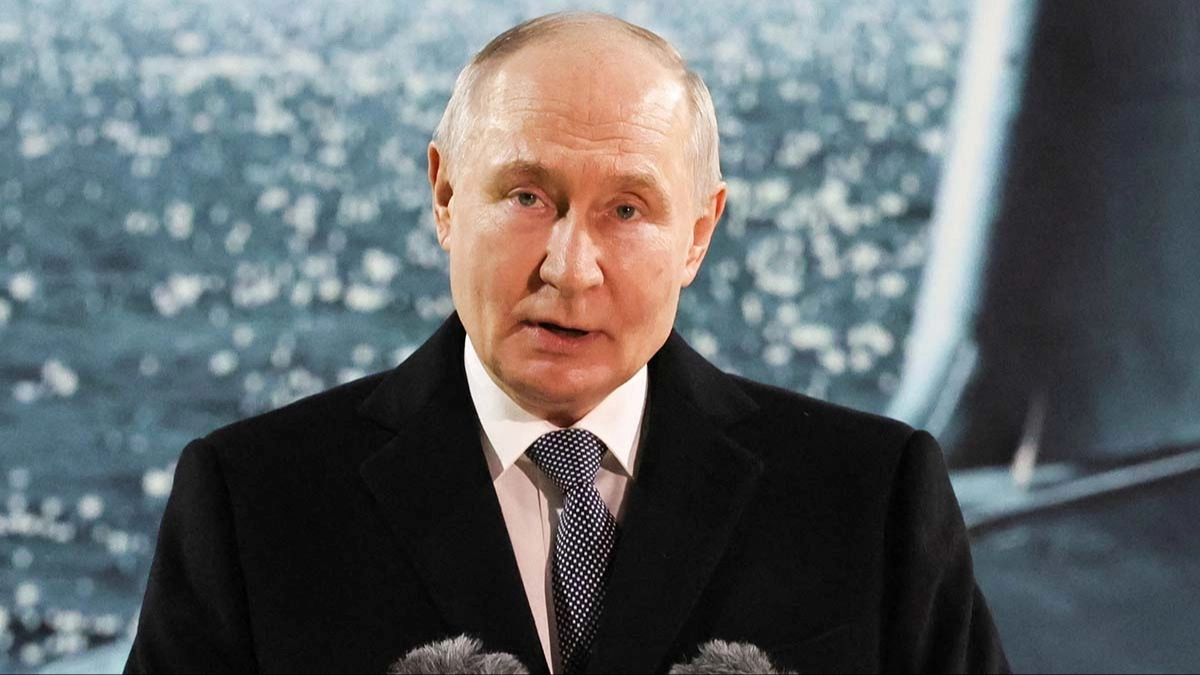
Spy agency issues warning over details of Putin's new 'space nuke' as experts respond to serious fears

Russian President Vladimir Putin's apparent new nuclear capabilities have caused experts to issue and urgent message regarding the potential world-ending outcome if detonated and just when it'll reach completion.
In the last few weeks, tensions between Russia and the rest of Europe has been getting worse and worse since its 2022 invasion of Ukraine.
As the tensions continue, Putin said he's 'ready for war' if needed, and coupled with a new cosmic superweapon the country is allegedly manufacturing right now, things aren't looking good.
Germany's spy agency, BND, has since Moscow's new nuke, which has been nicknamed Sputnik-S, could be ready to go live in around two months.
Advert
Josef Aschbacher, the head of the European Space Agency, called the bomb 'the ultimate nightmare scenario' and Aaron Bateman, a historian and space policy expert at George Washington University, said it could send the world into chaos - per Foreign Affairs.
"Russia's decision to detonate a nuclear weapon in space would almost certainly affect the Kremlin's satellites, too," he said. "But even if Russia never used a nuclear space weapon, Moscow might view its deployment as a new source of leverage, a sword of Damocles it could dangle over every other state's space systems. And it is hard to know the Russian calculus for employment."
The bomb itself is a serious threat that has caught the attention of NATO, as if detonated, can cause a catastrophic electromagnetic pulse (EMP) to tear into space, frying the electronics of orbital satellites in its path as it nosedives back into Earth.
On land, experts say it has the potential to fry energy grids for hundreds of miles, destroying emergency services and networks.
The radiation is also another factor, as if a nuke detonated in outer space, it would cause a radiation cloud to blanket above Earth and expand until it reached satellites all over the world.
The worst outcome is that within one week, 98 per cent of satellites would be disabled, and humanity would fall.
"We will always make sure we defend every inch of NATO territory, and that includes making sure we are safe when it comes to the space element," said NATO's Mark Rutte this week.
It's important to note that these reports have not been confirmed by Russia, so nobody knows for certain if it is in fact planning to detonate a nuke in space.
Although, there is something that could prevent Russia from being able to do this if it was to consider it.
As part of the Outer Space Treaty, it's illegal to detonate a nuke in space.
But according to Victoria Samson, chief director of space security and stability at the Secure World Foundation, it could become a power move by Russia.
She said, per the Daily Mail: "Russia has a historical legacy of being a major space power going back from the Soviet times. This is something they’re very proud of. I don’t think it’s something they’d give up lightly."
Now, this isn't the first time Russia has shown an interest in deploying space weapons, as it launched the Kosmos 2553 test satellite.
According to the US, it was suggested to be practice for an orbital nuclear weapon.
However, the satellite ended up losing control last year and began spinning uncontrollably and is now believed to be non-operational.
 Britt Jones