Map shows best and worst place to survive an apocalypse, according to new study

Your location may be able to help you if an apocalypse ever does happen - or hinder you, according to a new study.
In the first study of its kind, researchers set out to find out which areas on Earth are 'most resilient to global catastrophic risk (GCR),' against the impacts of nuclear war, large-magnitude volcanic eruptions, large-scale cyberattacks, pandemics, plus more.
The study, published at the end of August in the Global Challenges journal, looked into a number of factors, including population, food security and the amount of human necessities.
However, there's no need to pack your bags and move somewhere just yet - as the study states that 'there is no place on Earth which is resilient against all kinds of GCR.'
Advert
There are some, however, that are better equipped than others...
Where is the best place to survive in an apocalypse?
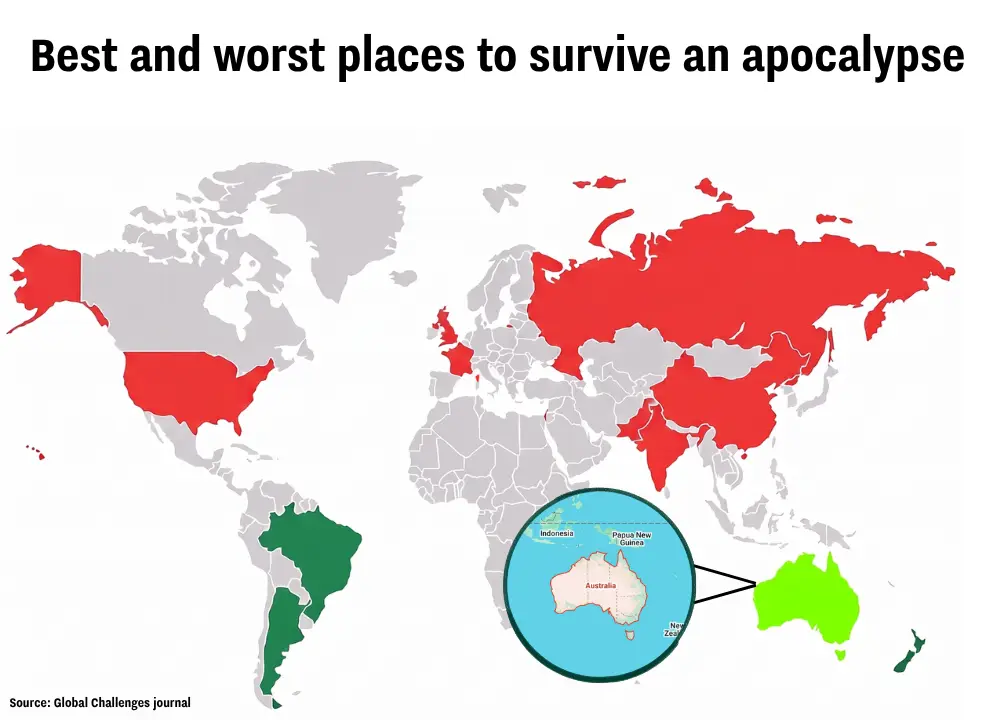
According to the study, it's actually Australia that shows the most resilience against all kinds of global catastrophic risks.
This they say, is due to the fact that the country has self-sufficiency in food production, their remoteness, and the fact it is rich in energy and minerals.
In particular, experts say Tasmania seems to be the best.
New Zealand, Argentina, Brazil, and Uruguay, also came out well.
However, Australia doesn't come without problems of its own, with the risks of bushfires and floods.
Where is the worst place to survive?
Unfortunately, for those who reside there, the study states that Russia scored the lowest, with Florian Jehn, who led the study, telling The Times: “It is a top nuclear target, and it scores poorly on governance, inequality and corruption. Those are the factors that matter most and are hard to change."
Russia isn't the only country that ranked low, however.
Despite being isolated, similar to Australia, the study says the fact the United Kingdom is isolated as an island gives it protection, it still doesn't rank top of the list.
As well as its isolation, the UK's healthcare system would also serve well in a pandemic, the study says.
However, it relies on an international supply chain, and also vulnerable to ‘bad space weather'.
Plus, it's said to be one of the countries most in danger from a nuclear war, as well as the United States, France, China, India, North Korea and Israel.
Those city boys and girls may want to rethink - as experts say that urban areas are prone to becoming 'death traps'.
Why's this? Well, researchers from the study state that they are 'highly reliant on continuous import of foods and other daily products'.
What does the study say about the United States?
Like the United Kingdom, the study also says that the United States is a mixed bag.
In terms of a nuclear war, the study states that the USA is, along with another of countries listed below, 'in most danger' from a nuclear war.
This is due to the fact that countries who possess nuclear weapons are more likely to be targeted.
However, the country does have a huge productivity capacity - with the ability to produce essential goods.
Topics: Australia, World News
 Kiesha Dosanjh