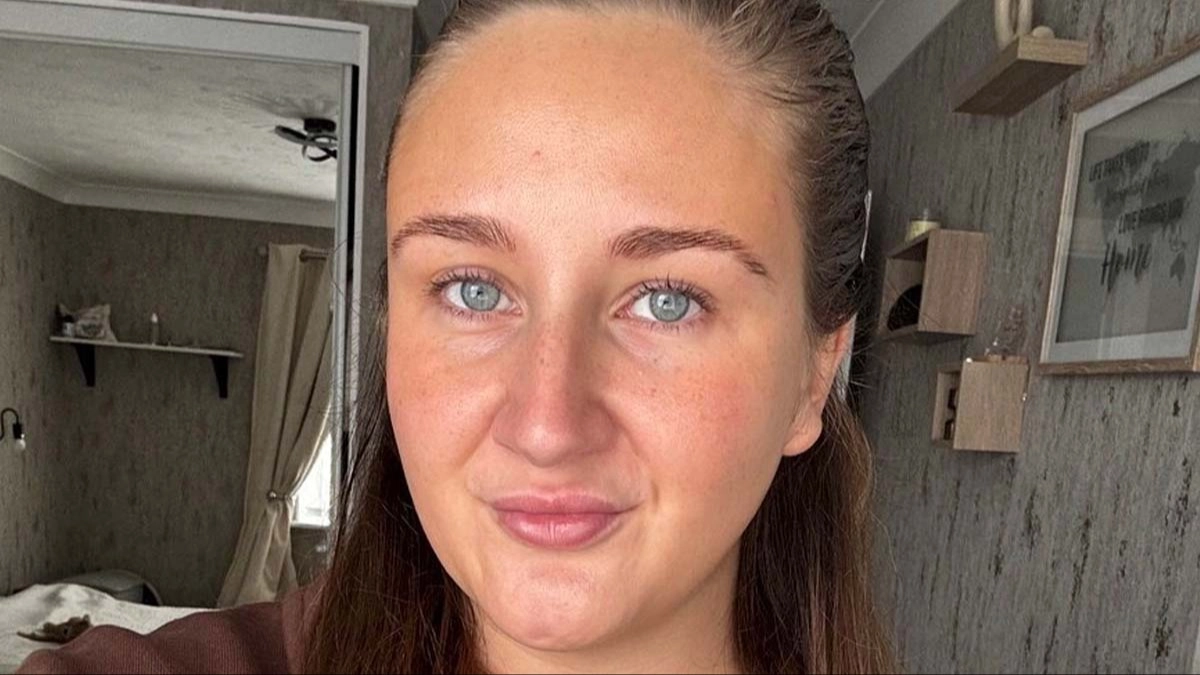
Mom hasn't peed in five years and says doctors don't know why

Kirstie Scothern, a 29-year-old complaints handler from Nottingham, England, was taken to hospital by ambulance in April 2021 after noticing that her stomach looked swollen.
Doctors at Queen’s Medical Centre drained 2.5 liters of urine from her bladder, and five years on, the mom of two still can’t pee.
Despite numerous tests, Kirstie said nobody has been able to tell her why.
The symptoms began with a migraine. Kirstie realized she hadn't peed since the night before, even though she had drunk plenty of water and run the tap to help things along. Her husband, Justin, 33, decided to call an ambulance.
Advert
Medics used an MRI of her head to check whether the migraine was responsible, but concluded it was not.
She was sent home with a catheter, a tube inserted into her urethra to drain urine into a bag, but still couldn't go when it was removed two weeks later.

What is Fowler's syndrome and how is it treated?
Kirstie believes she has Fowler's syndrome, though doctors are still unsure what is causing the problem. “I think doctors are reluctant to diagnose Fowler's syndrome because it's not well known,” she said.
National Institutes of Health (NIH) defines Fowler's syndrome as a rare condition that causes urinary retention (the inability to pass urine) in young women, typically in their 20s and 30s.
The condition leaves women suddenly unable to pee because of a problem with a muscle that allows the bladder to empty.
Some patients manage it with a bladder pacemaker, pressing a button on a phone-like box connected to an implant at the bottom of the spine to make the bladder release.
Doctors at City Hospital, where she was treated as an outpatient, first wondered whether the migraine medication she has taken for years was responsible, but she didn't improve after stopping it.
Botox to relax muscles so her bladder could release didn't help either, and CT scans and urodynamics tests haven't produced an answer.
Kirstie said she is 'frustrated' that she still has no confirmed diagnosis after five years.

How do you live with a bladder that won't empty?
Self-catheterizing was not easy at first. “It was incredibly painful and it's extremely difficult to even find your urethra, let alone insert a tiny tube into it,” Kirstie said.
Before she learned to use the tubes to empty her bladder straight into the toilet, she carried a catheter bag, which leaked once at work and another time in a colleague's car.
“This was extremely upsetting and embarrassing,” she said.
Today, she uses small tubes to empty her bladder and sets a reminder every four hours because she only feels the urge to go when it is very full.
She carries a radar key for accessible restrooms and a 'can't wait' card, but said people sometimes still tell her to go to the back of the line.
“It's very difficult and upsetting, particularly since it takes all my courage to ask if I can go ahead of them,” she said.
She has found a support network on Facebook and Instagram, though she sometimes feels like the ‘world is not designed for me’.
Kirstie said she wants others going through this to know they are not alone.
“You do adapt, and it does get easier,” she added.
 Thomas Bamford