
North Korea issues new tactic as guns are pointed towards the border with a chilling message to the US

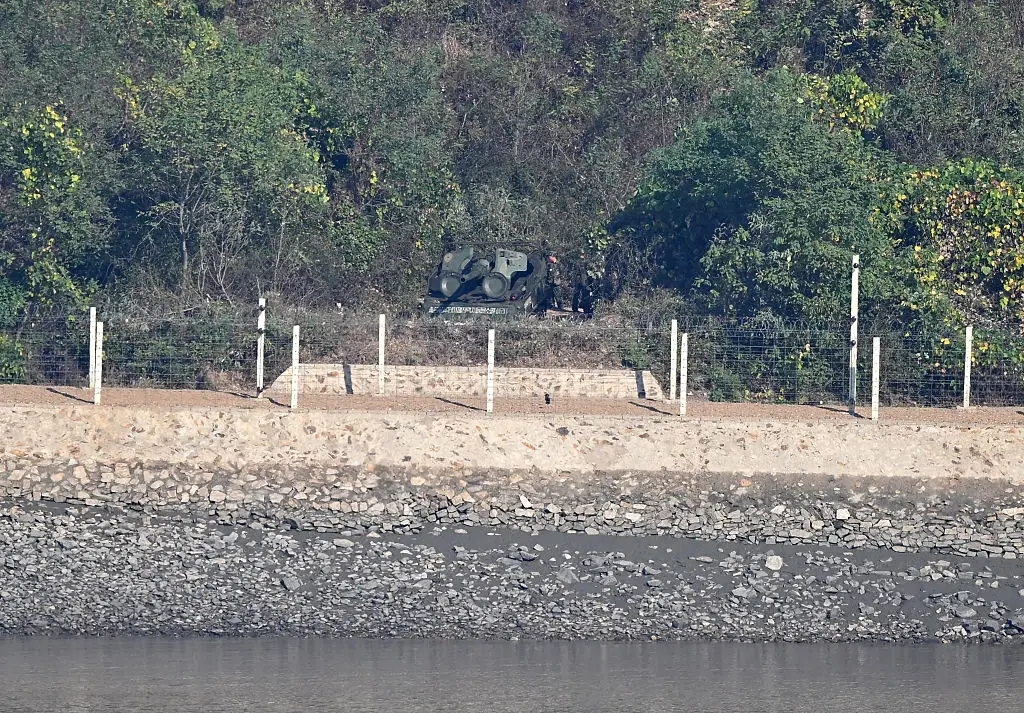
North Korea has stationed armoured vehicles at the border of the demilitarized zone between them and South Korea as as tensions flare between the neighbouring nations.
In what has been described as a 'significant display of power' by Seoul's Joint Chief of Staff, North Korea have bought 122mm howitzers to the border, emblazoned with the message “Destroy the US imperialist aggressors, the sworn enemies of the Korean people”.
South Korean media outlets photographed an armoured vehicle on Friday, but by Monday, there were up to three of the vehicles with their cannons pointed towards South Korea.
They also reported 30 soldiers carrying out fencing work in the area.
Advert
The howitzer is not a new weapon, initially being used by the North Korean military when it came into service during the 1970s.
It is a long-range artillery weapon designed to fire shells in a medium-to-high 'arcing trajectory'. It specializes in indirect fire, meaning it lobs heavy explosive rounds high into the air so they can plunge down onto targets hidden behind obstacles -such as mountains, hills, forests, or fortifications - that are not in the crew's direct line of sight.
The weapon has a range of about 15 miles, putting the South Korean town of Gimpo firmly in within its crosshairs.
Why have tensions risen between North and South Korea?
Tensions between North and South Korea have surged due to a rapid succession of hostile border developments, a high-stakes dispute over a recent landmine explosion, and aggressive military posturing by Pyongyang.
Relations severely deteriorated following a September 21 landmine explosion inside the Demilitarised Zone (DMZ) that wounded three South Korean soldiers.
Backed by a joint investigation with the U.N. Command, South Korea concluded that North Korea deliberately planted the mines south of the Military Demarcation Line (MDL) in violation of the armistice. North Korea vehemently deny this.
Further to this, on October 20, a group of about 10 armed North Korean soldiers crossed the frontline demarcation line into the eastern section of the DMZ.
South Korean troops broadcast warnings and fired defensive warning shots to force the North Korean soldiers back across the border. Pyongyang heavily criticized the warning shots, calling them a deliberate provocation and warning of 'grave consequences'.
Kim Yo Jong, the sister of North Korea's leader, said last week that Pyongyang would place loudspeakers that can blast anti-South Korean propaganda on standby along the entire border within days. This tactic goes back to the cold war where the two sides would blast propaganda at each other.
Speaking to the Reuters, Jang Gil-seong, an 83 year old Vietnam War veteran who lives in the area said: "I'd only seen on TV that North Korea had deployed 122-mm artillery, but seeing the area in person makes me realise just how real the danger is.
"I'm really concerned about how much South Korea will need to do to prepare for and respond to this threat in the future."
Seoul's Joint Chiefs of Staff spokesperson Jang Do-young said on Tuesday that while North Korea has mentioned new weapons systems in its recent statements “we believe that this cannot be considered as such”.
Topics: North Korea, Korea, World News, Military
 Thomas Bamford