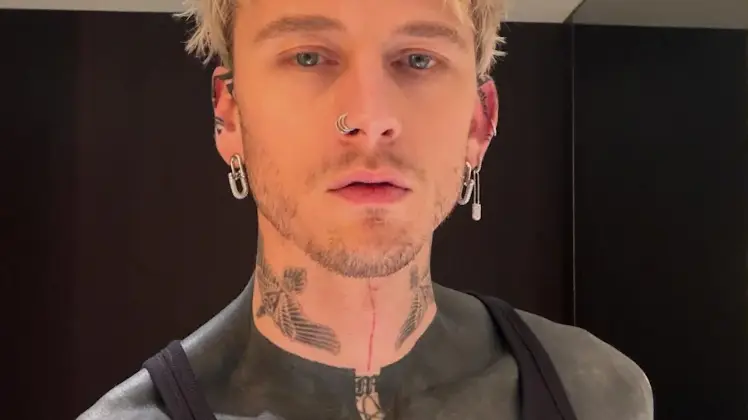
Risks of blackout tattoos as Machine Gun Kelly reveals horrifying side effects he experienced

A doctor has said there are several reasons why blackout tattoos carry more risks than other types of ink.
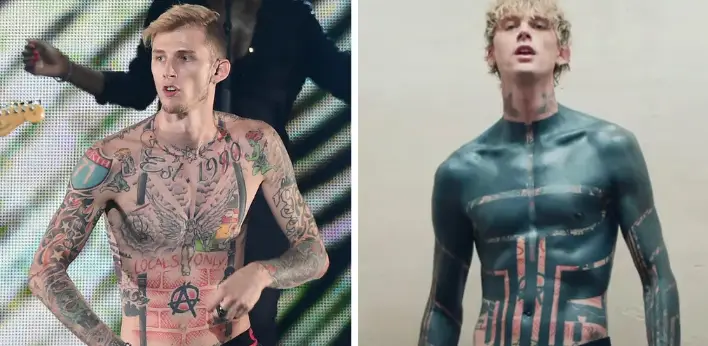
It comes as US rapper Machine Gun Kelly said he struggled to move and sleep after getting a large 'dark mode' tattoo, which he first unveiled back in 2024.
Speaking to Billboard Canada, the musician - who shares a daughter with ex Megan Fox - said he needed a change after looking at his old tattoos made him see ‘death and drugs in all these patterns that I was literally writing on my body’.
But after trying to complete an upper body blackout tattoo that should take two years in two months, he says he paid the price.
Advert
He explained: "After the first week, we hit my lymph nodes around my armpits and shoulders, and I got really sick.
"My skin was turning yellow. I wasn’t able to sleep. I stopped being able to move certain parts of my upper body."
While your skin turning yellow isn’t a standard side effect of getting a blackout tattoo, there are still some key risks to your health to consider before getting one.
Will Kirby, M.D. is the medical director of a facility in New York City which specializes in tattoo removal.
He explained that it's not necessarily the amount of ink in this style which is the issue, but the type of ink.
“It’s not only the quantity of ink but the constituents of the ink injected,” he told Women's Health. “These days artists frequently mix ink together, and an all-black tattoo, which clinically appears to be composed of just carbon-based ink, may actually be an amalgamation of different inks.”
Nonetheless, he added that a design which requires more ink, with a blackout tattoo needing the most of any style, will make this worse.
“While these ingredients in any amount are worrisome, there is a valid argument for problems being dose dependent—meaning the higher volume of ink you have in your body, the more likely you are to suffer negative consequences from it," he said.
A blackout tattoo can also make cancer screening more difficult.

David E. Bank, director at The Center for Dermatology, Cosmetic, and Laser Surgery in New York told the same publication: “Since the black ink contains iron oxide, it makes it difficult for MRI scanners to heat up and actually take a reading.
“The area might also swell or feel like it is burning while under an MRI.”
On top of that, it can also make detecting skin cancer more difficult.
New York dermatologist Dr Howard Sobel said: “With such large, dark tattoos, it’s very difficult for a physician to distinguish between a normal mole and one that’s abnormal - or even melanoma.”
Ultimately, it's up to you to weigh up the risks before getting such a significant bit of ink.
 Kit Roberts