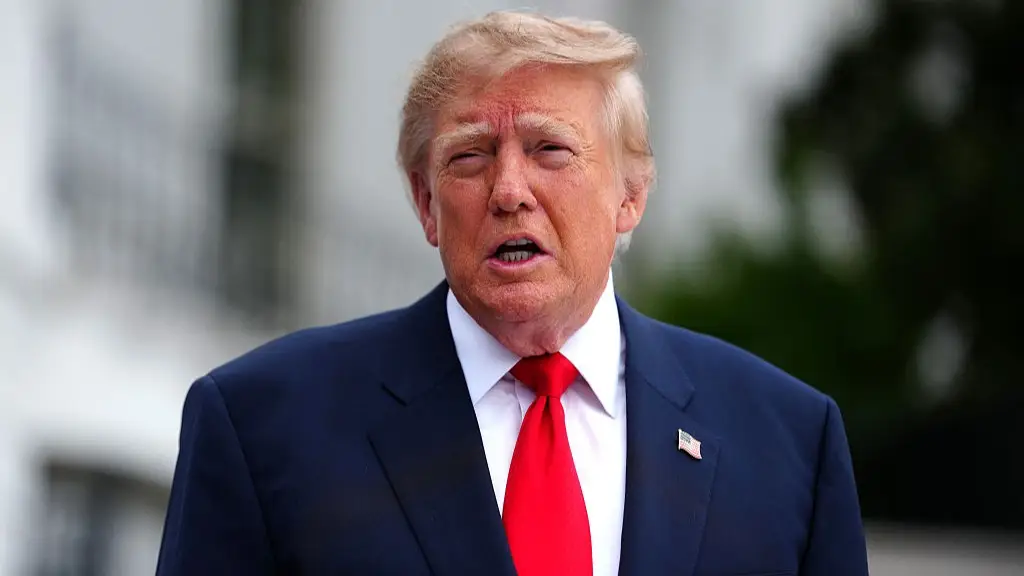
AI predicts the legal loopholes that could see Donald Trump serve a third term

It is the political nightmare—or ultimate fantasy, depending on your cable news channel of choice—that never quite goes away: Donald J. Trump in the Oval Office past January 2029.
Trump himself has repeatedly nudged the boundary, joking at rallies and private donor dinners that perhaps two terms shouldn't be the limit, or hinting that because his first term was plagued by investigations, 'they owe me four years.'
Standing between the 47th President and a permanent stay in Washington is the 22nd Amendment, ratified in 1951 to prevent another Franklin D. Roosevelt-style four-term dynasty.
The rule seems absolute: you get two bites at the apple, and then you’re out. Or are you?
Advert
We fed constitutional law, legal scholarship, and institutional precedent into an AI model to ask a simple question: Is there a legitimate legal backdoor that could let Donald Trump serve a third term?
Here is what the algorithm surfaced—from sneaky technicalities to full-blown constitutional breakdown.
What does the Constitution actually say?
To make this work, we have to start with the basics. What does the Constitution actually say?
According to our AI model, it all hinges on a single sentence ratified in 1951: "No person shall be elected to the office of the President more than twice..."
Notice the operative word: elected. It does not say a two-term president can never hold the office, nor does it say they cannot exercise executive power. It specifically bars them from being elected to it.
To constitutional originalists and textualists—the very judicial philosophy that dominates today’s federal courts—individual words matter immensely.
Because the Framers of the 22nd Amendment wrote "elected" instead of "serve as," they accidentally left the door cracked for several bizarre succession scenarios.
AI Verdict: "Ambiguous on paper, ironclad in practice. While hyper-literal grammarians can drive a truck through the gap between 'serving' and 'being elected,' courts look at original intent. The 22nd Amendment was written specifically to stop an American presidency from turning into an elected monarchy. Any reading that treats "elected" as an invitation for backchannel succession runs counter to why the amendment was drafted in the first place."

Could Trump just run as Vice President?
One of the most popular theories currently gaining traction on the internet, is the idea that Trump could run as JD Vance's Vice President, and potentially step into the role of POTUS once more, if Vance steps down.
This is known in legal circles as the 'Backdoor Succession' scenario.
Under this theory, a surrogate like JD Vance, runs for President in 2028 with Donald Trump on the ticket as his running mate. They win.
Five minutes after taking the oath of office on January 20, 2029, the newly sworn-in President resigns. Under the 25th Amendment, the Vice President immediately ascends to the presidency.
Trump wouldn't have been elected President. He was elected Vice President and merely succeeded to the chair - so on paper it's all above board and entirely possible.
However, our AI model says this bold strategy comes with one fairly substantial catch: The 12th Amendment.
The 12th Amendment, which governs presidential elections, includes this kicker: "No person constitutionally ineligible to the office of President shall be eligible to that of Vice-President."
Some prominent constitutional scholars. including Dan Coenen of the University of Georgia School of Law, have pointed out that Article II defines what makes someone 'eligible to the office' (being 35 years old, a natural-born citizen, and 14 years a resident).
The 22nd Amendment, by contrast, only limits eligibility to be elected. Therefore, a hyper-literal textualist could argue Trump remains eligible to hold the office, making him legally eligible to run for Vice President.
AI Verdict: "Dead on arrival at the Supreme Court. While clever on paper, even the conservative supermajority on the Roberts Court would likely read the 12th and 22nd Amendments together. Allowing a candidate to bypass presidential term limits via the vice presidency would turn the Constitution into a punchline."
What if he skips the ballot entirely and takes the Speaker’s gavel?
The U.S. Constitution does not specifically require the Speaker of the House to be an elected member of Congress.
So in theory, House Republicans could simply appoint Donald Trump Speaker of the House in January 2029.
Under the Presidential Succession Act of 1947, the Speaker of the House is third in line to the presidency.
This means that if the newly inaugurated President and Vice President were to simultaneously resign or be incapacitated, the Speaker becomes Acting President.
AI Verdict: "A slightly tougher legal knot, but equally doomed. The Succession Act specifically requires that the next-in-line officer be "eligible" under constitutional terms. It runs headfirst into the exact same 12th Amendment debate—plus, it requires a sitting President and Vice President to voluntarily surrender the most powerful office on earth."
Could Trump argue that his non-consecutive terms "reset the clock"?
While this argument circulates frequently on social media, it has zero legal traction.
FDR won four consecutive elections, which inspired the 22nd Amendment, leading some commentators to claim the amendment was only intended to stop consecutive dynasties.
But the text doesn’t care about breaks in service: "No person shall be elected... more than twice." Grover Cleveland served split terms in the 19th century, well before the 22nd Amendment existed.
AI Verdict: "It's impossible. Two wins are two wins, consecutive or not."
What about just repealing the 22nd Amendment?
According to our AI model, this is the only 100% legally watertight path, and it is also virtually impossible to execute.
"To amend or repeal a constitutional amendment under Article V, you need: A two-thirds vote in both the House of Representatives and the Senate AND ratification by 38 of the 50 state legislatures (three-quarters)," explains the model.
"In an era where passing a routine budget pushes Congress to the brink of government shutdowns, finding two-thirds of both chambers and 38 state legislatures willing to grant an incumbent an indefinite lease on the Oval Office is a mathematical fantasy."
AI Verdict: "Extremely unlikely, but not completely impossible."
What has Trump actually said about running again?
Now comfortably halfway through his second term, Donald Trump has spent years turning the third-term question into a classic rhetorical tease, alternating between knowing winks to his base and standard legal reality checks.
To House Republicans, he famously quipped back in November 2024: "I suspect I won't be running again unless you say, 'He's so good we got to figure something else out'".
In interviews, he has also cryptically teased that "there are methods which you could do it" and admitted he "would love to do it".
Yet when pressed directly on the constitutional mechanics, he consistently walks it back.
He has acknowledged that the 22nd Amendment's legal wall is "very strong", and when asked specifically about running as Vice President to engineer a succession backdoor, he dismissed the idea: "You'd be allowed to do that, but I wouldn't do that. It's too cute... people wouldn't like that".
Giving a more definitive answer on a potential third term in August 2025, Trump seemingly put to rest any talk of stepping up for another four years, when he told CNBC: "There are many people selling the 2028 hat, but this is not something I'm looking to do. I'm looking to having four great years, and turn it over to somebody, ideally a great Republican. A great Republican to carry it forward. But I think we're going to have four years, and four years is plenty of time to do something really spectacular."
Topics: Donald Trump, JD Vance, Election, US News, Politics
 Phoebe Tonks