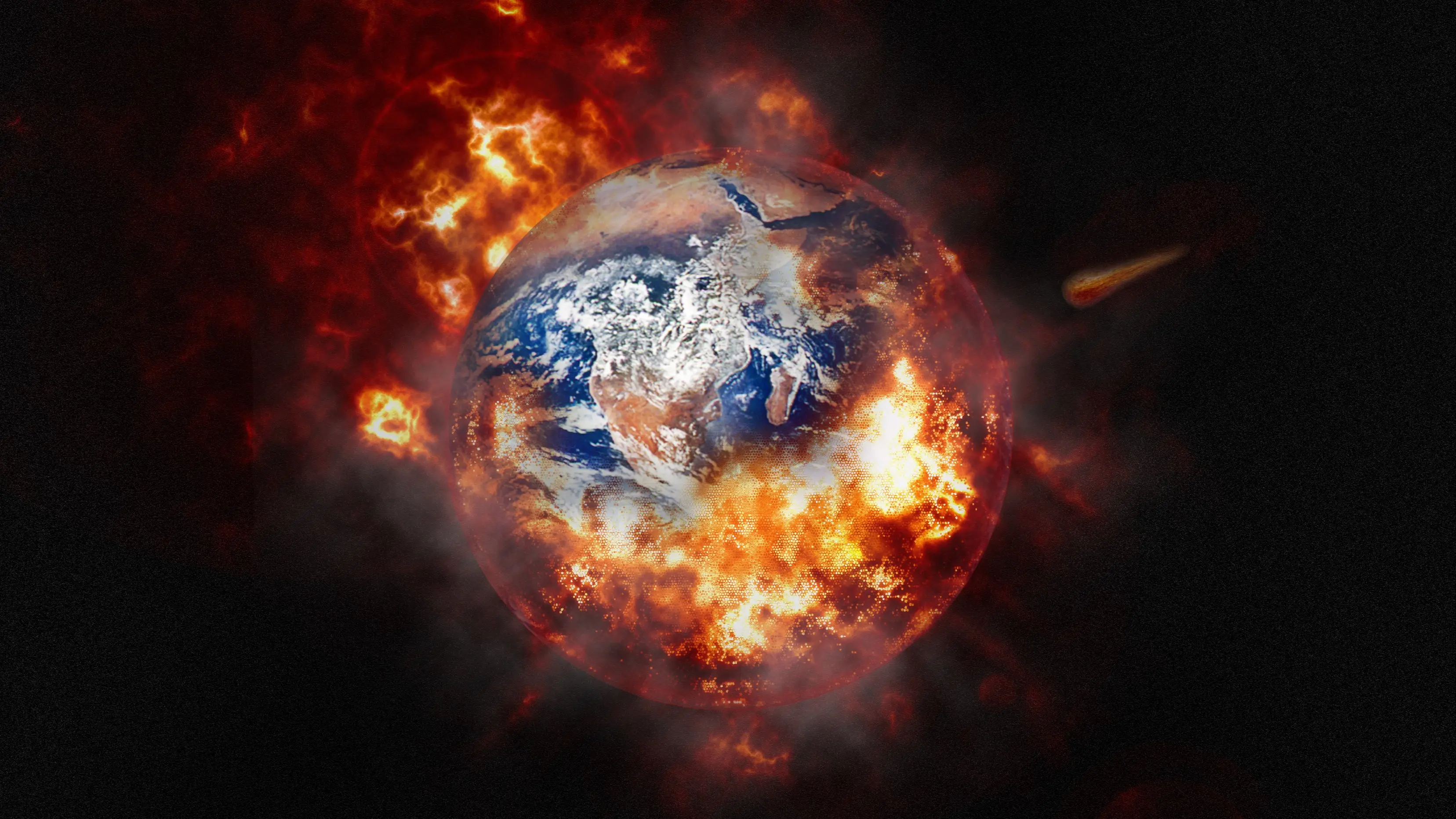
Scientists predict date humans will go extinct and claim it's 95% accurate

Scientists have crunched the numbers to try and work out how long we have left until humanity becomes extinct - and it's not great news.
It’s not the first time boffins have pencilled in a date for the end of everything on the calendar, and estimates vary wildly.
One Nobel Prize-winning physicist thinks humanity will be wiped out in about 30 years. Meanwhile, a supercomputer from the University of Bristol in the UK reckons we’ll be alright for about 250 million years.
This prediction is somewhere in between. The scientist who came up with it insists it's 95 percent accurate.
Advert
As for how he got there… his thought process is certainly interesting.
Let me take you back to 1983, when an astrophysicist called Brandon Carter came up with something called the ‘doomsday argument’.
Carter started by estimating how many people had ever lived (this will become relevant later, promise). He landed on 117 billion.
For context, the current world population is a little over eight billion.
Carter then used something called the Copernican principle, adapting the reasoning of astronomer Nicholas Copernicus - the guy who broke it to us that the Earth is not, in fact, the centre of the universe, and orbits the Sun.
Applying this thinking to the population, Carter argued that if you plotted a timeline of every person who ever lived, it’s much more likely you occupy a random place in it, rather than a significant position at the very start or end.
Why probability makes it more likely that humanity only has thousands of years left
This is where you’ll need to concentrate very hard. To steal an analogy from Scientific American, imagine two boxes, one filled with balls numbered one to ten, while the other has balls numbered one to 100,000.
If someone were to draw a ball numbered four, the odds are much more likely it came from the box filled with ten balls rather than 100,000.
Therefore, if we’re around the 177-billionth person to be born on Earth, statistically, it’s more likely we are somewhere in the middle of every human who will ever live, rather than at the start of trillions upon trillions of humans who will be born in the future.

Using this logic, Carter decided about 2.34 trillion people will be born in total.
So how long will it take all these people to be born?
Noting that roughly 130 million babies have been born each year for the past 40 years, if this remains constant, it will take 17,100 for the total number of human births in history to reach 2.34 trillion.
So around about the year 19,100 AD is when we need to start getting worried.
It might not surprise you to know that not all scientists agree with Carter’s findings, and the whole thing sort of falls apart if you think about it too hard.
After all, it is based entirely on maths, rather than anything actually happening in the world.
With the ever-looming threat of nuclear war and climate change, some might argue humanity will be lucky to make it another 17,100 years. Gulp.
Topics: Science
 Britt Jones