
Democrats share four-word message after historic midterms win

The Democratic party have won control of both chambers of the US Congress following a resounding election victory, leaving Donald Trump facing the prospect of being a 'lame duck' president for the rest of his term.
The party celebrated with a short but sweet message to people who put their faith in the party, proclaiming 'Let's get to work' on X.
The resounding victory means Republicans have lost their grip on both the House of Representatives and the Senate, giving Democrats considerable influence over what legislation passes into law, and adds considerable bulk to their ability to scrutinize anything the Republican party wants to pass.
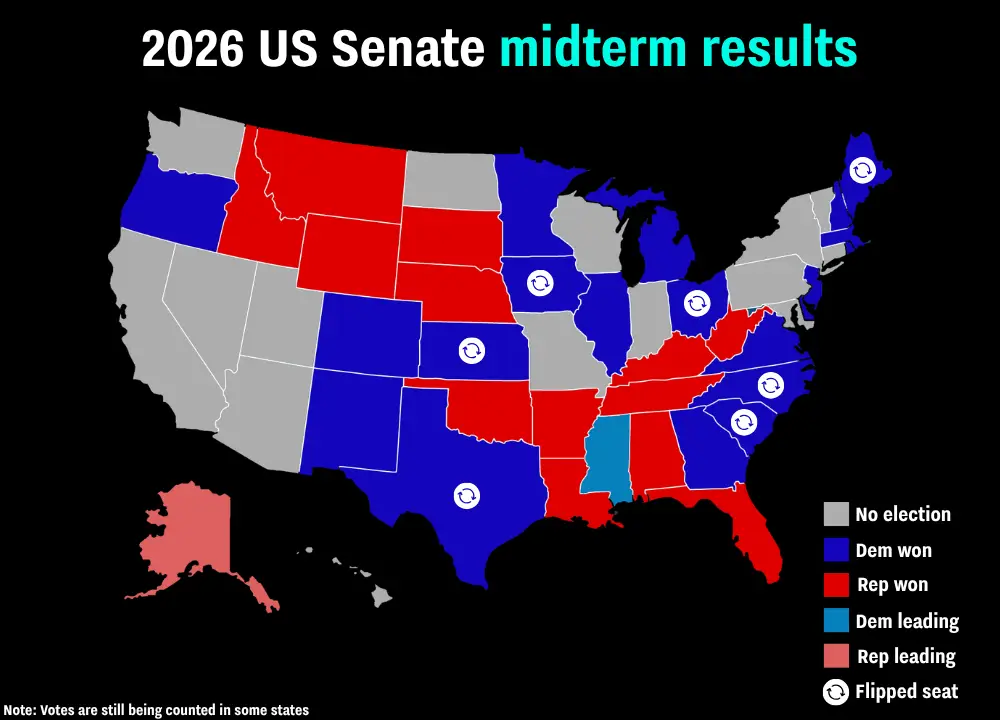
The Democrats crossed the 218-seat threshold needed to take control of the House after winning a series of traditionally Republican districts. Their success in the Senate also marks a major shift in Washington, with several Republican-held seats changing hands.
Advert
In Texas, the biggest shockwaves of the night were felt as Gina Hinojosa defeated incumbent Greg Abbott to capture the governor's mansion, while James Talarico broke a 38-year drought by winning the state's highly contested US Senate seat.

The political earthquakes continued across the Heartland: in Kansas, Adam Hamilton staged a historic upset to become the first Democrat elected to the Senate from the state since 1932, and in Iowa, challenger Josh Turek successfully flipped a crucial Senate seat.
Even the Deep South felt the shift, with Democrat Annie Andrews securing a historic win in South Carolina to flip a Senate seat held by Republicans since 1998.
Combined with resilient holds in states like Ohio and Michigan, these state-by-state upsets successfully handed Democrats outright control of both the House and the Senate.
Despite the huge losses, it doesn't mean Trump will be leaving the Oval Office.
His presidential term will continue until January 2029, although the chances of him implementing his agenda have now become more difficult.

What can the Democrats do now they have control of Congress?
The change in congressional power now gives Democrats the levers to challenge the president's administration.
A majority in the House would allow the party to control committees, launch investigations and demand documents and testimony from senior government officials.
House Democrat leader Hakeem Jeffries is poised to take a leading role, while Republicans will no longer be able to push legislation through the chamber without Democratic support.
There is also the looming possibility of another impeachment attempt against Trump.
Jeffries has reportedly refused to rule out impeachment, while Republican House majority leader Steve Scalise previously predicted Democrats could attempt it on 'Day 1'.
The Senate victory could prove particularly significant, as the chamber is responsible for confirming Cabinet members, ambassadors and federal judges, including Supreme Court nominees.
A Democratic majority could therefore block or delay many of Trump's appointments and force the White House to negotiate over legislation.
Which investigations could Democrats launch against Trump?
Several potential investigations have already been highlighted by Democratic lawmakers.

One area of interest is Trump's family business dealings. Robert Garcia, the top Democrat on the House Oversight Committee, has identified alleged corruption involving the Trump family as a priority.
Representative Jamie Raskin has also requested information about the business activities of Trump's son Donald Trump Jr. and son-in-law Jared Kushner.
The handling of documents relating to convicted sex offender Jeffrey Epstein could also face renewed scrutiny.
Millions of files were released by the Department of Justice following efforts by Representatives Ro Khanna and Thomas Massie.

However, concerns have been raised about redactions, missing material and the disclosure of victims' names.
Colorado Congressman Jason Crow has also indicated that he intends to examine the Pentagon, citing reports of defense funding being directed towards companies linked to the Trump family.
The outcome could bring back memories of Trump's first presidency, when Democrats took control of the House in 2018 and launched multiple investigations.
The House impeached him in 2019 over his dealings with Ukraine, although he was acquitted by the Senate.

He was impeached for a second time in 2021 following the January 6 attack on the US Capitol, and was again acquitted.
For now, Democrats have two years to exercise their newfound congressional power before the next presidential election.
Topics: Donald Trump, Politics, US News
 Thomas Bamford