
I won $28 million at 21 after selling Powerball ticket to myself but quickly learned painful lesson

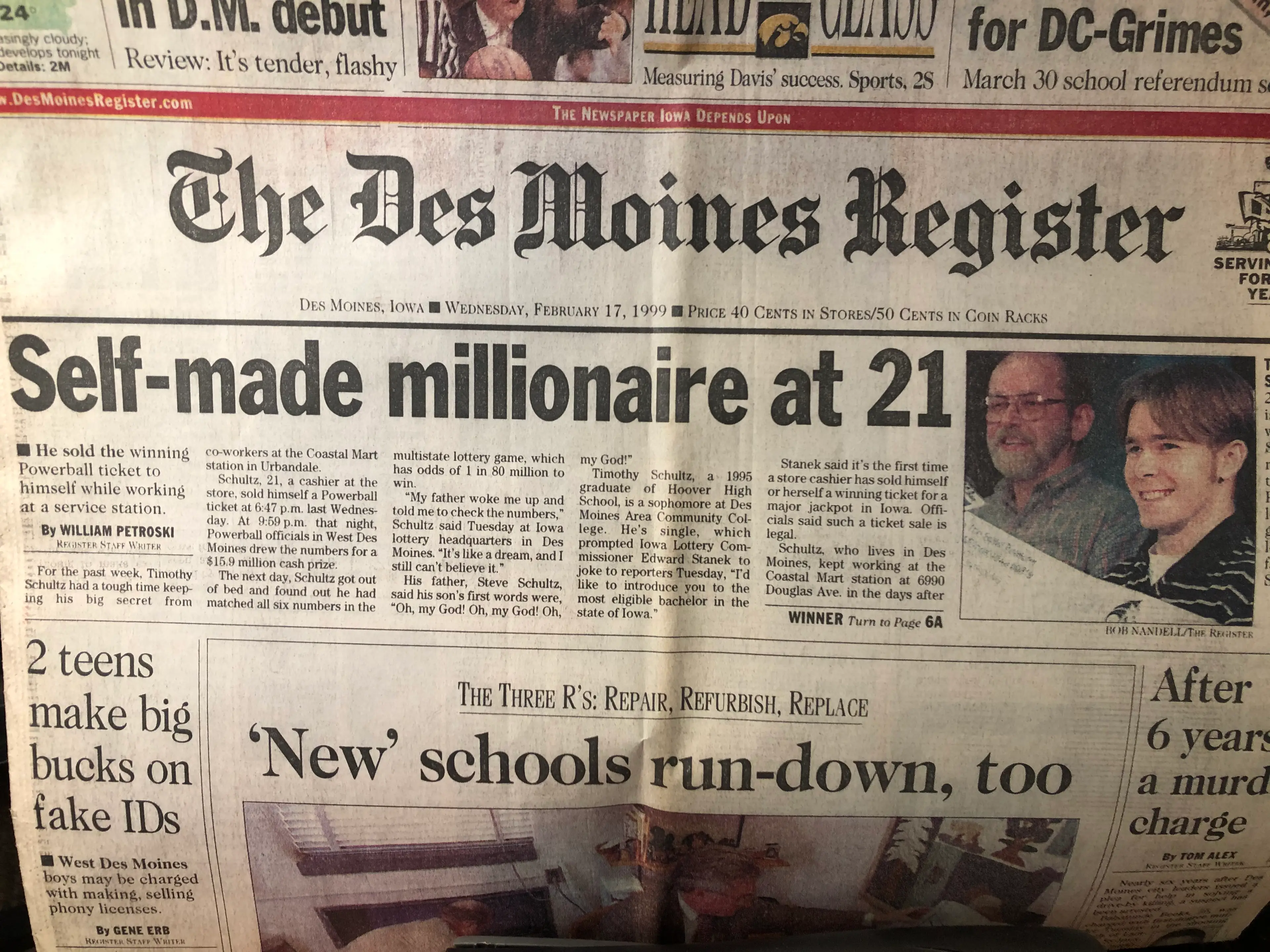
Timothy Schultz was working a shift at a gas station when he sold himself the winning Powerball ticket that would make him $28 million richer, and, at just 21 years old, an instant multimillionaire.
More than two decades on after winning the money, Schultz hosts the Dreams & Fortune with Timothy Schultz podcast, where he interviews other lottery winners about how their lives changed.
But he has now opened up himself about the highs, the lows, and a painful lesson he learned in the process.
Schultz said the first ‘extravagant’ purchase he made after the 1999 win was a Nintendo 64, the era's newest games console.
Advert
"It didn't cost thousands of dollars, but to me, it felt extravagant," he said. "I was in heaven."
The first thing he actually needed, he explained, was a new wardrobe, having spent years wearing the same gas station uniform almost daily.
He described a trip to the Mall of America as ‘surreal’, adding that walking out with bags of new clothes 'almost felt like I had traded my old life in for a new one'.
Do most lottery winners really go broke?
According to Schultz, one of the biggest myths surrounding sudden wealth is that the majority of jackpot winners eventually lose everything.
"People throw around claims that 70, 80 or even 90 percent of winners lose everything within five years, as though that's an established fact," he said. "In reality, it's closer to an urban legend."
He said that after interviewing dozens of winners, from those who scooped $1 million to others who won hundreds of millions, he has seen a very different picture.
"Most are doing just fine and managing their money responsibly," he said, adding that financial disasters 'are simply the stories that receive the most attention'.
That is not to say the transition to sudden wealth is without its complications. Schultz said his friendship circle ‘shrank substantially’ after the win, as he found himself questioning whether new acquaintances wanted to know him for the right reasons. "I wasn't just Tim the college student or Tim the gas station clerk. I was Tim the millionaire," he said.
He also received ‘stacks of letters from strangers asking for help’ following the win, and said learning to set boundaries, even with loved ones, was one of the more painful lessons of sudden wealth.
"Lending money could quickly complicate even a close friendship," he explained.
Despite being able to retire at 21, Schultz chose to return to college, where he largely kept his win private.
During one film class, he recalled a lecturer asking who in the room believed it was possible to win the lottery, arguing it was effectively ‘a tax on the poor’.
Schultz was the only student who raised his hand, unbeknownst to the teacher that an actual Powerball winner was sitting in the room.

What's the biggest mistake lottery winners make?
Schultz said moving too quickly is one of the most common errors he sees among new winners.
"When you realize you're holding a ticket worth millions, your heart is racing and your mind is going in a thousand directions," he said. "But claiming the prize shouldn't be treated like a race." He advised anyone in that position to first consult an attorney familiar with the lottery laws in their state, since even how a ticket is signed can affect a winner's options, including anonymity.
He also warned against trusting the first person who offers to manage a windfall.
"If I had a dime for every person who wanted to invest mine, I'd practically be a billionaire by now," he joked, before urging winners to shop around for professionals they trust rather than anyone who ‘pressures you or promises spectacular returns.’
Schultz said the hardest part of newfound wealth was not feeling different internally, but convincing others he had not changed.
"Almost overnight, I went from Tim the gas station clerk or Tim the college student to the millionaire kid who won the lottery," he said.

Asked if he has any regrets, Schultz laughed off one in particular: missing out on Bitcoin.
"I regret not buying Bitcoin 15 years ago. If I had, I'd probably be a gazillionaire by now," he said, before adding that, jokes aside, he does not regret how his life unfolded. "Even the difficult moments taught me something and helped shape who I am today."
Schultz previously told Business Insider that consulting wealth professionals before turning in his ticket was central to avoiding the fate of winners who blow through their fortunes.
He said he invested conservatively in ‘stocks, bonds, and mutual funds’ to make sure the money would last a lifetime, a strategy that appears to have paid off more than 25 years later.
 Thomas Bamford