
Astronomer identifies 7 planets with highest chance of alien life

Topics: Space, Aliens, Technology
 Emily Brown
Topics: Space, Aliens, Technology
Everyone has their thoughts on whether there are aliens out there, but we have to be honest - some people are more qualified than others when it comes to speculating on the matter.
Having literally written a book on the subject, Lisa Kaltenegger, astronomer and director of the Carl Sagan Institute at Cornell, is among those whose educated guesses around space carry a little more weight.
Kaltenegger, who wrote the book Alien Earths, and more recently worked as senior author on a paper about the best places to look for alien life, has now spoken to UNILAD about three planetary systems she believes are top contenders for alien life, along with seven planets within them. Spoiler alert: we won't be hearing about little men on Mars today.
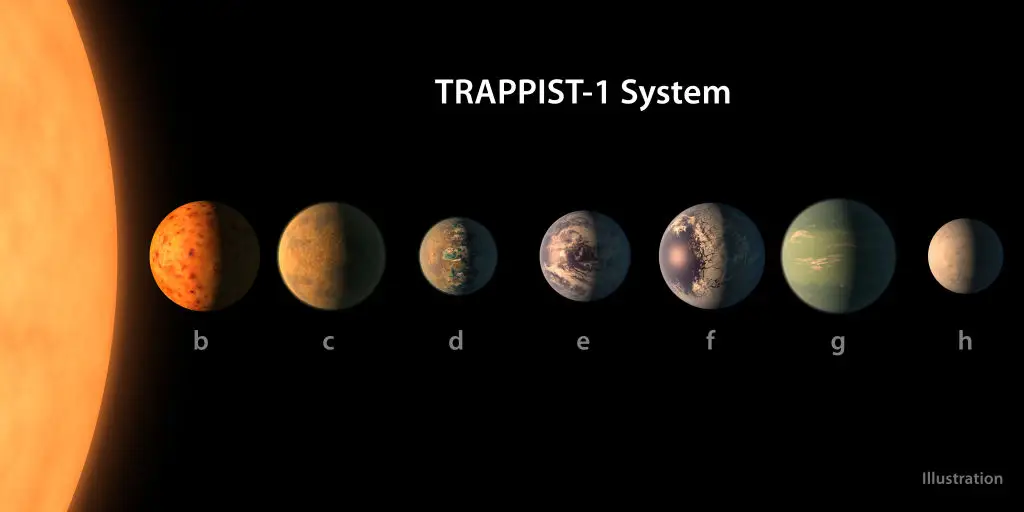
Trappist-1, which is an ultra-cool red dwarf star, hosts seven planets that are roughly Earth-sized. According to NASA, all seven planets have potential for water on the surface, meaning that future studies could confirm that they have conditions suitable for life.
Advert
However, Kaltenegger only highlighted four of them as potential homes for aliens, due to the first three likely being too toasty for life.
In her book Alien Earths, she explains: "Planet TRAPPIST-1 b (circles its star in 1.5 Earth-days): way too hot; TRAPPIST-1 c (2.4 days): too hot; TRAPPIST-1 d (4 days): quite hot; TRAPPIST-1 e (6.1 days): just right; TRAPPIST-1 f (9.2 days): just right; TRAPPIST-1 g (12.3 days): almost just right but a bit cold; TRAPPIST-1 h (18.8 days): probably too cold.
Described by Kaltenegger as 'the planet next door', this particular world inspired films like Avatar, according to the astronomer.
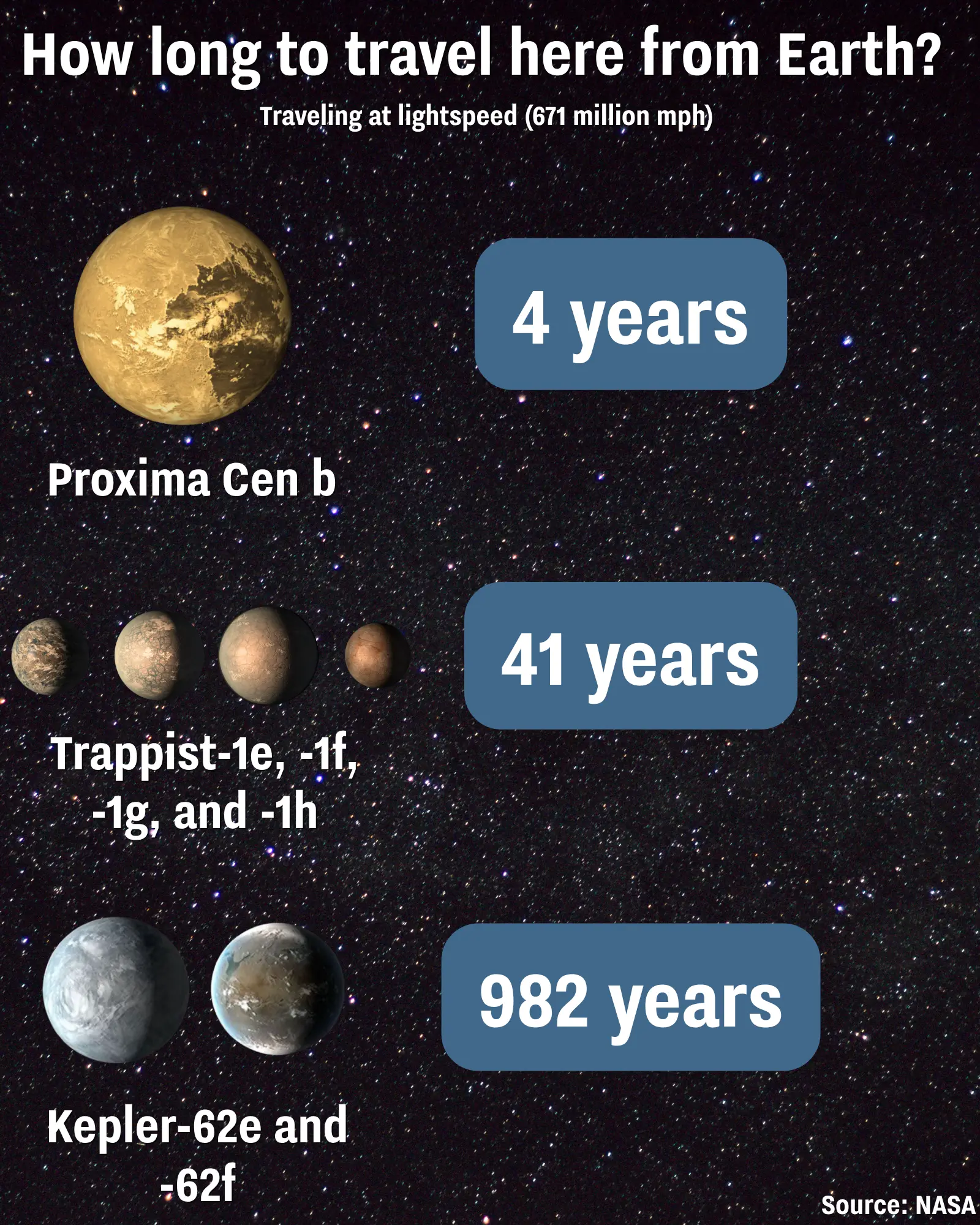
Promixa Cen b 'tugs' on our neighboring star, Proxima Centauri, which makes it wobble back and forth and consequently revealed its presence to telescopes here on Earth.
Kaltenegger continued: "About four light-years away from us in the constellation Centaurus, Proxima Centauri is the easiest destination for us to reach once we invent ships that can travel those vast distances. A red star about the same age as our Sun, it is part of a triple- star system, consisting of two yellow suns, Alpha Centauri A and B, and a red sun, Alpha Centauri C (Proxima Centauri).
"Proxima Centauri wobbles just the right amount. Its planet takes only eleven days to complete its path around its red, active sun, which bombards it with flares of intense radiation. The short time it takes to circle its star means that the planet is likely tidally locked, captured in synchronous rotation. That means that only one side of the planet ever sees the sun; you would have to walk away from the sunlit parts of the planet to experience dawn or dusk and then trek even farther to reach the part of the planet that is shrouded in perpetual darkness."
Perpetual darkness, eh? Sounds like a pretty good spot for aliens to lie in wait, if you ask me...
In her book, Kaltenegger goes on to explain that neither of the two yellow suns, Alpha Centauri A nor Alpha Centauri B, have known planets, but both 'have inspired the imagination of sci-fi writers for decades'. She writes: "If one of the two stars had a planet, that planet would see two suns in its sky (and a third dim red one very far away).
"In the 2009 3D-movie Avatar, a film written and directed by the science enthusiast James Cameron, the lush, inhabited fictional moon Pandora has an atmosphere poisonous to humans. It is a little smaller than Earth and circles a fictional gas giant, Polyphemus, around Alpha Centauri A.
"The idea of habitable moons as abodes for life is based on our hope of finding life on some of the moons in our own solar system. And if a habitable moon were massive enough—like the fictional Pandora— it should be able to provide environments similar to Earth’s if it gets comparable amounts of starlight."

Kepler-62 is a system that sits about 1,200 light-years from Earth, and was discovered in 2013.
Today, Kaltenegger acknowledged, there are 'most likely billions of rocky planets circling their stars at just the right distance for life, not too hot and not too cold'.
However, before the discovery of Kepler-62, although astronomers had found planets in Goldilocks zones, they’d done it using the 'wobble technique', which Kaltenegger says gave them an idea of the mass of the planet but did not let them distinguish between rocky planets like Earth and uninhabitable small gas balls like Neptune.
"Scientists believed that warm, rocky planets like Earth existed, but it was by no means a certainty," she said.
In her book, she explained of the discovery: "Two rocky, temperate worlds circling another star, news that everyone hoping to find life on other worlds had been sitting on the edges of their chairs waiting to hear. And suddenly, my research to find life in the cosmos went from visionary to practical, from far-fetched to applied, from future- oriented to needed- right- now."