
Dermatologist reveals what those tiny bumps you've had for years actually are

Anyone who has spotted a small, yellowish bump on their face that refuses to budge no matter how much they exfoliate might finally have an answer as to why.
Dermatologist Dr Danny Guo has used his YouTube channel to break down some of the most common lumps and bumps people develop over the years, including skin tags, seborrheic keratoses, dermatofibromas, milia, molluscum contagiosum, venous lakes, cherry angiomas and plantar warts.
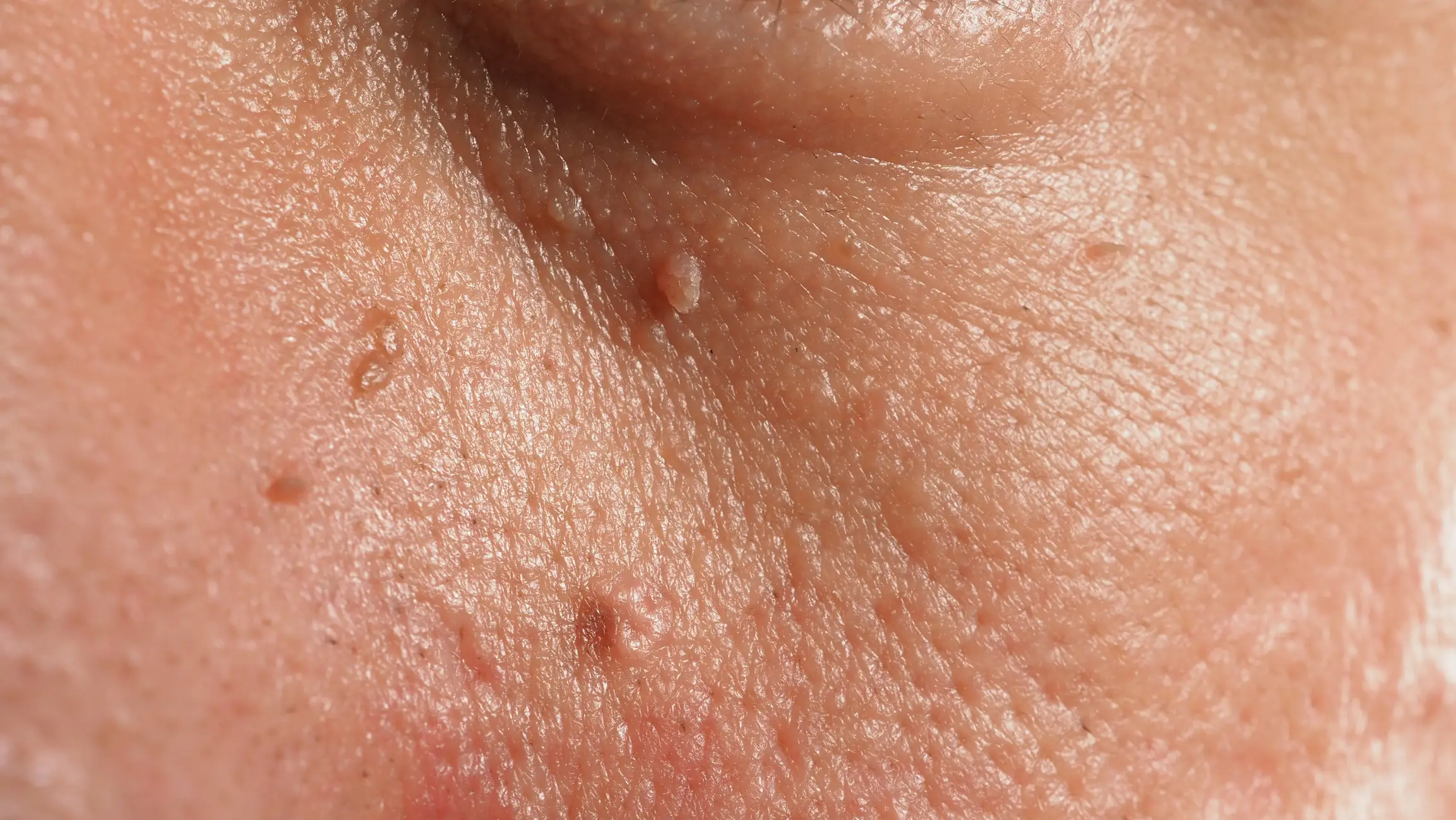
But it's sebaceous hyperplasia, a condition often confused with a stubborn whitehead, that tends to catch people out the most.
According to Dr Guo, these bumps have a few telltale features that separate them from a run-of-the-mill spot.
Advert
He explained they usually have 'tiny yellowish balls, a central divot' and are 'a bit bigger than whiteheads', and can even show 'tiny blood vessels' running through them.
Crucially, he noted that no amount of skincare will shift them, since they 'don't go away with retinoids or exfoliating'.
What causes sebaceous hyperplasia?
Dr Guo said the bumps form largely down to genetics rather than lifestyle or hygiene.
"Some people get sebaceous hyperplasias while others don't, mostly because of genetic tendencies," he said, adding that certain medications can occasionally trigger them too, although he stressed these aren't drugs most people take regularly.
Once they appear, the bumps are in it for the long haul.
Dr Guo confirmed people can have sebaceous hyperplasia 'for years', and that it 'doesn't tend to spontaneously go away' without treatment.
If left alone, he said, the bumps will simply stay put indefinitely rather than fading on their own.
Can sebaceous hyperplasia be mistaken for skin cancer?
Perhaps most notably, Dr Guo revealed that patients sometimes arrive at his clinic convinced they have something more sinister.
"It is occasionally referred to me as a basal cell carcinoma however a trained dermatologist can almost always distinguish them with a dermatoscope," he said, referring to the handheld magnifying tool dermatologists use to examine skin closely.
That distinction matters, since basal cell carcinoma is a form of skin cancer, and Dr Guo's comments highlight just how similar the two can look to the untrained eye.
He said the warning signs that should prompt someone to get a bump checked include it 'rapidly growing, gaining brown colors, spontaneous bleeding, or you are just worried'.
Dr Guo's wider advice for anyone dealing with an unidentified bump is to resist the urge to deal with it themselves.
Attempting to cut, burn, freeze or extract a growth at home can lead to infection, bleeding and scarring, and may also delay the diagnosis of something more serious if the bump turns out not to be harmless.
Instead, he recommends seeing a qualified medical professional whenever a spot is new, changing, painful, bleeding, growing quickly, or simply doesn't look right, even if that just comes down to a gut feeling rather than any obvious symptom.
While many of the bumps covered in Dr Guo's rundown, including skin tags and milia are common and harmless, it's important to get a second opinion from a dermatologist to put your mind at ease if you're worried.
 Thomas Bamford