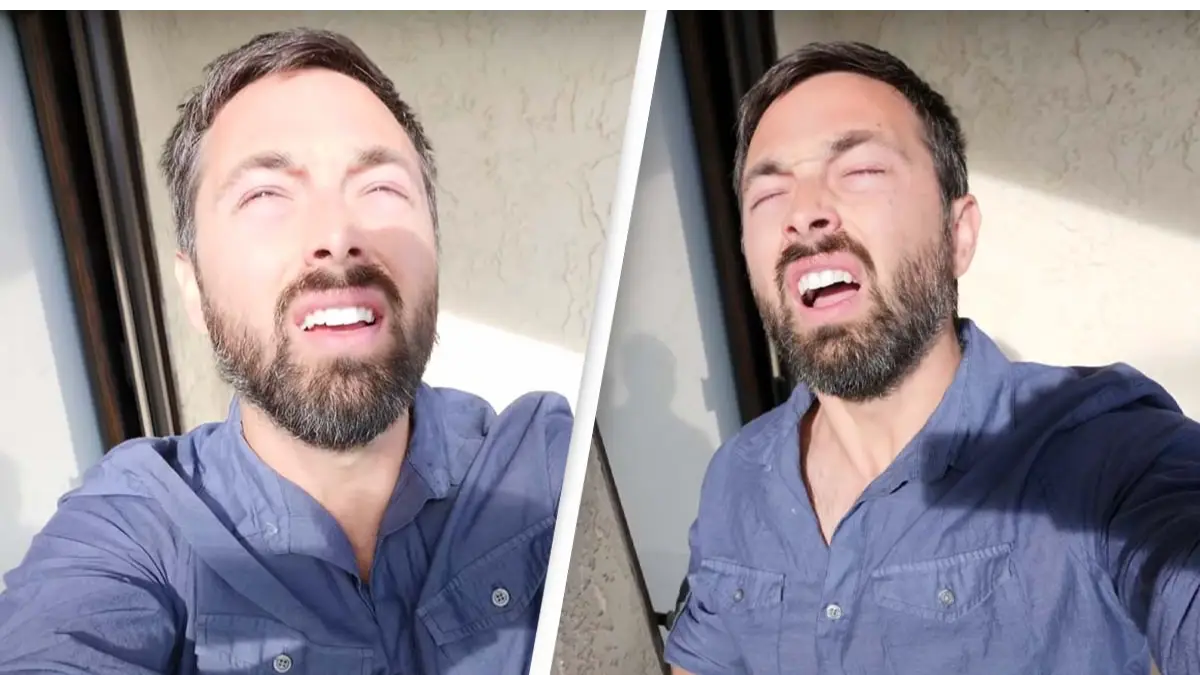
Small percentage of people suffer from ACHOO syndrome involving bright light and don't even realize

If suddenly seeing bright light makes you sneeze then you may have ACHOO syndrome, a medical mystery that's been baffling scientists and doctors alike for 2,500 years old.
For most of us opening a dusty book, inhaling a rogue speck of black pepper or seasonal allergies can induce an achoo.
But if you sneeze when you see a bright light, then you might be part of the small percentage of the population with a strange condition appropriately called ACHOO syndrome.
Short for 'autosomal dominant compulsive helio-ophthalmic outbursts' aka 'photic sneeze reflex' (PSR), it's not serious or life-threatening on its own Dr. Louis Ptáček, a neurology professor at the University of California San Francisco told Insider.
Advert
However, it could be dangerous if your job involves precision or heavy machinery.

Circumstances that can trigger ACHOO syndrome include watching a bright TV or movie screen in the dark before walking outside into bright sunlight, waking in a dimly-lit bedroom and turning on overhead lights, for example.
According to estimations, up to 35 percent of the world's population have this condition.
And it's cause has been confusing scientists since 350 BCE, according to surviving written records.
So what's the difference between ACHOO syndrome and regular sneezes?

Here's the science: usually when we sneeze, the mucous membranes of your nose or throat get irritated by particles.
Think dust, pollen or a very spicy curry.
It's a clever reflex designed to help the body clear irritants and stay healthy.
ACHOO sneezing doesn't happen in response to any kind of particle but rather occurs when someone is exposed to bright light all of a sudden.
And the condition doesn't just cause one sneeze but rather uncontrollable sneezing episodes of at least two or three in a row.
People often just experience a tingling sensation in their nose but don't actually sneeze, Dr. Annie Nguyen, an ophthalmologist with Keck Medicine of USC, said.
Nguyen further explained to Insider: "The reflex seems to be triggered by a change in intensity of light rather than a specific type or wavelength of light."
Don't worry - ACHOO syndrome isn't contagious, but it is passed down genetically, meaning you have a 50 percent chance of inheriting the trait if one of your parents has it first.
However, the only way to know if you have the condition is to get professionally diagnosed first.

But to this day, it is still unknown what causes it.
Ancient explanations include the sun dissolving nasal moisture which has to be pushed out by a sneeze in 350 BCE to a seventeenth century assumption that bright light makes the ears tear, which drips down into the nose and leads to an achoo moment.
A 1990 theory was that bright light constricts the pupils and triggers irritation in the nose and a 1995 study thought the phenomenon could be linked to a deviated septum.
Meanwhile, in 2010, scientists surmised that 'overexcitability' of the visual cortex causes it and in 2019, a study theorized that the photic sneeze reflex may be a part of the trigeminocardiac reflex or disturbances in the parasympathetic nervous system whenever the trigeminal nerve (which provides sensation to the face) is stimulated.
Whatever the cause, just make sure you have your hanky at the ready if you decide to look at your phone at night.
 Amelia Jones