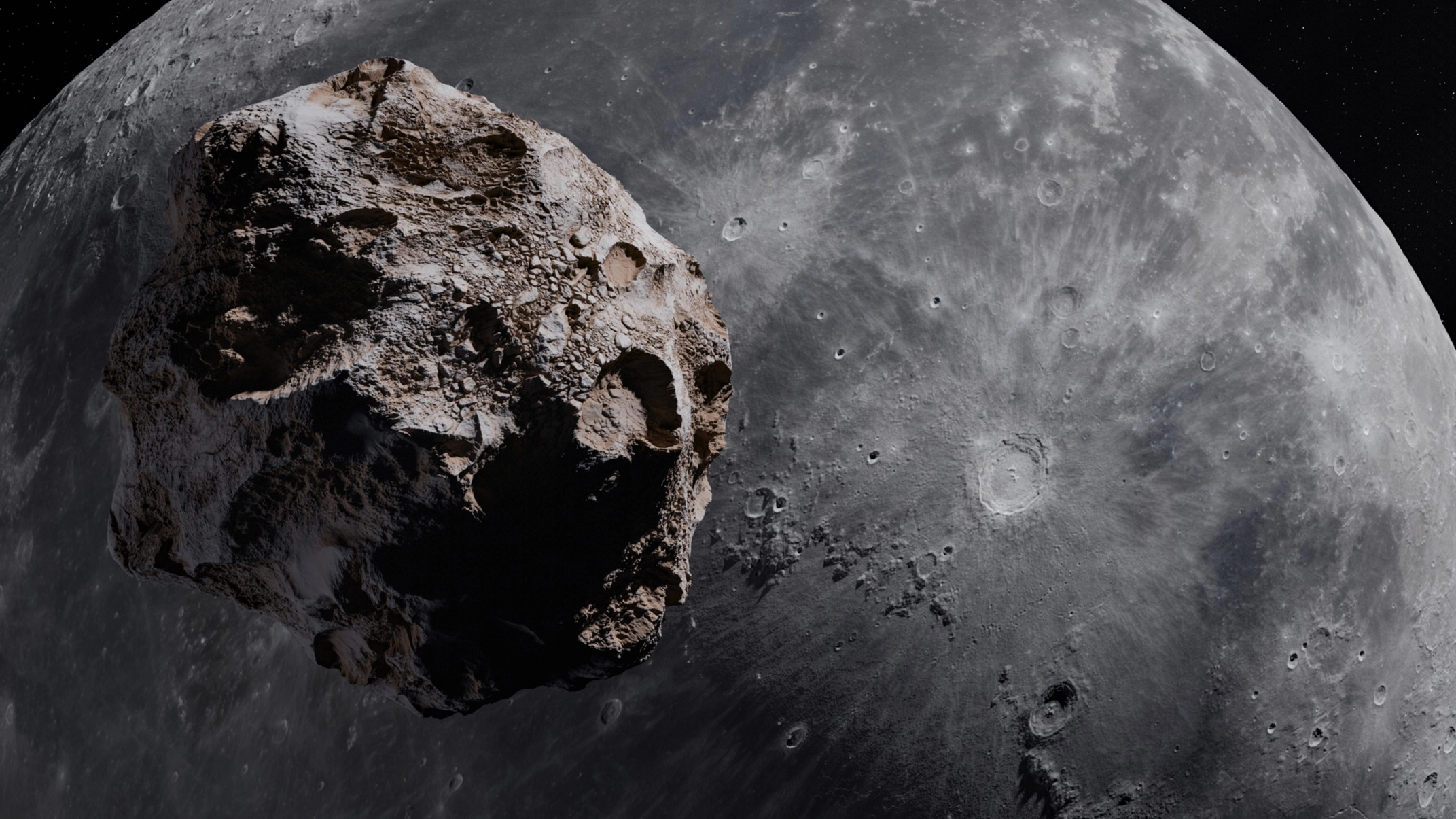
NASA reveals exactly when ‘city-killer’ asteroid YR4 will make closest pass by the Moon

NASA has ruled out the possibility of asteroid 2024 YR4 crashing into the Moon in 2032, following new observations from the James Webb Space Telescope.
Interstellar comet 3I/ATLAS might have stolen the headlines last year, but you might also remeber the 'city-killer' asteroid that had a slight chance of colliding with the Moon in a few years' time.
Well, NASA has now given an update on when the Statue of Liberty sized asteroid will make its closest pass to our lunar body.
Data collected on February 18 and 26 allowed experts at NASA’s Center for Near-Earth Object Studies (CNEOS), based at the Jet Propulsion Laboratory in California, to refine the asteroid’s orbit with far greater precision.
Advert
As a result, scientists have confirmed the space rock will pass safely by the Moon on December 22, 2032, at a distance of around 13,200 miles (21,200 km).
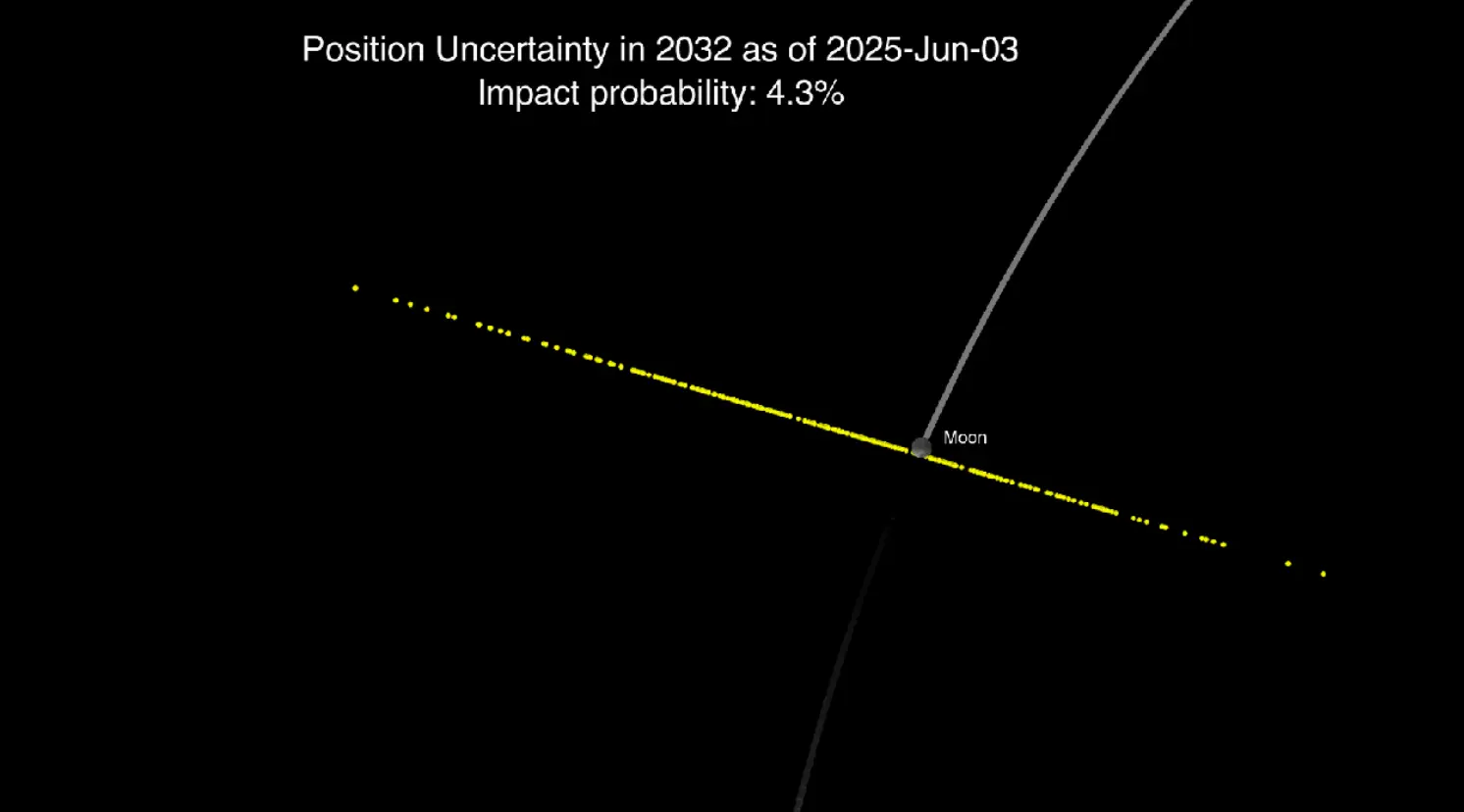
Earlier calculations had suggested there was a 4.3 percent chance of a lunar impact. However, NASA stressed that the asteroid’s path has not changed; instead, the new Webb data has reduced uncertainty about where it will be in the future.
The updated analysis shows there is no longer any possibility of a Moon impact in 2032.
The Webb telescope played a crucial role in securing the new measurements.
Since spring 2025, 2024 YR4 has been too faint and too distant to be observed by most Earth- and space-based telescopes.
A team led by the Johns Hopkins Applied Physics Laboratory used Webb’s powerful instruments to capture some of the faintest asteroid observations ever recorded.
Asteroid 2024 YR4 was first discovered in late 2024 by the NASA-funded Asteroid Terrestrial-impact Last Alert System (ATLAS) in Chile - the same one that first spotted 3I/ATLAS.
When initial trajectory data was analysed in early 2025, scientists identified a small but notable chance of the asteroid impacting Earth in 2032.
As more observations were gathered from telescopes around the world, NASA later concluded the asteroid does not pose a significant threat to Earth on December 22, 2032 - or at any point over the next century, for that matter.
It is common for impact probabilities to shift as new data improves orbital models, NASA explained.
The asteroid, estimated to be around 90 metres wide, was once described as a potential 'city-killer' due to the damage it could cause if it struck Earth.
However, current calculations show it will remain at a safe distance.
While 2024 YR4 is no longer considered a threat, NASA continues to track near-Earth objects closely as part of its planetary defence efforts.
However, as some worried scientists pointed out recently, it's impossible to track them all...
Topics: NASA, Space, Moon, Science, Technology
 Ellie Kemp