
Planetary scientist admits city-killer asteroids keep her 'up at night' as NASA can't stop them

You might be familiar with the phrase 'what you don't know can't hurt you,' but when it comes to asteroids hurtling towards Earth, the old adage doesn't exactly ring true.
A scientist has admitted that NASA doesn't know where certain rocky city-killers are, and it 'keeps her up at night' - which isn't very reassuring, is it?
Kelly Fast is head of planetary defense at the US agency that tracks near-Earth objects and prevents them from destroying our planet.
Or, in her own words, she finds asteroids 'before they find us' and develops ways of 'getting asteroids before they get us.'
Advert
Speaking to the American Association for the Advancement of Science, she said, via the Sun: “What keeps me up at night is the asteroids we don’t know about.
“Small stuff is hitting us all the time so we’re not so much worried about that.

“And we’re not so worried about the large ones from the movies because we know where they are.
“It’s the ones in between, about 140 metres and larger, that could really do regional rather than global damage and we don’t know where they are."
She added that there are around 25,000 of those asteroids and 'we're only about 40 percent of the way through.'
“It takes time to find them, even with the best telescopes," she added.
Researchers have previously warned of multiple 'city-killer' asteroids impacting Earth, as well as YR4, a 90-meter-wide space rock that was initially given a one-in-32 chance of hitting us as early as 2032.

NASA has since downgraded that possibility to zero percent, but the asteroid continues to be tracked by NASA's James Webb Space Telescope this week as there's a 4 percent chance it could collide with the Moon, as the Times reports.
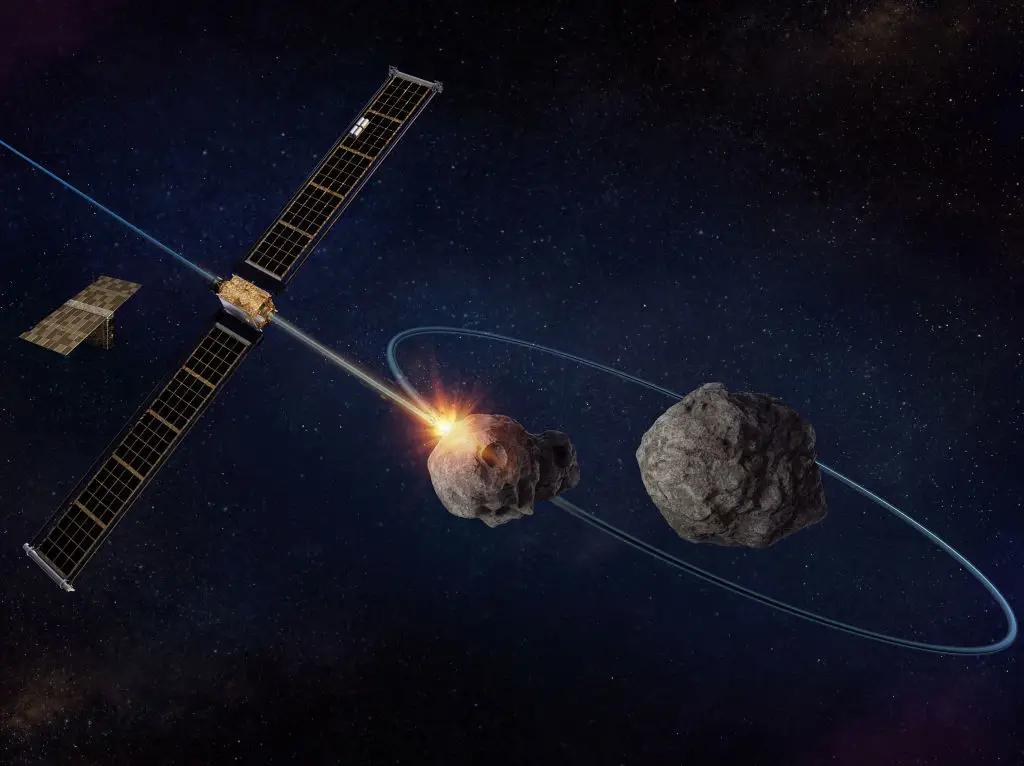
Back in 2022, NASA experimented with knocking potential asteroids off-course - and succeeded.
They launched a Double Asteroid Redirection Test (DART) spacecraft into a mini-moon orbiting around an asteroid, launching it at 14,000 miles per hour and altering its path.
Nancy Chabot, a planetary scientist at Johns Hopkins University who led the DART mission, has expressed concern despite the successful mission.
Why? Because such spacecrafts are few and far between.
“We don’t have [another] DART just lying around. If something like YR4 had been headed towards the Earth, we would not have any way to go and deflect it actively right now," she said.
Chabot is also kept up at night by the uncertainty of it all.
“We could be prepared for this threat,” she said, referring to YR4. “We could be in very good shape. We need to take those steps to do it. If anything keeps me awake, it’s that.”
 Ellie Kemp