
NASA scientist claims to have found evidence of ‘Non-Human Intelligence’ in our skies

Do aliens exist or not? That is the question.
Well, one NASA scientist certainly seems to think there's a chance.
Ivo Busko, a retired NASA developer who worked at the Space Telescope Science Institute, has backed a recently published study that investigated sky flashes during the early nuclear age, decades before humans had satellites to properly track them.
This week, NBusko published a preprint confirming the mysterious transient flashes first identified by astronomer Dr Beatriz Villarroel and her VASCO research team, and reported in the peer-reviewed journal Scientific Reports last October.
Advert
Busko reviewed studies conducted in the 1950s by Villarroel, a researcher at the Nordic Institute for Theoretical Physics in Sweden, that showed 'transient' lights appearing in the sky.
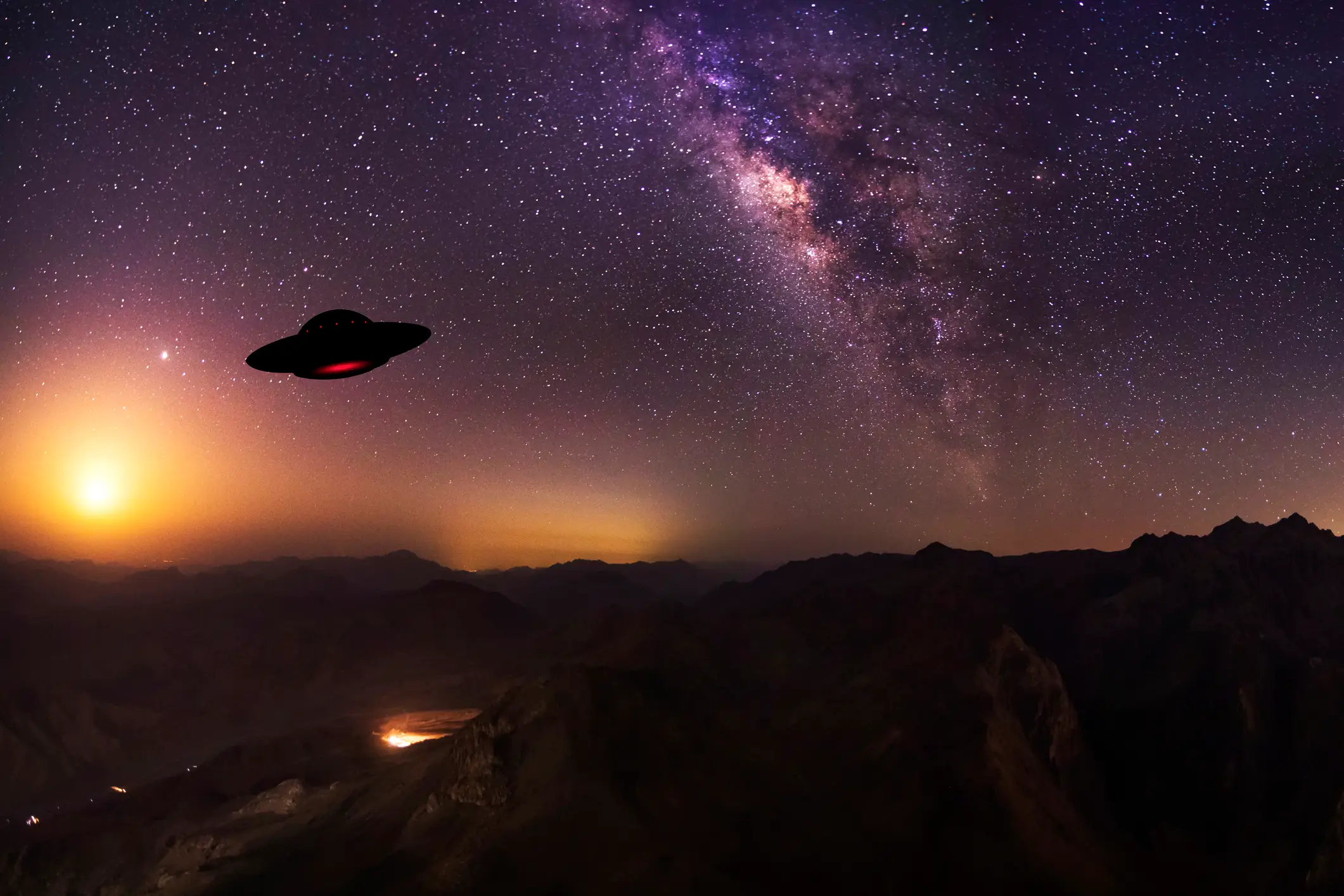
Before now, many struggled to explain these transients via natural means. According to Villarroel's observations, the transients were ‘mirror-like’ and appeared to be rotating in the sky.
After reviewing Villarroel's research, Busko followed through with his own research, sifting through archival sky photographs from the 1950s but using a separate analytical method to verify his predecessor's earlier work.
From there, he discovered dozens of transient flashes with the same bizarre lights as previously reported by the VASCO team.
These 'independently confirm the presence of such transients', Busko concluded.
'By analyzing pairs of plates taken in rapid sequence (about 30 minutes apart) of the same sky regions, we find evidence of transients similar to those previously reported by the VASCO Project,' he added in the study, which was published in arXiv.
Many of those bright lights actually predate the launch of the first man-made satellite, Sputnik-1, which was sent into orbit in October 1957 and thus could not be created by humans.
Busko believes this offers strong evidence for life beyond Earth.
His own research appeared to confirm the earlier findings, with similar 'transient' lights spotted in the sky.
An additional 98,000 photographic plates from separate sky surveys taken at the Hamburg Observatory in the 1950s also corroborated the findings.
'Glints' found in the photographs were startlingly similar to those found in the VASCO research.
According to the most recent paper, Busko's next plan is to digitize more archives in the hopes of confirming transients spotted in the original VASCO project, convinced that both sets of research point to the existence of life beyond Earth.
If he can confirm this, researchers believe the objects could be among the earliest recorded evidence of unidentified objects functioning above Earth's atmosphere.
 Alice Wade