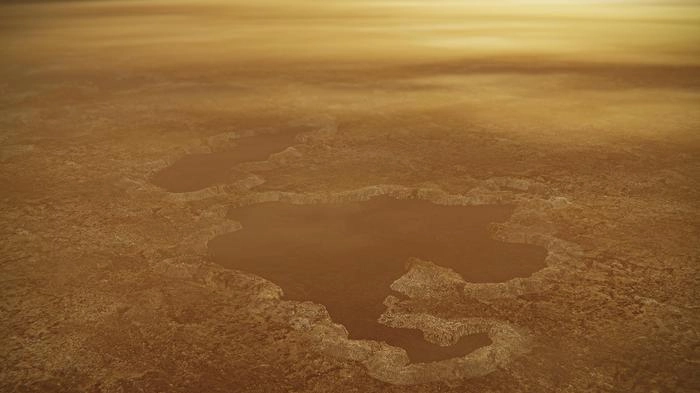
Scientists say alien life could exist on a moon close to Earth that's covered in icy boulders

A study has looked into whether or not it would be possible for life on Titan to exist and what it would look like if so.
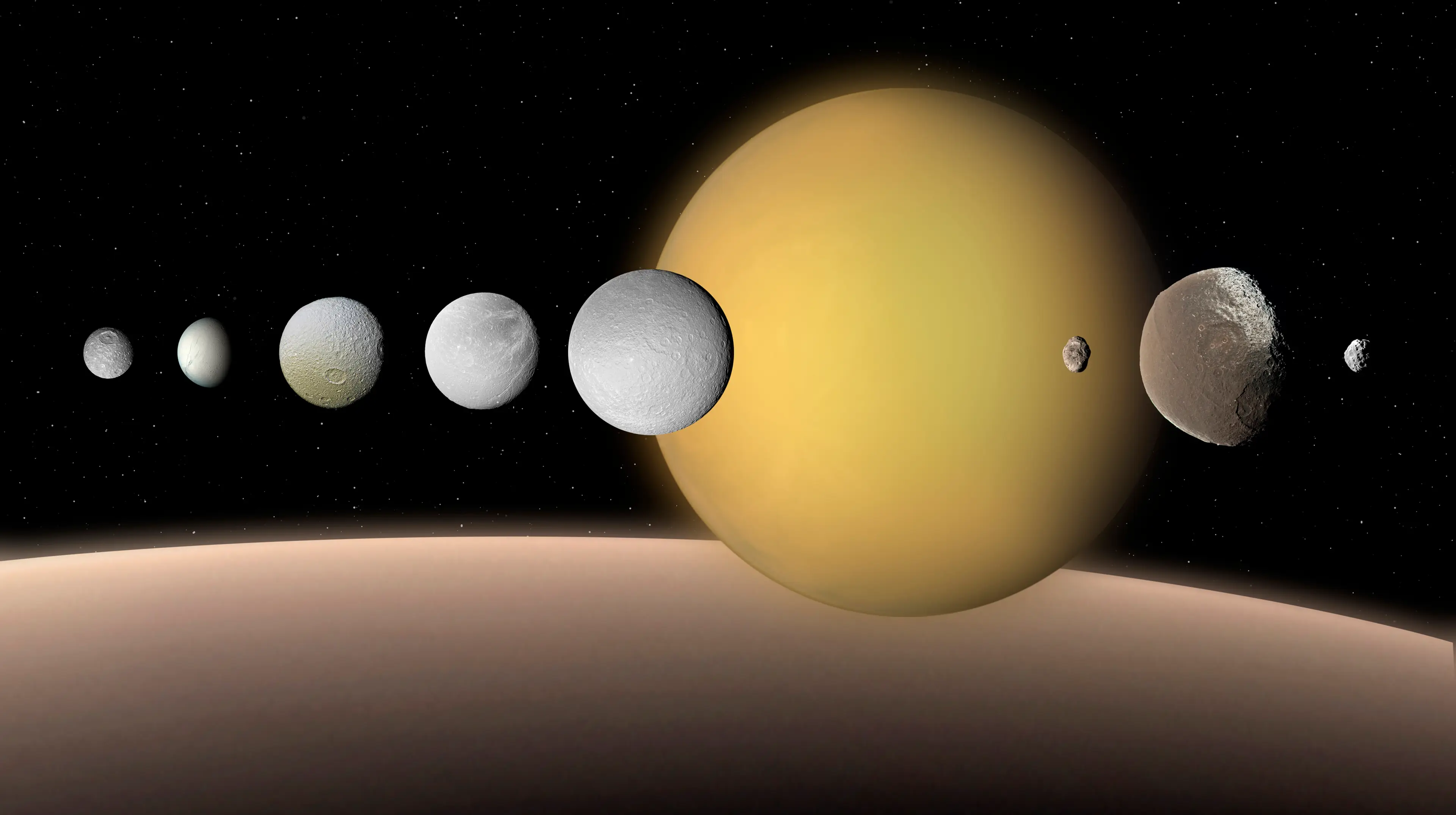
Saturn's largest moon, Titan, is the second largest moon in our solar system and is roughly 1.2 billion kilometers (745 million miles) from Earth.
Scientists have long pondered whether or not life could exist on the planet - often described as 'Earthlike on the surface, ocean world on the inside' - and what it might look like if it did exist - 'where it is most likely to occur and how much of it might be present'.
Advert
An international team of researchers co-led by Antonin Affholder at the University of Arizona Department of Ecology and Evolutionary Biology and Harvard University's Department of Earth and Planetary sciences conducted a study to theorize what this might look like and figure out just how possible it really is.
The study
The study - published in The Planetary Science Journal and titled The Viability of Glycine Fermentation in Titan's Subsurface Ocean - looked deeper into Titan's organic chemistry and theorized whether it could sustain life.
Lead author on the study Antonin Affholder said, as quoted by EurekAlert: "There has been this sense that because Titan has such abundant organics, there is no shortage of food sources that could sustain life.
"We point out that not all of these organic molecules may constitute food sources, the ocean is really big, and there's limited exchange between the ocean and the surface, where all those organics are, so we argue for a more nuanced approach."
The study looked at a process called fermentation - when microorganisms like yeasts and bacteria convert carbohydrates into alcohol, acids, or other products - which 'evolved early in the history of Earth's life' and looked at whether or not 'similar microbes [could] exist on Titan'.
Affholder continued: "If so, what potential does Titan's subsurface ocean have for a biosphere feeding off of the seemingly vast inventory of abiotic organic molecules synthesized in Titan's atmosphere, accumulating at its surface and present in the core?"
The study focused on an organic molecule called glycine - simplest of all known amino acids - with Affholder noting that glycine 'was relatively abundant in any sort of primordial matter in the solar system' and 'when you look at asteroids, comets, the clouds of particles and gas from which stars and planets like our solar system form, we find glycine or its precursors in pretty much all those places'.
But what did the study reveal?
Results
Well, the study revealed: "We found that Titan's subsurface ocean may host chemical conditions permitting energy extraction from glycine fermentation by known organisms, provided there is early dissolution of relevant organics from Titan's core.
"Regardless of any ongoing delivery, the ocean may therefore be instantaneously habitable to known Earth organisms."
However, 'sustained habitability' may be harder, as would require 'an ongoing delivery mechanism of organics to Titan's ocean, through impacts transferring organic material from Titan's surface or ongoing water–rock interactions from Titan's core.
"The surface-to-ocean delivery rate of organics is likely too small to support a globally dense glycine-fermenting biosphere," it added.
Affholder reflected: "Our new study shows that this supply may only be sufficient to sustain a very small population of microbes weighing a total of only a few kilograms at most – equivalent to the mass of a small dog. Such a tiny biosphere would average less than one cell per liter of water over Titan's entire vast ocean.
"[...] We conclude that Titan's uniquely rich organic inventory may not in fact be available to play the role in the moon's habitability to the extent one might intuitively think."
However, further investigation could be more promising.

Future investigation
It says: "Detecting a biosphere at Titan would be limited if this hypothetical biosphere was based on glycine fermentation alone.
"However, these estimates do not rule out localized concentrations of organic substrates, such as at the ocean–ice crust interface or other localized regions, which may provide more propitious conditions for detectable biomass.
"Other metabolisms may add on to glycine fermentation to amount to a larger global population."
The study noted further investigation is needed, but it highlights glycine fermentation as being a significant first-step when it comes to analyzing whether Titan's ocean is habitable.
 Poppy Bilderbeck