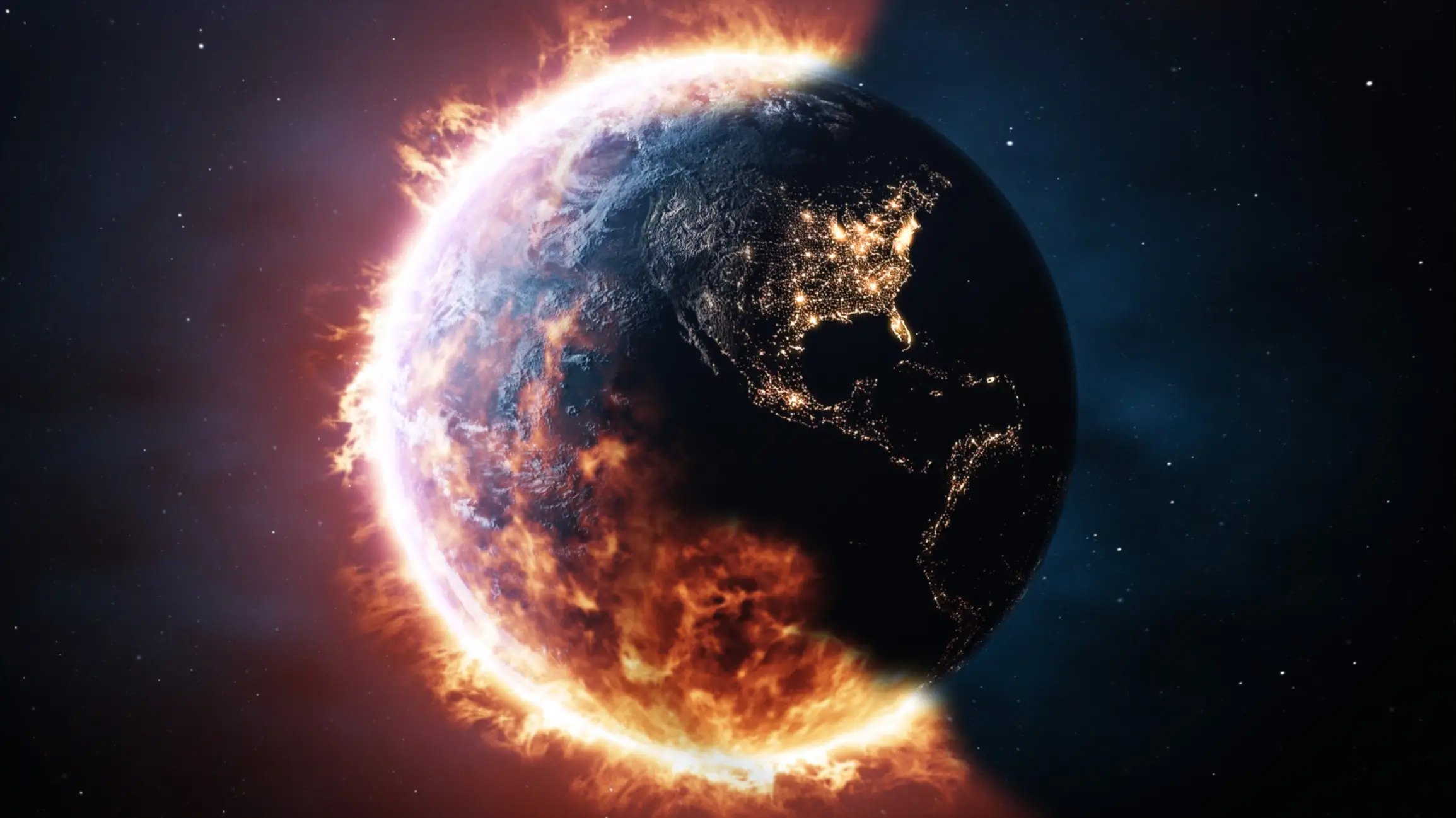
Mathematician’s ‘Doomsday’ prediction gave an exact date for the end of the world – and it’s just weeks away

A mathematician made a startling Doomsday prediction in the 1960s and, if his controversial theory is right, the end could be just weeks away.
The prediction has resurfaced decades later on social media now that the date is fast approaching.
While there have been doomsday predictions in the past, like the 2012 Mayan Long Count calendar, this one stands out because it used detailed mathematical modeling.
In 1960, Heinz von Foerster published a paper in the journal Science detailing a calculation he made with colleagues predicting that human population growth would reach a point that could mean catastrophe.
Advert
This key point in human history is coincidentally predicted to fall on a Friday the 13th.
Analysis by von Foerster looked into human population trends, suggesting that exponential growth of the human population could push humanity well past Earth’s capacity. This would lead to environmental breakdown, conflict, and depletion of Earth’s resources.

According to the mathematical model, if Earth’s population continued increasing at the rate it had been, humankind would ‘squeeze itself to death’ at the date predicted in the next few weeks - Friday, November 13, 2026.
There are currently 8.3 billion people on our planet, which is a notable increase from the 3.02 billion that roamed Earth in 1960.
However, global population growth has experienced a significant decrease in the decades that followed. Modern demographers say this is due to a number of reasons, including declining birth rates, improved education, as well as family planning.
Concerns over the rise in human population
But von Foerster’s work remains notable due to the warnings it raised about human population growth.
Contemporary experts now say the mathematical research serves more as a cautionary tale than anything that may come true, especially in the next several weeks.
The theory does raise concerns about climate change, sustainability, food security and the population limits of Earth.
‘Doomsday’ remains a key area of interest and an astrophysicist made a separate prediction in 1983.

Known as the Doomsday Argument, or Carter Catastrophe, this theory tries to estimate how many humans will ever live.
The idea is based on a simple assumption: if the total number of people who will ever exist were fixed, then you would be just as likely to be born at any point in human history.
That means being alive today could give us a clue about how many people will exist in the future.
In simple terms, the theory suggests that we shouldn't expect the human population to grow enormously beyond the number of people who have already been born.
The 2012 'Doomsday' prediction
Another famous end-of-the-world prediction centred on December 21, 2012, when a cycle in the ancient Maya Long Count calendar came to an end.
Some interpreted this as a sign that the world would end, with theories ranging from catastrophic solar activity to a collision with a mysterious planet.
However Maya scholars said the date simply marked the end of one calendar cycle and the beginning of another, not an apocalypse.
When the date arrived, as we all now know, there was no global catastrophe.
Topics: Earth, Science, Environment
 Greg Harris