Inside NATO's hybrid warfare protocol as it rushes jets to intercept Russian bombers

NATO scrambled fighter jets on Monday to intercept Russian bombers flying near allied airspace.
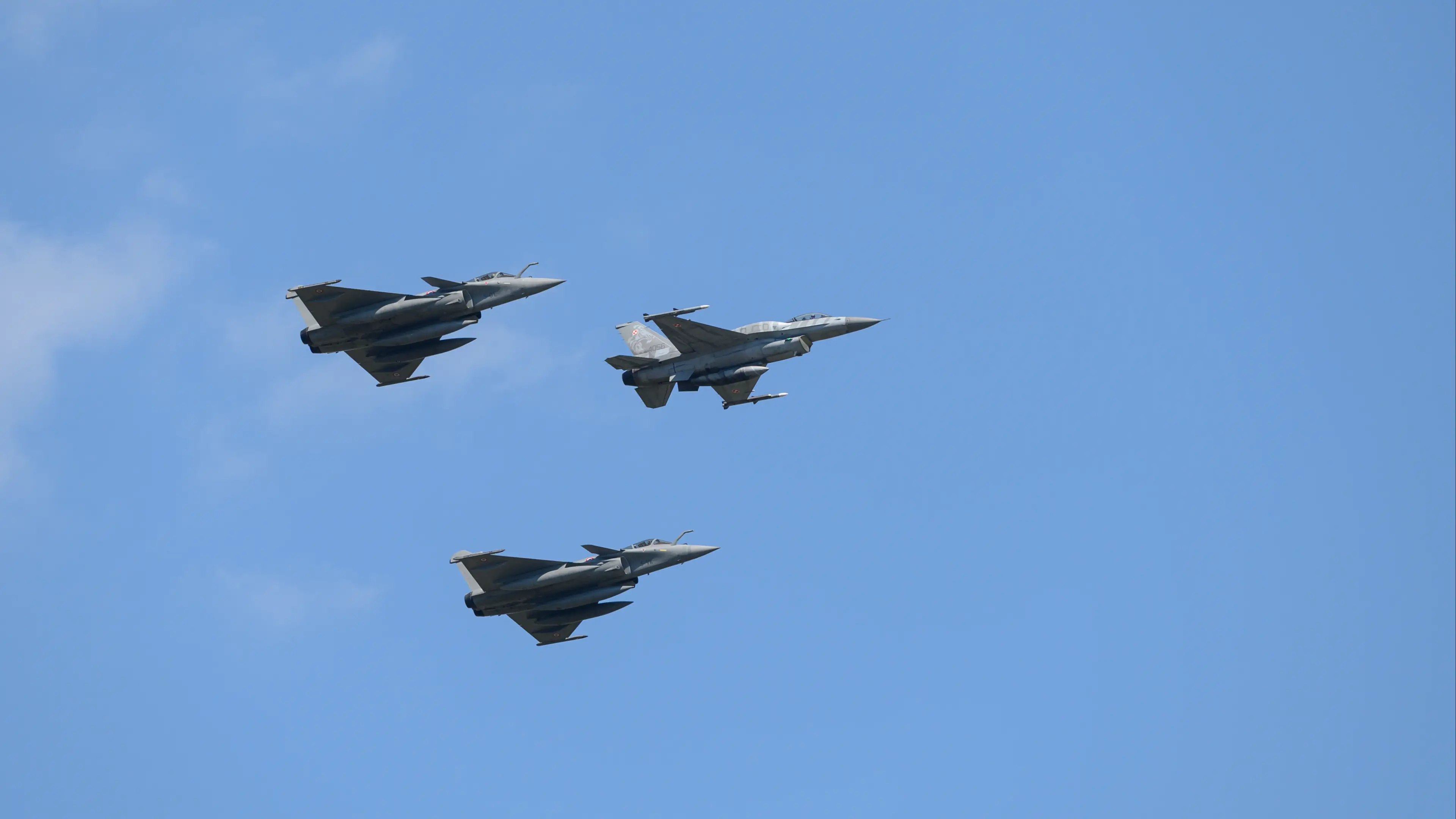
Fighter jets were deployed over the Baltic Sea to track and intercept formation of Russian aircraft earlier this week. The aircraft were flying over international waters, but close to NATO airspace, which triggered the interception response.
French Rafale jets, from NATO Baltic Air Policing, plus aircraft from Sweden, Finland, Poland, Denmark and Romania were involved with the mission on Monday.
The French Rafale fighters were deployed from an air base in Lithuania where they were stationed as part of a NATO air-policing effort that has lasted decades.
Advert
The Russian mission included two supersonic Tu-22M3s, and around 10 fighters, both SU-30s and SU-35s, that took turns escorting bigger strategic bombers.

According to a statement from the Russian Defense Ministry, escorting duties were rotated among accompanying aircraft as they supported the larger strategic bombers.
The Russian Defense Ministry said the long-range bombers’ flight had been pre-scheduled and took place over international waters in the Baltic Sea. The ministry added on Telegram that the mission lasted more than four hours.
"At certain stages of the route, the long-range bombers were accompanied by fighters of foreign states," the ministry said, per CBS News. "Crews of long-range aviation regularly conduct flights over the neutral waters of the Arctic, the North Atlantic, the Pacific Ocean, as well as the Baltic and Black Seas. All flights of Russian Aerospace Forces aircraft are carried out in strict compliance with international rules for the use of airspace."
The ministry has previously reported flights by its strategic bombers over the Baltic Sea, including in January, when NATO jets also responded, and at least four times last year, the publication reports.

NATO regularly scrambles fighter jets to intercept Russian military aircraft approaching or operating near its airspace. NATO says these aircraft often do not use transponders, communicate with air traffic control, or file flight plans, prompting identification missions by NATO jets.
Many Russian flights monitored by NATO’s Baltic Air Policing mission, set up in 2004 after Lithuania, Latvia and Estonia joined NATO, fly to and from Russia’s Kaliningrad exclave. Before the war in Ukraine, NATO was intercepting Russian aircraft around 300 times per year, mostly over waters near northern Europe.
The flight on Monday was one of several recent Russian military operations over and under the Baltic Sea. In recent years, there have also been multiple reported incidents of suspected Russian sabotage involving underwater cables in the region.
Topics: World News, Russia
 Greg Harris