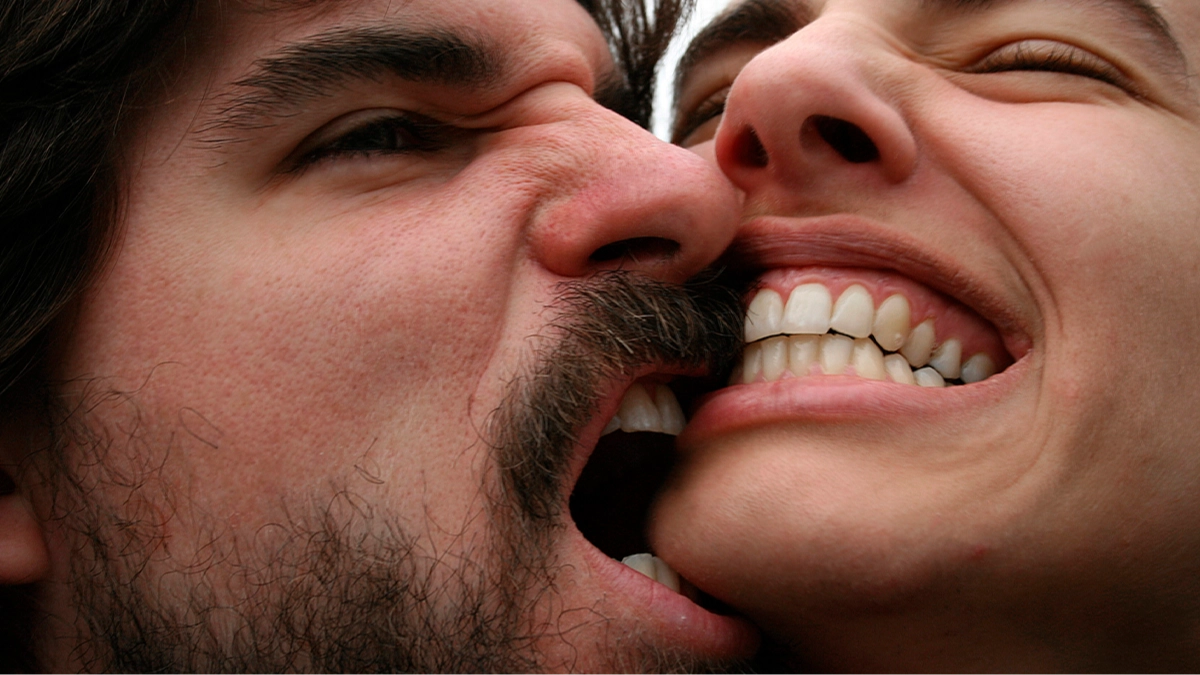
Study explains why the urge to 'bite or squeeze' your partner to death is completely 'normal'

Scientists have been studying the weird phenomenon of wanting to bite or squeeze something to death because they cause you so much joy.
In case you are new to the human experience, emotions can be pretty complicated, and acting on them can only make things even more messy.
But that is, essentially what makes us human.
With that said, there is a phenomenon which would likely raise some eyebrows if it was acted upon, but you likely have heard someone express it, even as joke.
Advert
The feeling of something being so cute or amazing you just want to bite them, or pinch them, or squeeze them, even to death....
sounds pretty bizarre, but there is actually a scientific explanation for it, and experts have weighed in and insisted this doesn’t mean you're a psychopath.
According to social psychologist and assistant professor of marketing at the University of Cincinnati Oriana Aragon, PHD, these can actually be signals of intense love, and are colloquially known as ‘cute aggression’.

Speaking to Phys.org, Aragon explained she has spent over a decade researching what is known as 'dimorphous expressions'.
She said: “Those strong feelings are welling up in us, and we are displaying something that's the opposite of care and affection.
“We're biting and pinching and doing things that on the surface are associated with aggression."
A 2021 study she conducted found that more than 75 tears of joy at some point in their life as an example of this phenomenon. Other expression, while more rare, are still considered normal, even those that may come across as aggressive.
She noted that the desires to bite, pinch, punch and squeeze something cute might seem aggressive the individual has no actual desire to cause harm.
She added: “When people do them, they seem to do more than one.
“And some people don't do them at all. The person who cries at a wedding is more likely to be the person who pinches the baby's cheeks and also more likely to be the person who would playfully bite a lover."

Interestingly, the expert also noted that people across the word, regardless of gender and age showcase dimorphous expressions. However she did explain that societal norms may influence how someone acts on this feeling.
She also added that some people will actively make efforts to ensure their emotions are not being misinterpreted by their eyebrow-raising behavior.
Aragon said: “I know from my work with tears of joy, people who do a dimorphous expression who are around others who don't or who are not dimorphously expressing will actually explicitly say, 'These are happy tears. These are happy tears.
“They try to make sure it's very clear that it's not intended to be the negative thing that's showing.”
Topics: Health, News, Sex and Relationships, US News, Psychology, Science, Mental Health
 Gerrard Kaonga