
Scientists detail 'Armageddon' style plan to stop Doomsday asteroid capable of destroying Earth

Chinese scientists have detailed an 'Armageddon' style plan involving nuclear bombs to stop a 'Doomsday' asteroid which is capable of destroying the Earth.
It might not be the most orthodox plan we've ever heard, but researchers believe it could potentially one day save the planet.
And it comes as NASA scientists warn that up to 15,000 several-hundred-foot-wide asteroids could be lurking undetected, despite being large enough to wipe out entire cities.
The unconventional plan is as follows: destroy the asteroid with a nuclear blast equivalent to multiple Hiroshima bombs.
Advert
Sounds straight-forward, right?
The study states: "Mitigating the risk of near-Earth asteroid (NEA) impacts is critical to global security and the survival of human civilization.
"In particular, large NEAs with short warning times pose a devastating threat to humanity."
The researchers write that 'directly destroying or rapidly deflecting' the threat is seemingly the 'only feasible method' to defending planet earth, in extreme cases.
"Asteroid impacts on Earth have occurred several times in human history, causing catastrophic environmental changes and mass extinctions," the authors added.
"It is one of the major potential threats that could lead to human destruction and has therefore become a hot topic of concern in the international community."
And with warning times ranging from days to weeks, there's really no time to be wasting.
What is it that scientists have actually proposed?
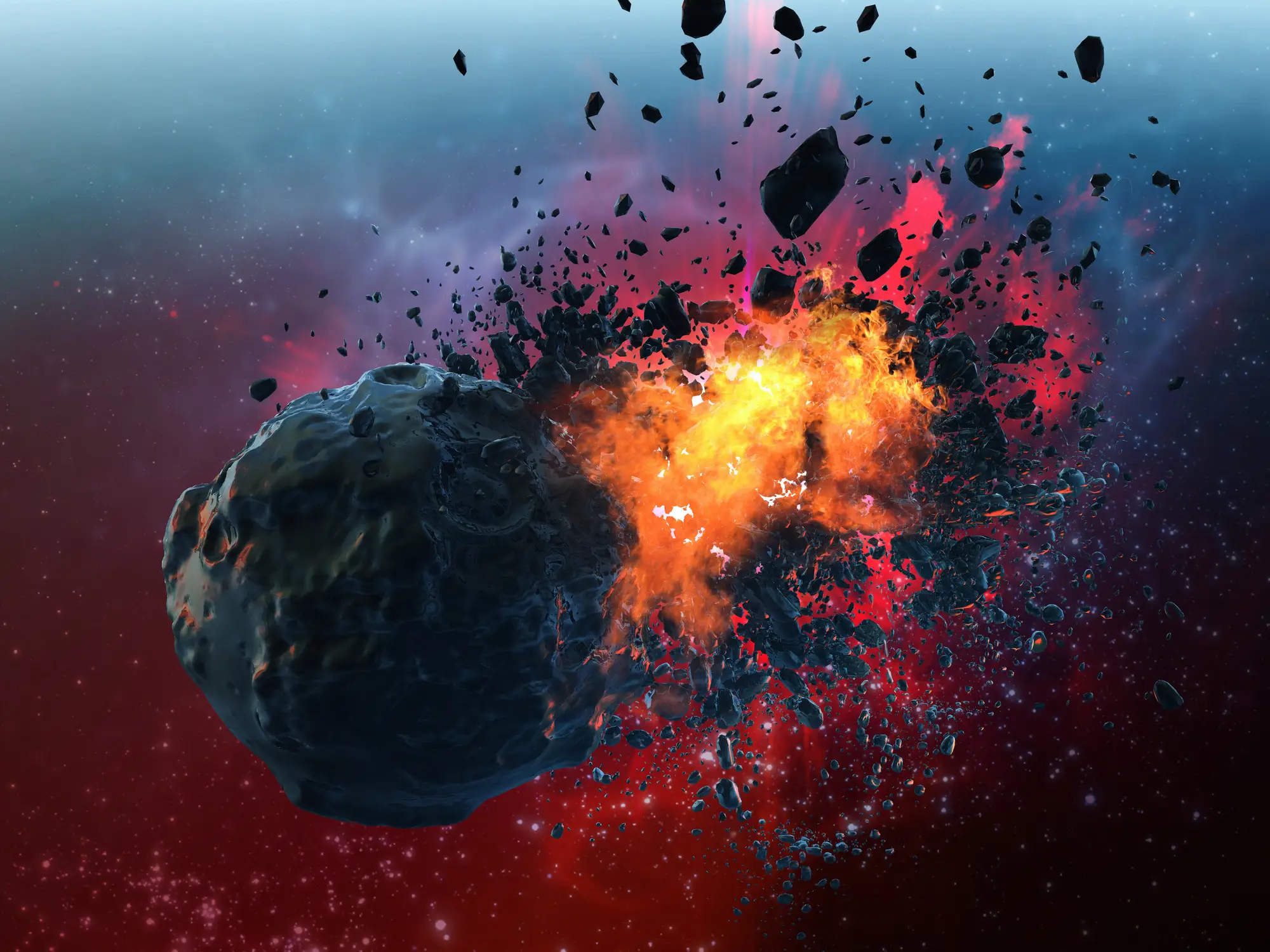
In the study, which involved the extensive use of simulations, researchers used a (virtual) nuclear bomb to destroy an asteroid before it reached Earth.
Rather than detonating the weapon nearby, the idea is to place it inside the asteroid so the explosion breaks it apart from within.
To test the theory, the team used computer simulations of asteroids heading towards Earth at around six miles per second.
They found that a 300-kiloton nuclear blast could completely destroy an asteroid measuring around 164 feet (50 metres) across, while a much larger 3-megaton explosion could break apart one measuring about 328 feet (100 metres) across.
"The defense against asteroid impacts on Earth has always been one of the major challenges in international astronautics," the scientists added.
"Carrying out research on NEA defense is an inevitable choice for humanity to protect its survival and development."
But it's not quite as fool-proof as it sounds.
What issues could scientists face?
The mission's real-life success would require the researchers to detect the threat early enough to execute the mission before it smashed into our homes on Earth.
But there's another problem - it would also require them to design a vehicle that is capable of carrying a drilling device and nuclear device that deep into space.
Nevertheless, the scientists hoped that their new-found theory 'holds profound strategic significance for enhancing humanity’s capability to respond to asteroid impact threats'.
 Mia Williams