
Disturbing discovery suggests Amelia Earhart could have survived her crash 88 years ago

One of the most enduring mysteries of the 20th century, other than the assassination of JFK and the disappearance of hijacker DB Cooper, has to be what happened to world-famous aviator Amelia Earhart.
In the 88 years since she and navigator Fred Noonan vanished while attempting to circumnavigate the globe, millions have been spent trying to figure out where their plane, 'Electra', ended up.
The accepted story after they failed to land on Howland Island in the Pacific six weeks and 20,000 miles into their journey on July 2, 1937, was that the pair had crashed into the sea after a series of technical and communication failures left them unable to locate the tiny remote sliver of an island.
Attempts to locate the Electra's wreckage in the miles of ocean surrounding Howland in the aftermath and in the decades since have failed to turn up any remnant of Earhart's plane and crew, but oceanographer Robert Ballard made a discovery in 2019 that suggested the aviator may have survived the crash.
Advert

Retired Navy offical Ballard is not just any oceanographer either, he probably holds the claim of being the most accomplished person in his field.
Over the years he has claimed responsibility for discovering the wreck of the Titanic, the battleship Bismarck, and the sunken USS Yorktown. And those are probably his smallest contributions to human history, as he is also the person who discovered the existence of deep sea geothermal vents.
Ballard explored one of the likelier alternative theories for what happened to the Electra on its way to Howland, that the pair set down on a coral reef roughly 350 miles southeast of their intended destination.
This spit of land, called Nikumaroro, has long been held as one of the places Earhart and/or Noonan could have made it to as their plane ran out of fuel.
Several disputed reports indicate distress calls coming from this part of the Pacific in the days after the crash, however some have dismissed these as a potential hoax due to the worldwide attention that Earhart's disappearance garnered.
While Ballard was searching for plane wreckage in the sea surrounding Nikumaroro, a team from National Geographic searched the island for any signs that the aviator or her plane ended up their almost nine decades ago.
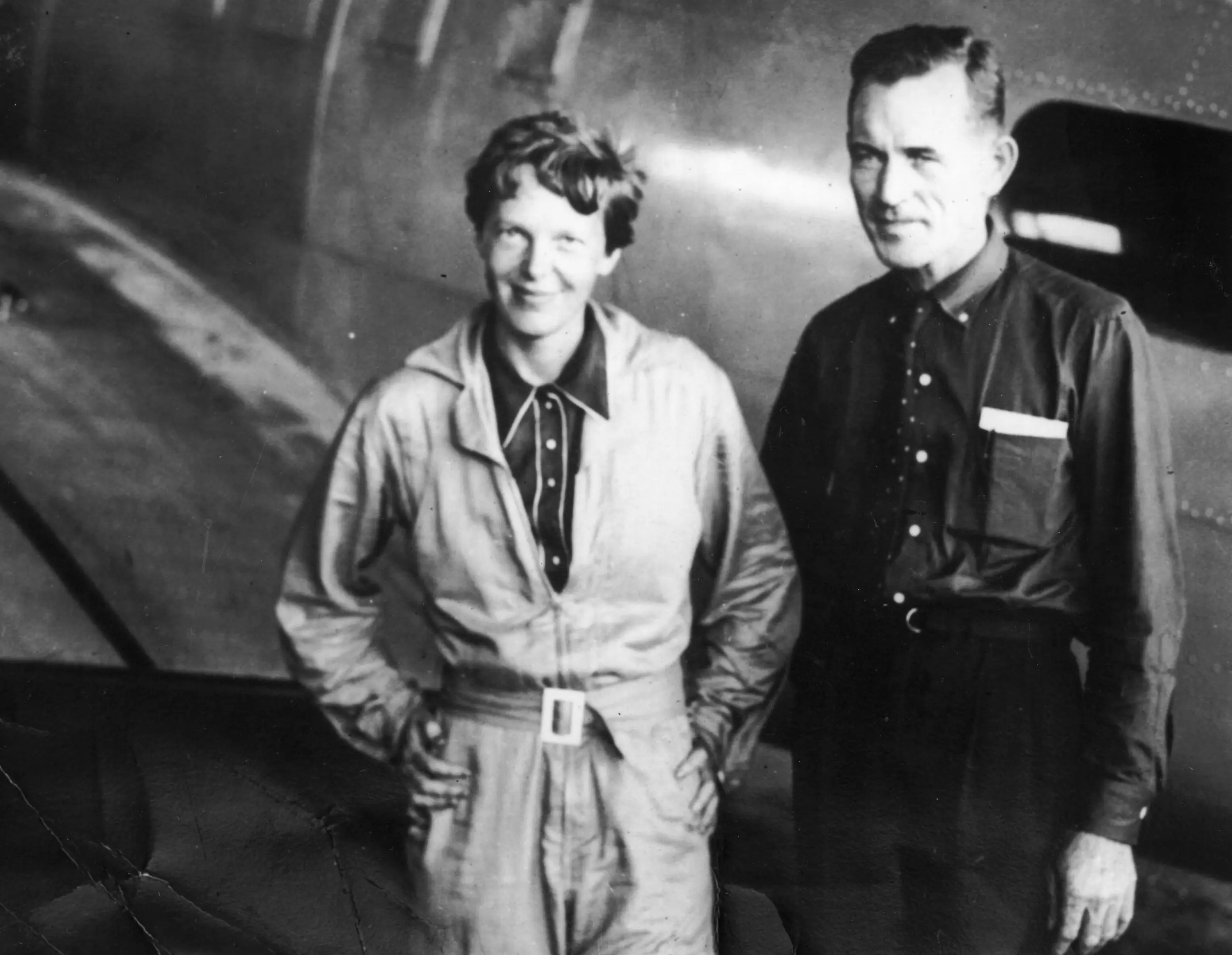
They were investigating a theory that started in 1940, when a group of Brits stumbled across 13 bones on the island, including a skull, which they believed could have belonged to the missing aviator.
What happened to the rest of the bones in her body became quickly apparent when they observed the behaviour of the island's large coconut crabs. After leaving a pig for the crustaceans to tear apart, they saw them moving bones as far as 60 feet away.
So, they theorized that, if Earhart had survived the crash and made it to Nikumaroro, her body may have been picked apart by crabs and scattered or lost to the sea.
However, Ballard was unable to locate any evidence of the Electra in the waters surrounding the small reef island, and the bones found by the Brits had long since been moved, making it impossible to prove the National Geographic theory.
Indeed, when the publication's archaeologist Frank Hiebert tracked down a fragment he believed belonged to the skull found on the island in 1940, despite finding out that it belonged to an adult female, the results were disappointing.
Instead of being Earhart, analysis suggested that the skull belonged to a Polynesian woman who had died on the remote reef over 1000 years ago. Proving, at least, that if Earhart had landed on Nikumaroro, she likely met an unpleasant end.
Topics: History, Conspiracy Theories
 William Morgan