
Personal trainer shows stark difference between 2,500 'good' calories and the opposite

A personal trainer and influencer has gone viral for comparing two very different 2,500 calorie meals in a bid to support people in their approach to living their healthiest lives.
We've all long been fed the narrative that in order to be healthy, lose weight or feel our best, we should reduce how much we eat. However, that's far from always the case.
More often than not, in fact, it's more about looking more closely at what we're eating, even sometimes eating more, but ensuring it's the right sort of food which is actually going to maintain and improve our energy levels, prevent us feeling bloated and actually fuel us - combined with regular exercise and water and all that good stuff, of course.
And a personal trainer called Leyon has taken to social media to clear up some common myths when it comes to living our healthiest lives, particularly when it comes to calorie counting.
Advert
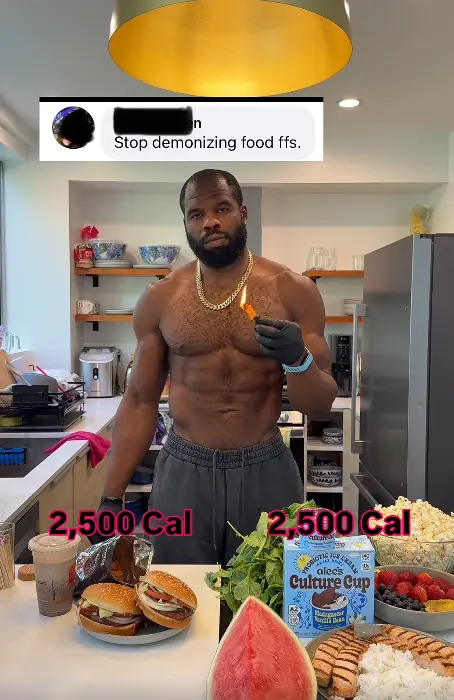
Indeed, in one of his videos which has gone viral, Leyon uses tape down the middle of a table to compare two different '2,500 calories' diets.
When it comes to calorie counting, Leyon notes: "Yes… a caloric deficit helps you lose weight. And that’s great. But what about the muscle you’re trying to keep… or even build?"
What was on Leyon's 'real food' list?
- Salmon and rice
- Fruit, including strawberries and blueberries
- Probiotic ice cream
- Watermelon
- Popcorn
- Salad
What was on Leyon's 'not-so-good' list?
- Two burgers
- A bag of chips
- A drink
However, Leyon is quick to note he's 'not demonizing food' and loves the odd burger here and there.
Instead, he compares the difference when you 'make them homemade with real ingredients' rather than buying them from fast food chains.
He explains eating a 'potato with salt and spices instead of the factory-made, chemically processed potato chip' and a 'homemade burger instead of an ultra-processed one' will ultimately help 'fuel' your body and is food that is 'high volume' with 'better macros' and 'higher protein' with 'carbs that actually fuel you'.
This means you feel fuller for longer, have 'steady energy,' and your body can actually 'perform' and 'recover'.
In comparison, the more processed side is 'low volume,' 'easy to eat,' 'calorie-dense' and with 'poor macros', which can leave you feeling 'sluggish,' 'bloated' with 'energy crashes' and 'right back looking for more'.
Ultimately, you can eat higher quantities of the healthier side too.
Leyon explains 'overall macros matter' when it comes to dieting, rather than simply thinking you can eat less calories of more processed foods and get the same results.
He reflects: "That’s how people stay stuck eating 2,500 but getting completely different results."
Leyon encourages: "Eat more food. Just make it real food."
And it's not just Leyon promoting trying to eat less ultra-processed foods either.
The USDA's Dietary Guidelines for Americans for 2025-2030 forefronts one key message: "Eat real food."
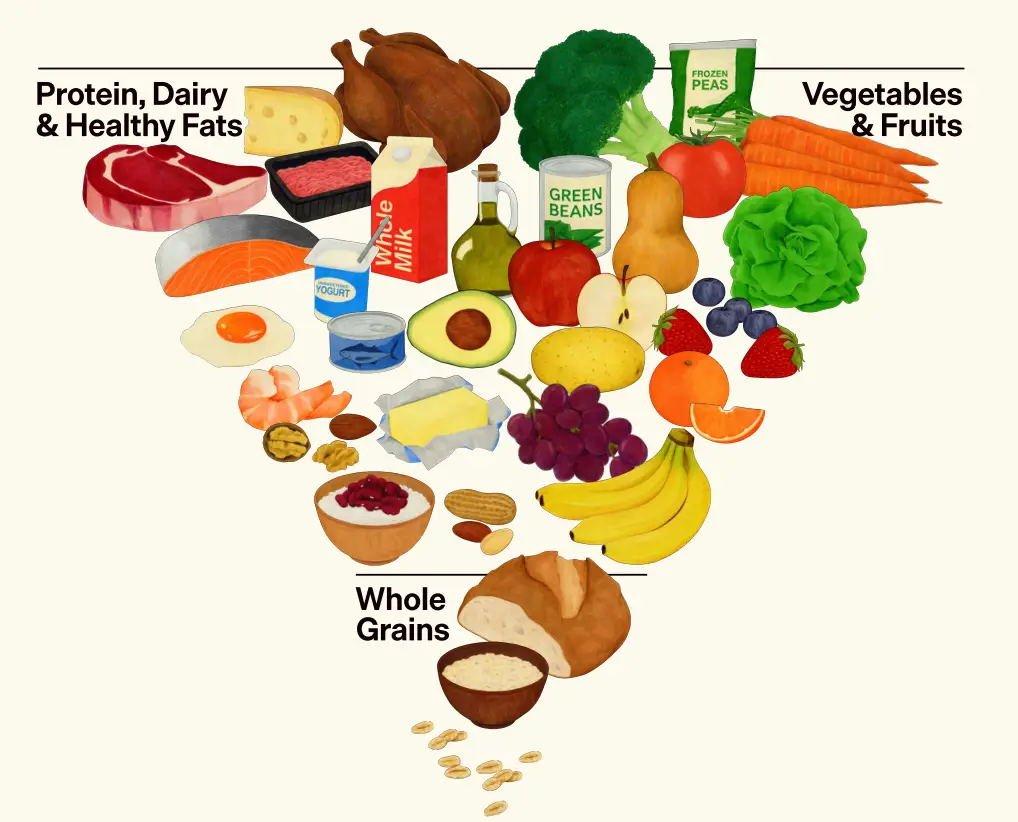
It states: "To Make America Healthy Again, we must return to the basics. American households must prioritize diets built on whole, nutrient-dense foods—protein, dairy, vegetables, fruits, healthy fats, and whole grains.
"[...] The United States is amid a health emergency. Nearly 90 percent of health care spending goes to treating people who have chronic diseases.1 Many of these illnesses are not genetic destiny; they are the predictable result of the Standard American Diet—a diet which, over time, has become reliant on highly processed foods and coupled with a sedentary lifestyle."
Mirroring what Leyon says, it adds: "We are putting real food back at the center of the American diet. Real food that nourishes the body. Real food that restores health. Real food that fuels energy and encourages movement and exercise. Real food that builds strength."
Despite being in support of Leyon's approach and breakdown, some social media users have pointed out that the different sides may come with quite different price points.
Leyon's advice, 'meal prep'.
Hey, we can only try our best, eh?
Topics: Health, Food and Drink
 Poppy Bilderbeck