
Doctor issues key advice to anyone considering getting 'dark mode' tattoo like MGK

Machine Gun Kelly's dramatic full-body blackout tattoo send the internet into a frenzy, but before you book your own appointment, a clinical expert is urging people to stop and ask yourself one question.
The 'dark mode' look, more technically known as a blackout tattoo, involved saturating large sections of skin in solid, opaque black ink.
Entire limbs, torsos or other areas are completely covered, sometimes with negative space left deliberately to create geometric or abstract patterns.
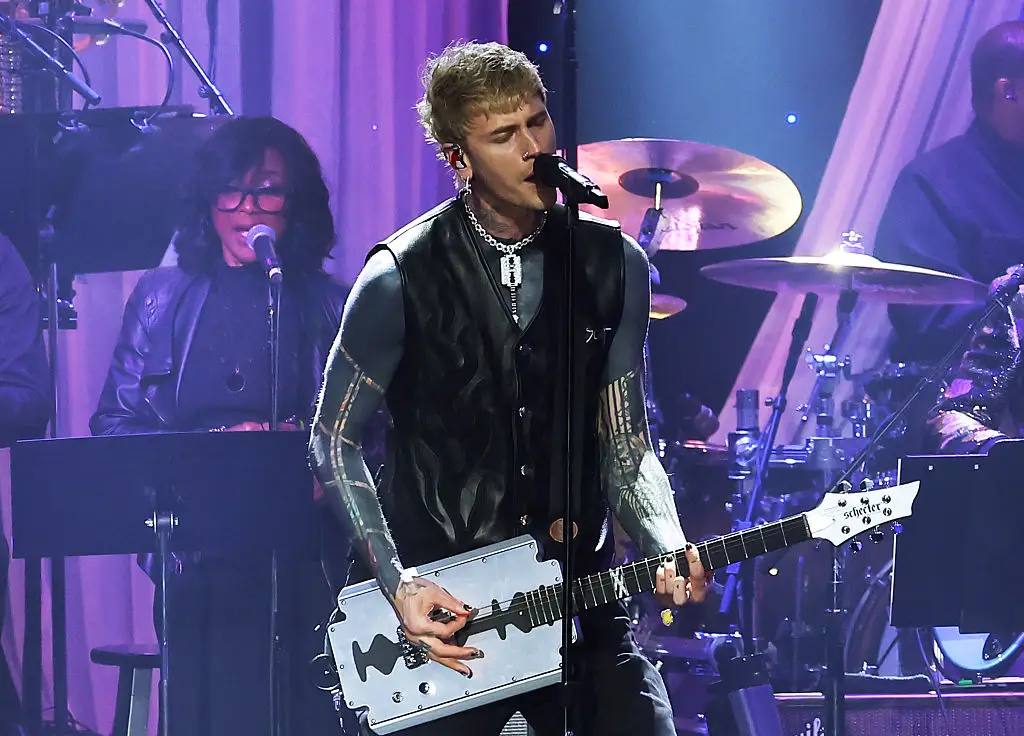
MGK made the style impossible to ignore when he debuted his heavily blacked-out body art, sparking a wave of interest in the look across social media.
Advert

But Dr. Caitlin Artiaga, PhD, LMFT, Clinical Director at Blume Behavioral Health, says the decision deserves a lot more thought than most people give it.
Before diving into the psychology, it's worth understanding what you're actually signing up for.
A blackout tattoo, also called a 'dark mode' tattoo, is not the same as standard dark-themed ink. While 'dark art' tattoos cover horror, gothic or occult imagery, and 'blackwork' uses black ink for intricate geometric line work or tribal designs, a true blackout piece means entire panels of skin completely filled with dense, opaque, black.
The appeal is varied. Some people use it as an extreme cover-up method, black ink being highly opaque makes it one of the most effective ways to hide old, unwanted, or poorly executed tattoos.
Others opt for it as an aesthetic statement, or as a form of spiritual rebranding, wiping the visual state clean. Some even use a fully healed blackout area as a dramatic backdrop for white ink or scarification work laid on top.

The doctor's warning you need to hear
Dr. Artiaga's advice cuts to the heart of what's really going on when someone feels the pull toward radical physical transformation.
"Take a moment to think about why you're changing," she says. "This isn't a challenge but a direct invitation to clarify your current purpose by understanding what motivates you to do this."
She points to MGK himself as an example of a legitimate, and very human, impulse.
The musician has spoken openly about looking in the mirror and no longer recognising himself, feeling the need for outward change that reflected an internal shift he'd already undergone. According to Dr. Artiaga, that kind of grounded, intentional motivation is very different from transformation driven by a desire to escape something.
"When transformation is driven from the outside, there is never a timeline that will feel quick enough, nor will there ever be an ending experience that provides you with the relief you are looking for," she explains.
Her advice isn't to avoid the tattoo, it's to do the emotional work alongside the physical change, not instead of it.
A therapist or counsellor, she says, can play a genuinely supportive role in helping you understand what you're carrying into the process.
On a purely practical level, her warning is equally stark. Blackout tattoos require deep, repeated needle passes over the same skin, making them significantly more painful than traditional work. Removal is extraordinarily difficult, laser treatment is expensive, rarely fully effective, and can take years. The healing process alone is intense enough that professionals strongly recommend spreading sessions across months or even years to avoid scarring.
"The person who is warning you to slow down and think about what you want before you start is not your adversary," Dr. Artiaga says. "They are your ally."
Topics: Machine Gun Kelly, Mental Health
 Thomas Bamford