
Doctor reveals the main things people misunderstand about sepsis after Kyle Busch dies aged 41

There are few better examples of the rapid onset and fatal danger of sepsis infections than the tragic death of NASCAR legend Kyle Busch.
The 41-year-old's passing on May 21 has shocked his competitors and fans alike, with many seeing the two-time NASCAR Cup Series champion in the week before his sudden demise, after a bout of severe pneumonia developed into a deadly infection.
The legendary speedster had even won a race less than a fortnight before, pipping other competitors to the finish line at the 2026 Ecosave 200. But just two weeks later, he had died from an unexpected sepsis reaction.
With lots of racing fans expressing disbelief at the abrupt loss of one of the sport's all-time greats, a doctor has spoken out about how a simple pneumonia infection could lead to the star's death.
Advert

"Sepsis is more common and more unpredictable than most people realize," Dr Jamin Brahmbhatt wrote for CNN after Busch's passing reminded people about the very real dangers of sepsis, which many may have heard of but few will understand.
He explained that rather than being an infection like pneumonia, sepsis is actually the 'body’s extreme response' to these sorts of infections. But sometimes the body's attempt at a cure can be worse than the disease itself.
Dr Brahmbhatt said: "Pneumonia isn’t the only infection that can lead to sepsis. A skin infection that keeps spreading and raises your heart rate. A urinary tract infection that suddenly lowers your blood pressure.
"An infected kidney stone that raises your temperature – these are not just infections anymore. They could be sepsis."
Sepsis is one of the leading causes of death in hospitals across the US, contributing to over a third of deaths in hospital.
The CDC says that 1.7 million Americans develop the dangerous condition every year and around 350,000 people die from it.

But although this over-the-top immune system response to infection remains a major killer, 'many people still do not recognize the symptoms or realize that common infections can trigger it', the doctor said.
And this is just one of a number of misconceptions that people commonly hold about sepsis.
"Many people think of infections as staying in one part of the body," Dr Brahmbhatt added, explaining that, when sepsis begins to set in, it can 'become much larger than the original infection'.
He continued: "Sepsis is like a kitchen fire that triggers sprinklers throughout an entire building. The original problem may start in one area, but suddenly the emergency response spreads much farther than intended or needed.
"The body is trying to contain the threat. But in some situations, the inflammatory response becomes wide enough that blood pressure falls, oxygen levels suffer and organs begin to fail.
"That is what makes sepsis dangerous. The infection matters, but the body’s response matters just as much, if not more."
The doctor also explained how an otherwise fit and healthy 41-year-old could seemingly deteriorate so rapidly, with no apparent complications.
"Most sepsis cases happen in people with at least one risk factor – older adults, infants, people with chronic conditions like diabetes or cancer, weak immune systems, or anyone recently hospitalized or recovering from surgery," he explained.
Dr Brahmbhatt added that the CDC estimates 'about one in five sepsis hospitalizations are cancer related', with a number of underlying conditions having the potential to cause someone's condition to suddenly decline.
He added: "That is why it is hard to look at public accounts involving sepsis and automatically assume someone waited too long, ignored symptoms or received the wrong care. Those situations do happen. But sepsis can also develop despite timely evaluation and treatment."
What are the symptoms of sepsis?
According to the Mayo Clinic, symptoms of sepsis can include:
- Change in mental status
- Fast, shallow breathing
- Unexplained sweating
- Feeling lightheaded
- Shivering
- Experiencing symptoms specific to the type of infection, for example, painful urination from a urinary tract infection or cough that's got worse from pneumonia.
However, the site notes: "Symptoms of sepsis are not specific. They can vary from person to person, and sepsis may appear differently in children than in adults."
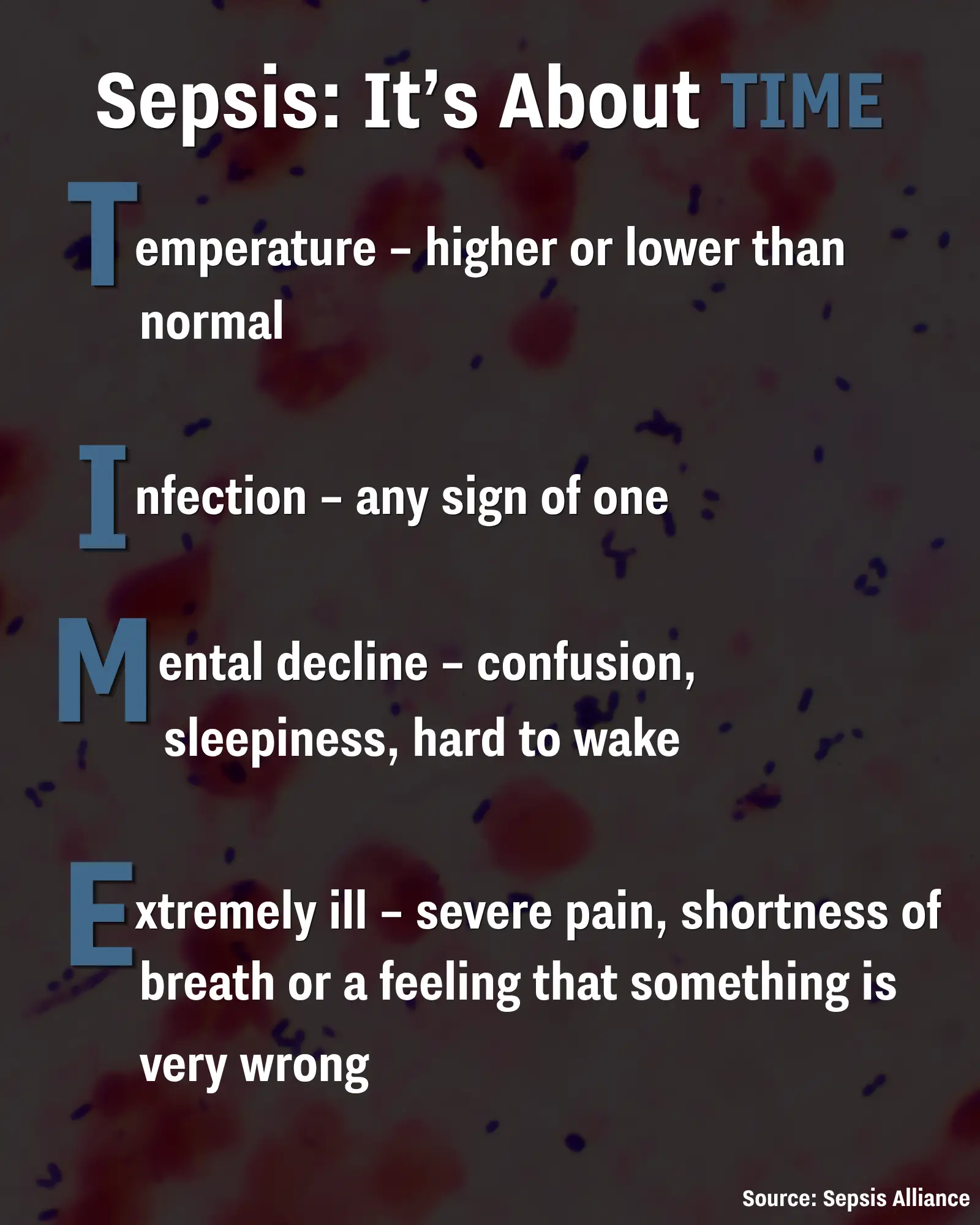
Meanwhile, the Sepsis Alliance, has urged the public to remember the 'TIME' acronym.
To avoid becoming one of the hundreds of thousands who die from sudden sepsis every year, anyone with an infection who becomes confused should immediately seek medical attention.
 William Morgan