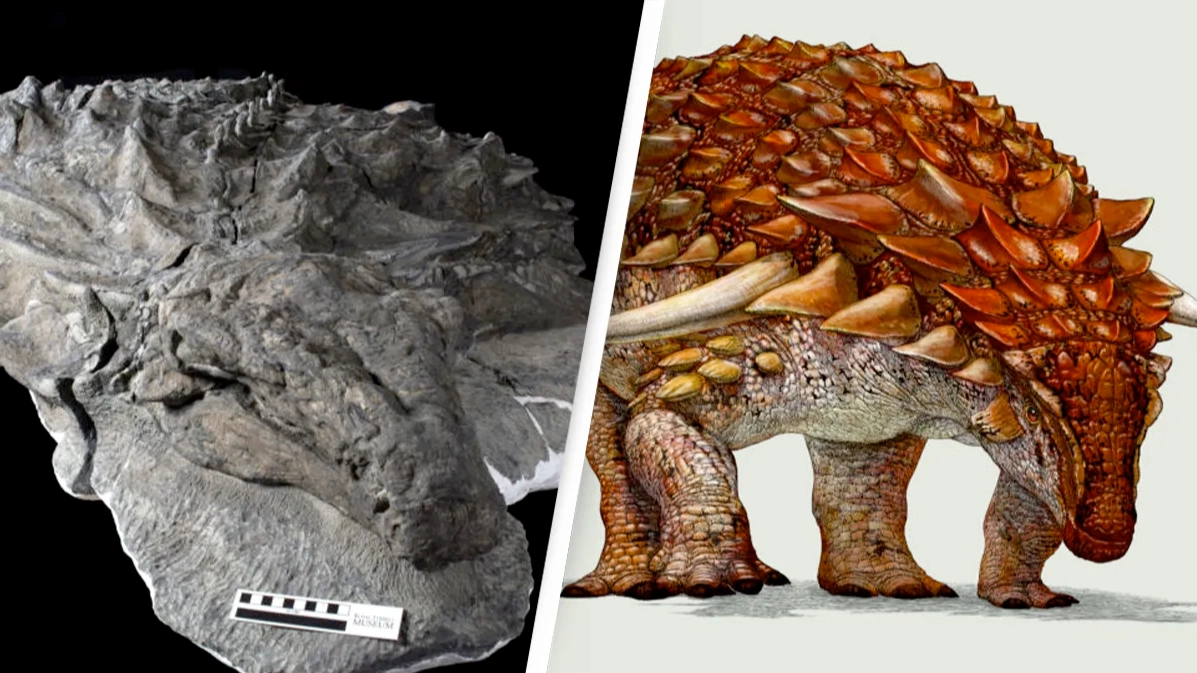
Scientists found a dinosaur with skin on its face still intact

Scientists have made a freak discovery that's potentially brought us closer to dinosaurs than we've ever been before.
Archaeologists uncovered one of the most well-preserved dinosaur fossils - so preserved that its very skin was still intact after all these years.
Talk about a good skincare routine, the discovery is now being hailed as a 'one-in-a-billion' find.
Advert
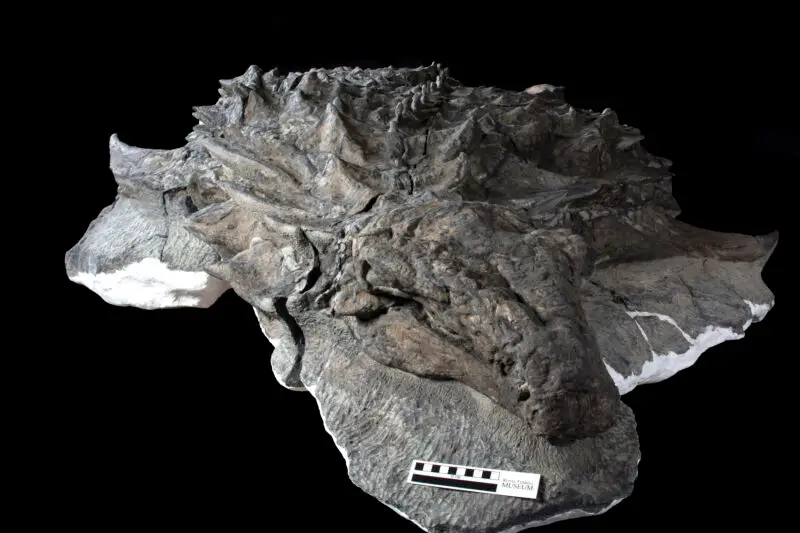
Scientists first discovered the groundbreaking dinosaur remains back in 2011.
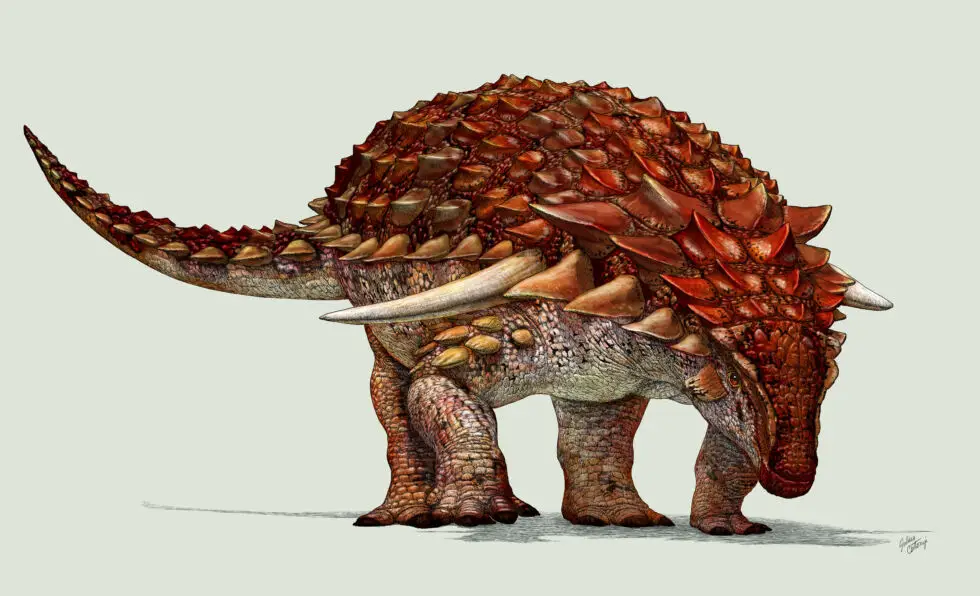
The miraculous find was a pretty much whole ankylosaur, with its jagged spikes, most of its limbs, armor coating, and even some of its stomach contents surviving a gruelling fossilization process.
The best addition of the discovery, though? The creature's near-immaculately preserved face and skin.
Known by its fancy Latin name as 'Borealopelta markmitchelli' - the nodosaur, a type of four-legged ankylosaur, has been dubbed the 'the world’s best-preserved armoured dinosaur'.
From way back when in the 'Early Cretaceous' period, these nodosaur remains date back anywhere between up to 145 and 100.5 million years ago.
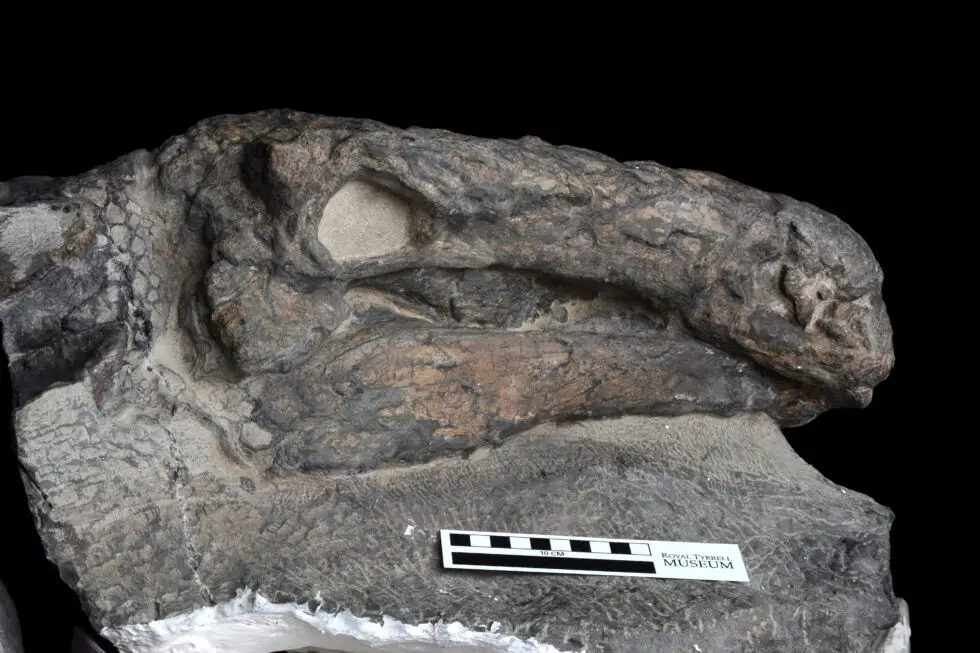
Dr. Donald Henderson, curator of dinosaurs at the Royal Tyrrell Museum of Palaeontology, has called the dino discovery 'one-in-a-billion find'.
Not only is its preservation remarkable, but the fossil has now become an important key to unlock the history of the Early Cretaceous ecology.
The preserved skin can be studied by archeologists to understand how the species may have lived within its environment.
Scientists have since studied the nodosaur's anatomy, gut contents and armor - giving them a whole new insight into the animal.
The fossil was found in an ancient marine environment which came as a complete surprise to researchers as the four-legged creature was a land-dweller.
Henderson explained to Ars Technica a little more about the bizarre, and very unexpected, find.
He said: "We can see it went in water deeper than 50 meters because it was preserved with a particular mineral called glauconite, which is a green phosphate mineral.
"And it only forms in cooler temperatures in water deeper than 50 meters."
Effectively, the dinosaur endured some very intense 'bloat-and-float' as it was most likely carried from a river to a sea after some flooding and with a build up of post-mortem gasses - the carcass remained buoyant.
Once the gasses were all out, the body simply sank to the bottom of the ocean floor - in totally pristine condition after its heavy armor stopped marine scavengers from taking a bite.
Henderson added: "It was just a nice set of conditions in the seabed that had very low biological activity that led to that preservation."
Senior preparation technician, Mark Mitchell, spent seven hours per day over five and a half years separating the fossil from the stone it was encased within.
Mitchell revealed the humungous task took him a staggering '7,000 hours'.
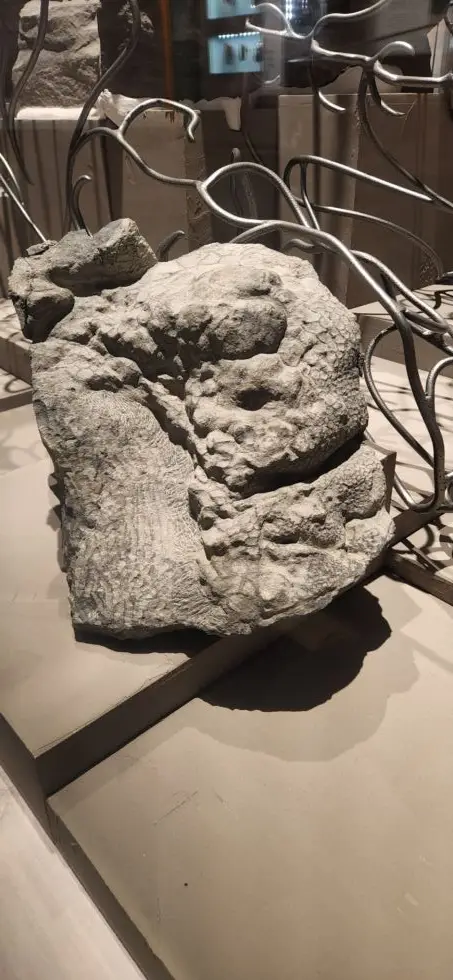
"You could really appreciate the impressiveness of the specimen and that this was a living creature with astounding preservation," he recalled.
One of the biggest takeaways from the discovery lay within the purpose behind the dinosaur's distinctive back spikes.
Such spikes, they found, were not actually meant to ward off potential predators, but were actual used as a flirting tool to show off and attract mates.
While more research needs to be done - it's clear that this discovery has definitely brought archeologists one step closer to unlocking the secrets of the ancient world that predates us.
Talk about something being set in stone.
 Rhiannon Ingle