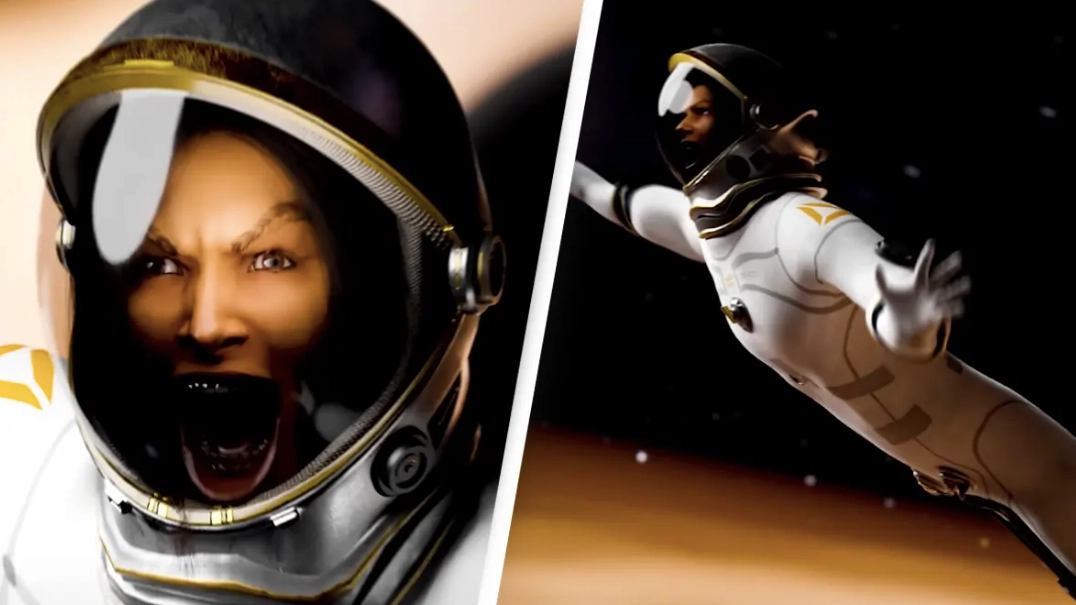
Chilling simulation shows what would happen to our bodies if we fell into a black hole

Falling into a black hole is hopefully something none of us will ever experience, but for people with an interest in the macabre, you’ll want to check out this simulation.
Firstly, what is a black hole? Despite its name, a black hole is not a hole. The term ‘hole’ is used because whatever has the misfortune of falling into one is trapped forever.
Instead of being holes, they’re 'huge concentrations of matter packed into very tiny spaces,' NASA explains, adding that a black hole has gravity just beneath its surface known as the event horizon.
This region is where, 'the pulling force of gravity is so strong that light is not able to escape'. The space agency also notes that, 'the event horizon isn’t a surface like Earth’s or even the Sun’s. It’s a boundary that contains all the matter that makes up the black hole.'
Although there’s still a lot to learn about black holes, scientists have learned about some of their scary properties.
Advert
And now, a YouTube content creator has made a simulation about the (hopefully) unlikely event of someone falling into a black hole.
The simulation was created by Zack D. Films, who often ponders the weirdest circumstances for his videos for viewers with a morbid curiosity. We’re talking about “Being Put Inside A Food Dehydrator” and “How To Survive Falling Off A Skyscraper”.
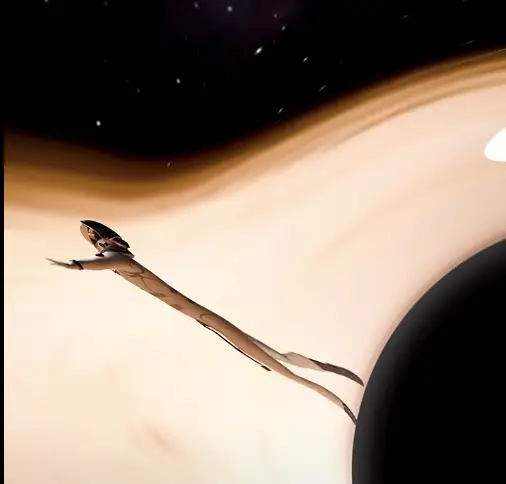
As you can probably imagine by this point, falling into a black hole would be terrifying. "If you fell into a black hole, the gravitational pull would stretch you out in a process called spaghettification," he narrates at the beginning of the video, which has over 12m views.
"As you get closer, the gravity at your feet would be much stronger than at your head, pulling you longer and thinner.
"Eventually, you'd pass the event horizon. At this point, time would appear to slow down for an outside observer, but for you, time might seem to speed up.
"Finally, you'd be crushed by the immense gravity, merging with the singularity at the black hole centre, lost forever in its depths."
Previously, an expert at NASA shared what it might look like to fall into a black hole.
Astrophysicist Jeremy Schnittman at NASA’s Goddard Space Flight Center worked on a different video about this scary situation. It shows what it might look like when someone passes the black hole's event horizon.
This is effectively the point of no return, where the gravitational pull of the black hole becomes too strong for their to be any hope of escape.
Schnittman spoke about the video, explaining why he decided to make it.
He said: “People often ask about this, and simulating these difficult-to-imagine processes helps me connect the mathematics of relativity to actual consequences in the real universe."
He explained: "I simulated two different scenarios, one where a camera — a stand-in for a daring astronaut — just misses the event horizon and slingshots back out, and one where it crosses the boundary, sealing its fate.”
 Greg Harris