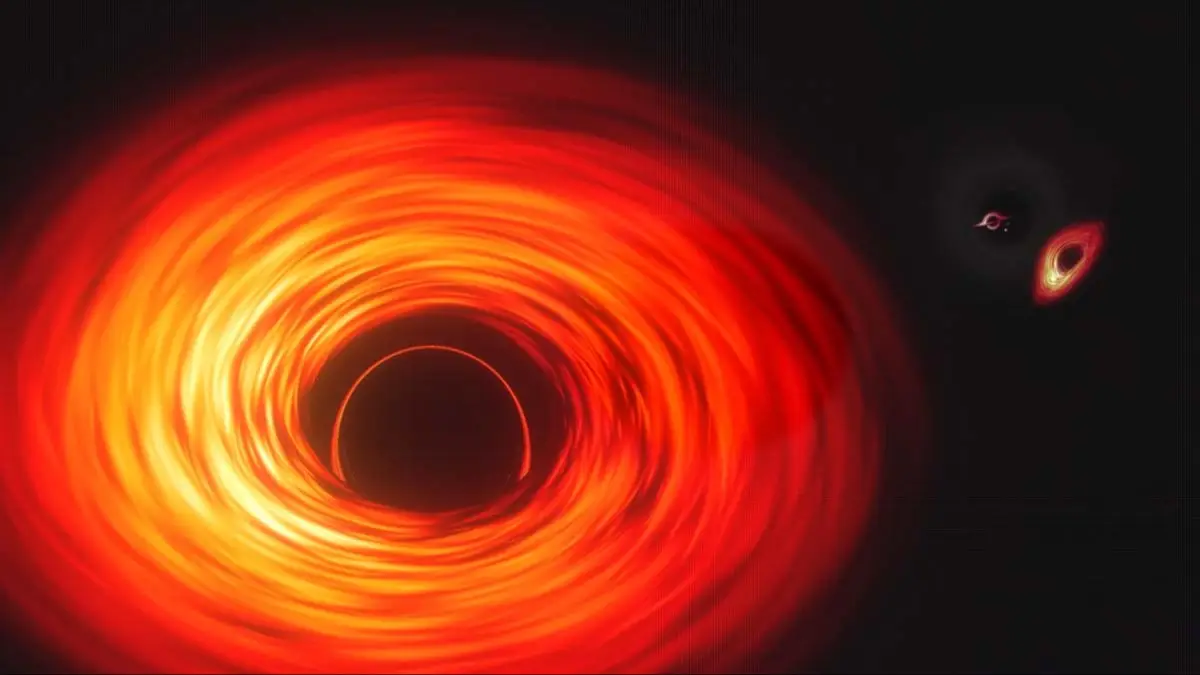
Terrifying NASA simulation reveals biggest known black holes and the largest could devour our galaxy

A NASA animation has sized the biggest black holes known to scientists, revealing the 'super' scale of supermassive black holes, including one that has the mass of 66 billion Suns.
Originally released in 2023, the animated clip aims to give us an idea of what kind of size we're talking about when we're discussing black holes, as in big space regions existing in the centers of most big galaxies, including our own Milky Way, and containing between 100,000 and tens of billions of times more mass than our Sun.
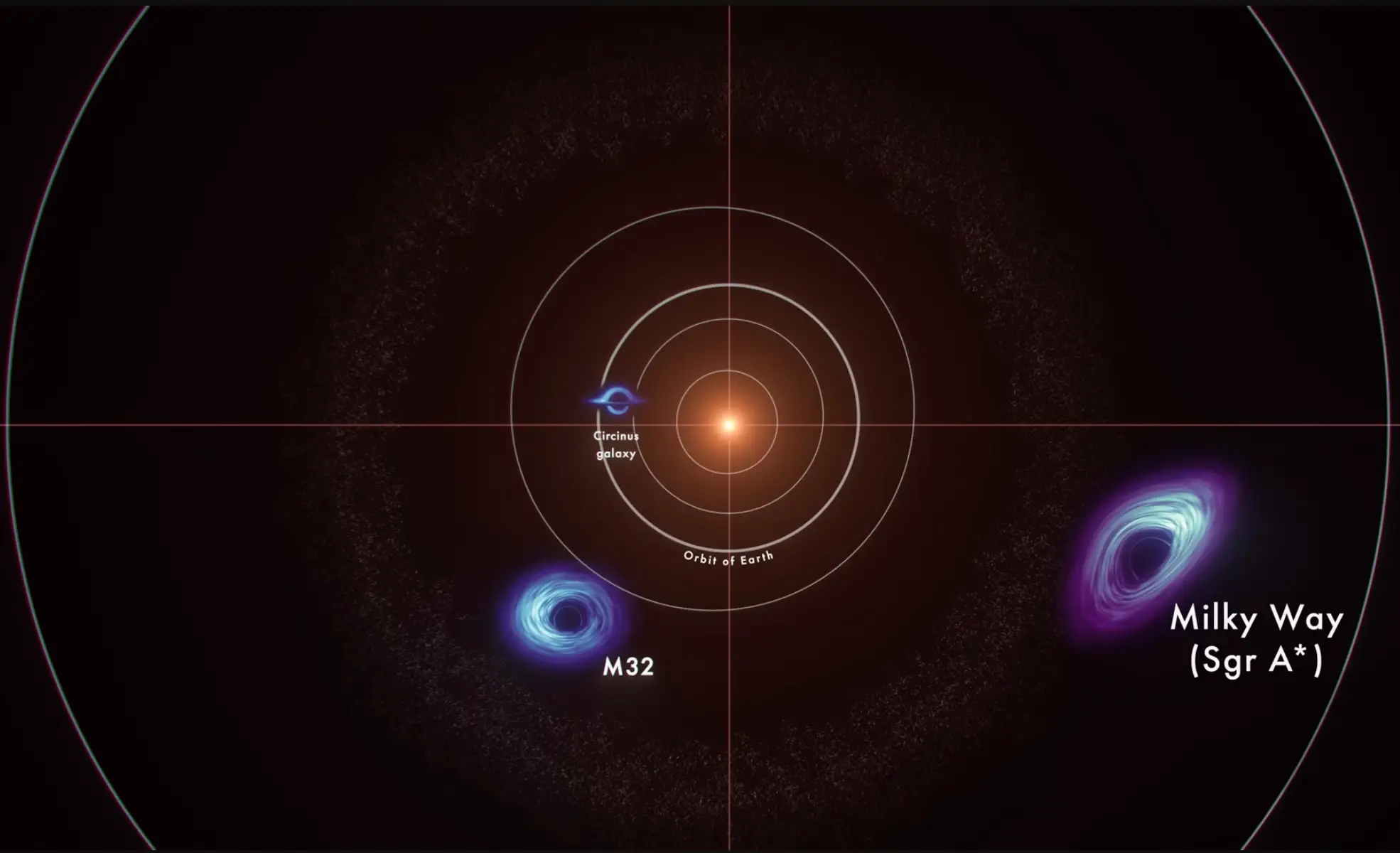
The fascinating, if slightly unsettling, animation shows 10 supersized black holes that occupy center stage in their host galaxies, including the Milky Way and M87, scaled by the sizes of their shadows. Starting near the Sun, the camera steadily pulls away to compare increasingly larger black holes to different structures in our solar system.
Measurements were made possible after a network of radio observatories called the Event Horizon Telescope attempted to capture images of the giant black holes at the centers of M87 and the Milky Way in 2019 and 2022, respectively. The images revealed a bright ring of hot orbiting gas surrounding a circular zone of darkness.
Advert
Any light crossing the event horizon, which is the black hole’s point of no return, becomes trapped forever, and any light passing close to it is redirected by the black hole’s intense gravity. Together, these effects produce a 'shadow' about twice the size of the black hole's actual event horizon, and is crucial in determining the size of the black hole.
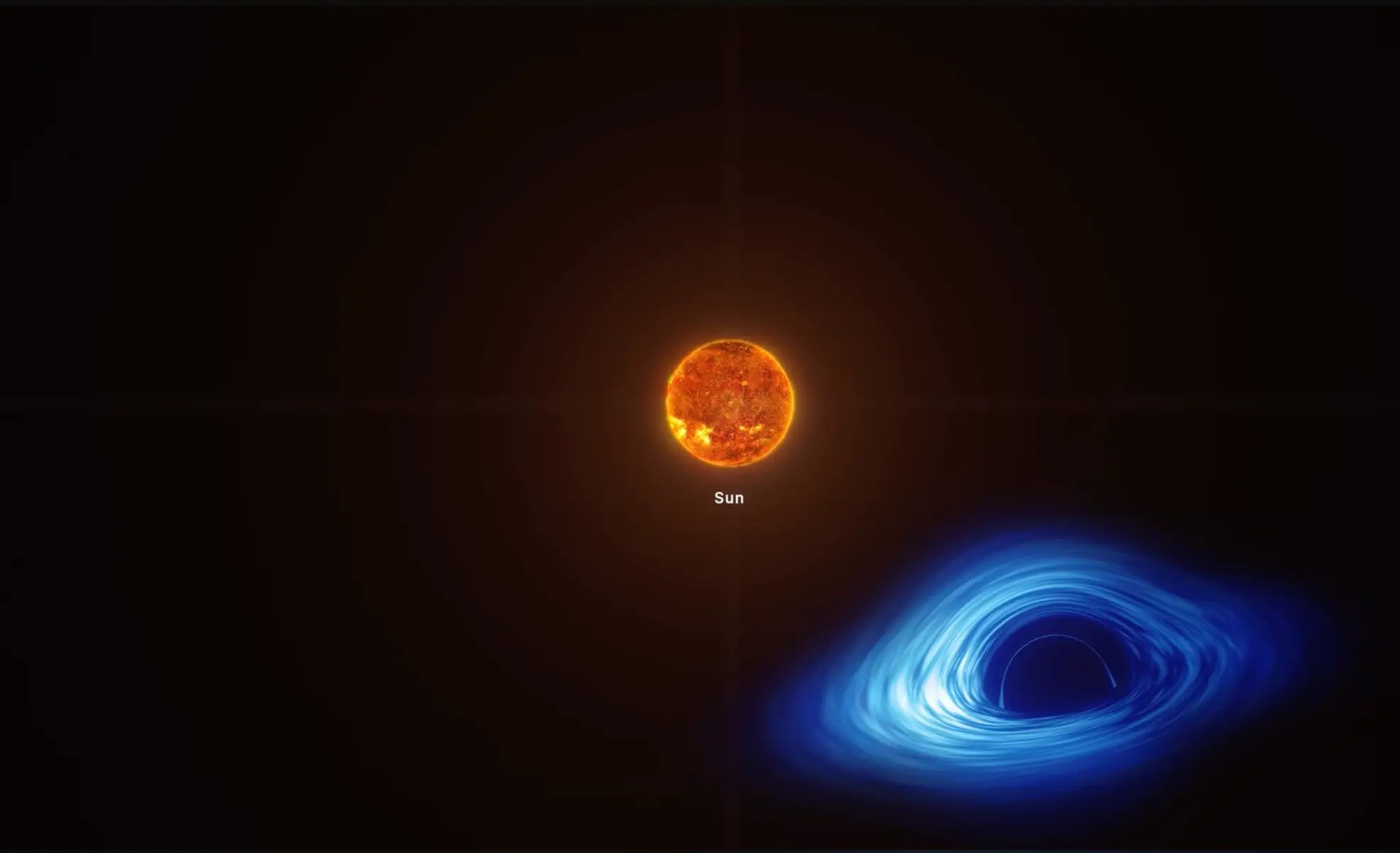
First up in the video is 1601+3113, a dwarf galaxy hosting a black hole carrying the mass of 100,000 Suns. The matter is so compressed that even the black hole’s shadow is smaller than our Sun.
The black hole at the heart of the Milky Way aka our own galaxy is called Sagittarius A* (pronounced ay-star) and has the weight of 4.3 million Suns based on long-term tracking of stars in orbit around it. Its shadow diameter spans about half that of Mercury’s orbit in our solar system.
The animation also shows two monster black holes in the galaxy known as NGC 7727. Located about 1,600 light-years apart, the smaller one weighs 6 million solar masses, while the other more than 150 million Suns. Astronomers predict that the pair will merge within the next 250 million years.
“Since 2015, gravitational wave observatories on Earth have detected the mergers of black holes with a few dozen solar masses thanks to the tiny ripples in space-time these events produce,” said Goddard astrophysicist Ira Thorpe (via NASA). “Mergers of supermassive black holes will produce waves of much lower frequencies which can be detected using a space-based observatory millions of times larger than its Earth-based counterparts.”
The video continues with M87’s black hole, which boasts a mass of 5.4 billion Suns. Its shadow is so big that even a beam of light – traveling at 670 million mph (1 billion kph) – would take about two and a half days to cross it.
The last black hole in the clip is TON 618, one of a handful of extremely distant and massive black holes for which astronomers have direct measurements. This huge black hole contains more than 60 billion solar masses, and it casts a shadow so large that a beam of light would take weeks to traverse it.
Speaking on the behemoth black holes, Jeremy Schnittman, a theorist at NASA’s Goddard Space Flight Center in Greenbelt, Maryland, said that 'when galaxies collide, their central black holes eventually may merge together too'.
Should we be worried that Earth may one day be swallowed by the Milky Way's own black hole, Sagittarius A*? It doesn't seem so. Contrary to the belief that wants black holes being the vacuum cleaners of the universe, these regions — areas of space of space where matter has become so densely packed that its gravity will let nothing escape — have a relatively compelling gravitation pull from a distance, while they consume material that crosses their event horizon (via BBC Sky at Night Magazine).
 Stefania Sarrubba