unilad homepage
unilad homepage
  • News
    • UK News
    • US News
    • World News
    • Crime
    • Health
    • Money
    • Sport
    • Travel
  • Music
  • Technology
  • Film and TV
    • News
    • DC Comics
    • Disney
    • Marvel
    • Netflix
  • Celebrity
  • Politics
  • Advertise
  • Terms
  • Privacy & Cookies
  • LADbible Group
  • LADbible
  • SPORTbible
  • GAMINGbible
  • Tyla
  • UNILAD Tech
  • FOODbible
  • License Our Content
  • About Us & Contact
  • Jobs
  • Latest
  • Archive
  • Topics A-Z
  • Authors
Facebook
Instagram
X
Threads
TikTok
YouTube
Submit Your Content
NASA gives major new update on chances 'city-destroying' asteroid could hit Earth in just seven years
Home>Technology>Space
Published 18:52 25 Feb 2025 GMT

NASA gives major new update on chances 'city-destroying' asteroid could hit Earth in just seven years

The asteroid in question - 2024 YR4 - is around 130 to 300 feet (40 - 90 meters) wide

Niamh Shackleton

Niamh Shackleton

google discoverFollow us on Google Discover
Featured Image Credit: Tobias Roetsch/Future Publishing via Getty Images

Topics: Science, Space, NASA, Earth

Niamh Shackleton
Niamh Shackleton

Niamh Shackleton is an experienced journalist for UNILAD, specialising in topics including mental health and showbiz, as well as anything Henry Cavill and cat related. She has previously worked for OK! Magazine, Caters and Kennedy.

X

@niamhshackleton

Advert

Advert

Advert

NASA has given an important update on asteroid 2024 YR4.

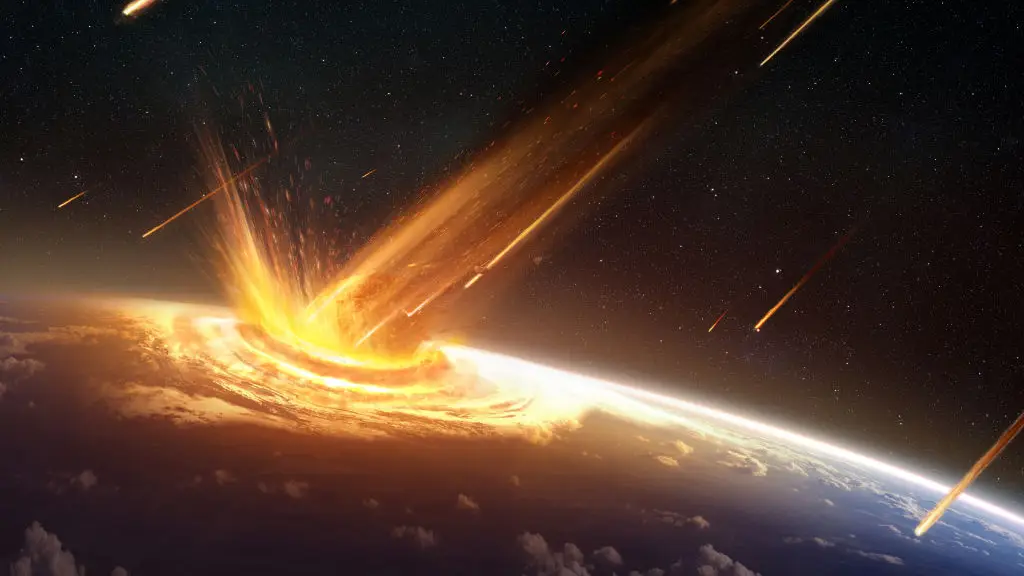
If you've been keeping with up with astronomy news of late, it's likely you'll have heard about a 'city-destroying' asteroid that's currently hurtling towards Earth.

2024 YR4 was first spotted after it set off automated asteroid warning systems in December 2024, and astronomers have been tracking it ever since.

According to NASA, the space object measures around 130 – 300 feet across (40 – 90 meters) and should it hit Earth, the force would be hundreds times the force of the Hiroshima bomb.

Advert
NASA has been tracking 2024 YR4 since December last year (Thomas Fuller/SOPA Images/LightRocket via Getty Images)

Initially it was given just a 1.2 percent chance of colliding with Earth in December 2032, but it wasn't long until this figure more than doubled.

In a worrying update given last week, the likelihood of hitting our planet was increased to 3.2 percent; making it the biggest threat to Earth in NASA's history, beating the infamous 'God of Chaos' asteroid.

But the 'God of Chaos' (officially known as 99942 Apophis) has now regained its titled after 2024 YR4's chances of hitting Earth have drastically decreased.

In an update issued by NASA yesterday (February 24), the agency said: "NASA has significantly lowered the risk of near-Earth asteroid 2024 YR4 as an impact threat to Earth for the foreseeable future. When first discovered, asteroid 2024 YR4 had a very small, but notable chance of impacting our planet in 2032.

"As observations of the asteroid continued to be submitted to the Minor Planet Center, experts at NASA Jet Propulsion Laboratory’s (JPL’s) Center for Near-Earth Object Studies were able to calculate more precise models of the asteroid’s trajectory and now have found there is no significant potential for this asteroid to impact our planet for the next century.

"The latest observations have further reduced the uncertainty of its future trajectory, and the range of possible locations the asteroid could be on Dec. 22, 2032, has moved farther away from the Earth."

It continued: "There still remains a very small chance for asteroid 2024 YR4 to impact the Moon on Dec. 22, 2032. That probability is currently 1.7%."

Anyone else just breathe a sigh of relief?

The asteroid has been downgraded to a 1.7 percent chance of collision (Getty Stock)

With the update in mind, the asteroid is now in NASA's 'normal' category on its Torino Scale, compared to 'meriting attention from astronomers' when the chance was above three percent.

The NASA website says of items in category 1: "A routine discovery in which a pass near the Earth is predicted that poses no unusual level of danger.

"Current calculations show the chance of collision is extremely unlikely with no cause for public attention or public concern. New telescopic observations very likely will lead to re-assignment to Level 0."

  • Experts issue urgent warning over city-destroying asteroid that could devastate Earth without direct impact
  • NASA reveals truth behind asteroid hurtling past Earth at 46,908 mph next week
  • Astronomer explains why we’ve probably all missed 1,300 lb space probe’s return to Earth, including NASA
  • NASA explains stunning Earth phenomenon captured from ISS that looks like something from a movie

Choose your content:

3 days ago
5 days ago
  • Getty Stock Photo
    3 days ago

    iPhone users are just discovering what the orange and green dots on their screen really mean

    Apple's support page has explained what the dots mean

    Technology
  • Getty Stock Image
    5 days ago

    Experts reveal why common email apology is actually making co-workers hate you

    Many way want to rethink their phrasing, as one common phrase is seen as 'irritating'

    Technology
  • Justin Sullivan/Getty Images
    5 days ago

    How to use Downdetector to see when top sites like Facebook and Instagram go down

    With outages hitting platforms seemingly all the time, this free tool tells you instantly whether it's your connection or a bigger problem

    Technology
  • Thilina Kaluthotage/NurPhoto via Getty Images (edited)
    5 days ago

    Facebook down as thousands of users report issues

    Reports are flooding in from users unable to access the platform, here's what we know so far

    Technology