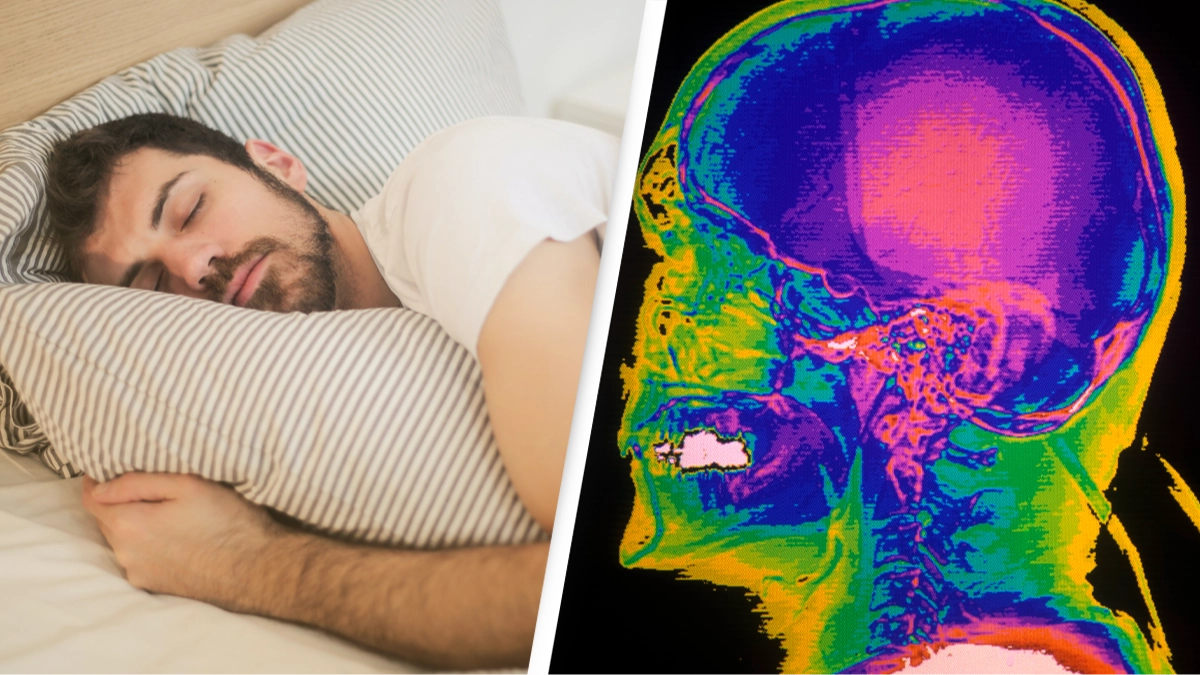
Scientists create device which lets you play back your dreams

Scientists have discovered a way to read people's dreams.
Given the nightmares I was experiencing last night after finishing my binge-watch of Netflix series The Haunting of Hill House and frequent sleep paralysis, I'm not sure I'm going to be rushing to see what's been cropping up when I close my eyes and going to sleep anytime soon.
But for those of you having dreams about fairies and unicorns, maybe this one's for you.
Advert
A team of scientists from ATR Computational Neuroscience Laboratories in Kyoto, Japan used a modified magnetic resonance imaging (MRI) scan machine, as well as an electroencephalogram (EEG) machine, to take a deeper look into people's dreams.
The study took three participants and monitored their brain activity during sleep, placing them in a MRI scanner across several 3-hour time blocks over 10 days, according to Smithsonian Magazine.
Participants had an EEG machine attached to their scalp via electrodes to pick up tiny electrical signals taking place in the brain and the MRI machine was edited to provide functional MRI readings (fMRI), picking up up changes in blood flow by capturing images at different stages of the participant's sleep.
The team of scientists focused on the period of sleep where participants were in stage one of non-REM sleep - a few minutes after dozing off where 'quick, sporadic hallucinations' can occur, as per Smithsonian.

The participants were woken up after entering stage one of non-REM sleep and asked to describe what they'd seen in their dreams - a process repeated around 200 times.
Scientists gaged what the most common items were seen by participants in their dreams - for example, a person or building - and later showed the participants images from the internet of those items while they were still in the MRI machine, but this time, when they were awake.
To identify a pattern, the team then compared the MRI machine's scans of the participant's brains when they were awake and viewing images of the images, compared to when they were asleep and dreaming of the items.
This data was then put into an artificial intelligence (AI) program for analysis.

The results of the learning algorithm led scientists to be able form basic images of participants' dreams, which they grouped together into a video.
And when the scientists asked participants how their dreams played out, their recollections matched up pretty well with the video predictions formed by the AI.
The study revealed the algorithm was able to predict what a participant had seen in their dream 60 percent of the time, but was better at telling the difference between a person and scene, than identifying specific details of a scene - such as being able to tell if a participant was dreaming about a person in a street or in a building.
The question is, would you want to be able to replay your dreams?
Topics: Health, Mental Health, Science, Technology, Film and TV, World News
 Poppy Bilderbeck