
Surprising scientific study reveals the most narcissistic countries in the world

We might have to rethink everything we thought we knew about narcissism as new research has highlighted the most narcissistic countries in the world, busting the myth that connects the personality style and disorder to highly individualistic nations.
Narcissism has largely become a buzzword over the last few years, often thrown around to describe a self-involved, manipulative individual.
Narcissistic traits may include an inflated sense of self and a lack of empathy, with the narcissistic personality disorder described as a mental health condition in which 'people have an unreasonably high sense of their own importance' (via Mayo Clinic).
Now, 2026 research has helped understand the levels of narcissism across different countries. Shifting the Western-centric perspective often used in studies on narcissism, the researchers from Michigan State University analysed responses from 45,000 people from 53 nations about their own traits and tendencies.
Advert
Surprisingly, the top 5 doesn't include the United States, the country frequently associated with narcissism, as William Chopik, associate professor of personality psychology at Michigan State University, and one of the researchers behind the study, put it.

“Most of what we know about narcissism comes from studies conducted in Western countries – often in the US,” Chopik told BBC Science Focus.
“The US often comes up in public discourse as the example of narcissism, so people might expect it to be far and away the highest. In reality, the US was toward the higher end, but it certainly wasn’t at the extreme.”
“The truth is, there was a wide range of narcissism in every country,” Chopik continued. “Each one had their own mix of people who were narcissistic and people who were self-effacing.”
So, which were the countries that came up on top in this unenviable ranking? Unexpectedly, the top 5 saw Germany being the country with most narcissistic respondents overall, followed by Iraq, China, Nepal and South Korea. The most self-effacing countries, on the other hand, were Serbia, Ireland, the UK, the Netherlands and Denmark.
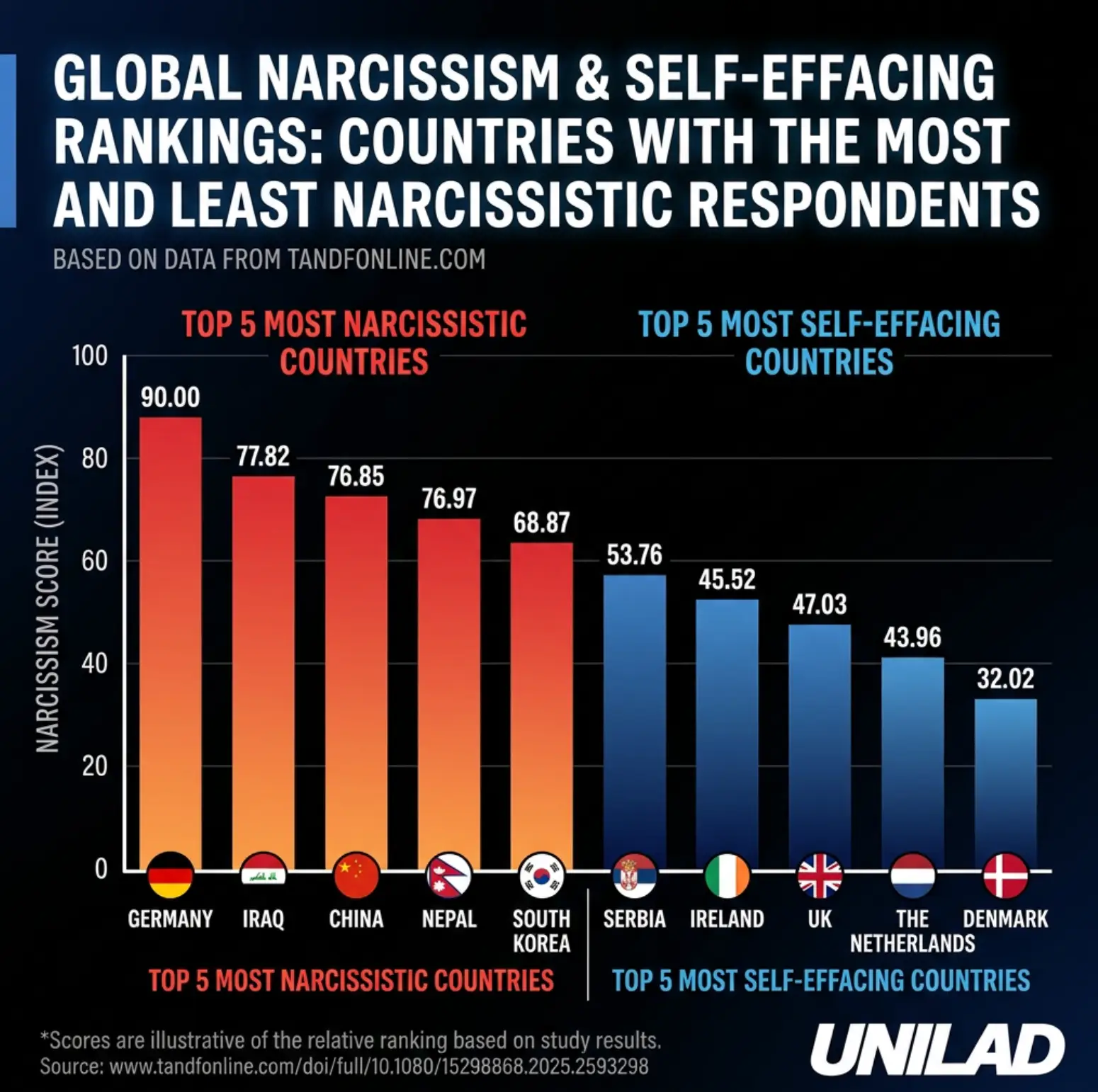
As for the US, it did rank in the top third, but only at number 16 out of 53.
The study also pointed out a prevalence of narcissistic traits among younger respondents, while also highlighting a higher likelihood of men possessing narcissistic traits compared to women.
“For younger people, narcissism may actually serve some developmental purposes,” Chopik said. “Early adulthood is a time when people are trying to establish an identity, gain independence and compete for status. Traits like confidence and self-focus can be useful in that context.”
As for the gender disparity, the researchers suggested this might be due to widespread, internalized beliefs about male dominance.
Researchers also took into account two different type of narcissism, dividing their analysis into two parts: admiration and rivalry.
Narcissistic admiration focuses on traits which serve the self, such as exaggerated self-esteem or boasting about achievements, while rivalry describes tensions that a narcissistic individual may create with others, such as defending themselves or putting others down.
The admiration traits were most prevalent in Nigeria, Iraq, China, Nepal and Turkey – and they were lowest in Norway, Denmark, Ireland, Russia and the UK.
Meanwhile, the highest scorers for narcissistic rivalry were Germany, South Korea, Nepal, Iraq and Romania – and the lowest were Serbia, Mexico, Colombia, Austria and South Africa.

Chopik and his team also expected to find lower scores for narcissism in countries known to emphasize the importance of the collective or group, but were surprised to discover the opposite was true.
Survey respondents from more collectivistic cultures (Senegal, Bangladesh, Morocco, Nepal and Iraq in this study) generally reported higher levels of narcissistic admiration compared to countries which are more individualistic (Sweden, Denmark, Germany, Norway and Finland).
“That challenges the simple story that narcissism is just a byproduct of individualistic cultures, or how collectivistic countries are idealized as perfectly harmonious and selfless,” said Chopik.
“Narcissists were present everywhere, and the sensitivity to hierarchies in collectivistic countries may exacerbate this.”
Finally, the study showed that status plays a key role in connection to narcissism. Researchers found that people from richer countries had higher levels of narcissism, possibly because wealthier societies might place more value on achievements and self-promotion.
“It’s not confined to one country, one generation or one type of person,” Chopik concluded. “It shows up everywhere, often in predictable ways, and sometimes for understandable reasons.”
Topics: Mental Health, Psychology, Science
 Stefania Sarrubba