Study reveals how unexpected creature ruled the ocean over 100 million years ago

The deep depths have always been a scary place, and remain largely unexplored to this day.
Strange creatures lurk in the deep, dark and completely silent depths of the ocean under pressures that would crush a human.
There is still a huge air of mystery around the deeper parts of the ocean, as only 28.7 percent of the global seafloor has been mapped.
Crazily, explorers have actually seen less than 0.001 percent of the deep ocean seafloor, an area roughly the size of Rhode Island. To put that in perspective, we have more detailed maps of the moon than we do of the deep seafloor.
Advert
But this week, scientists confirmed that in one point in history the deep and dark depths of the ocean were even scarier than they are now.
New research from Japan's Hokkaido University, published in the journal Science this week, has confirmed that a colossal, kraken-like octopus once ruled the oceans around 100 million years ago, and it was absolutely not to be messed with.
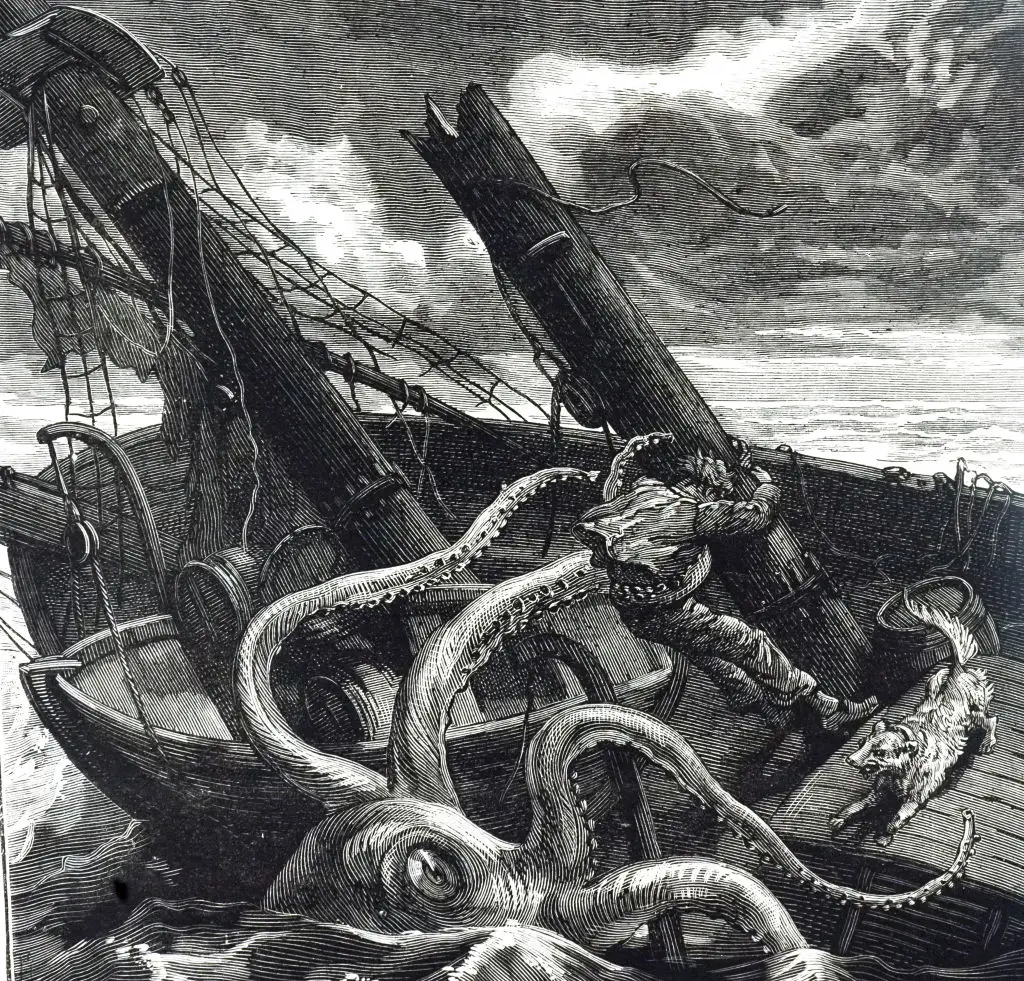
We are talking about a creature that stretched over 60 feet in length. That's longer than a bowling lane.
What did the giant octopus eat?
Lurking in the same oceans that were already packed with mosasaurs and plesiosaurs, the apex predators of the Cretaceous seas, this beast wasn't hiding from them. It was snapping them up for a light breakfast.
Scientists analysed dozens of jaw fossils dating back between 72 and 100 million years, discovering wear patterns on the beaks so extreme that they suggest the creature could crush through both shell and bone.
"The most surprising finding perhaps was the extent of wear on the jaws," said lead author Dr.Yasuhiro Iba, describing evidence of chipping, scratching, cracking and polishing that points to what he called 'an unexpectedly aggressive feeding strategy'.
Gulp. In simpler terms, this means this animal chomped down hard, and ate often.
The Giant finned octopus, Cirrata
The fossils, which were found in Japan and on Vancouver Island, belonged to an extinct group of finned octopuses known as Cirrata.
And if the size of them wasn't scary enough, there are also signs these creatures were highly intelligent.
The fossils showed uneven wear on either side of the jaw, a sign of laterilization, the same brain behavior link we associate with intelligence in modern animals.
So yes: a 60 foot, hyper intelligent, bone-crushing, killing machine octopus was at the top of the food chain even while dinosaurs ruled the planet.
"Our study shows that these were not simply large versions of modern octopuses,' Dr Iba said.
"They were giant predators at the very top of the Cretaceous marine food web.
"This changes the view that Cretaceous seas were dominated by large vertebrate predators."
What is the largest Octopus alive today?
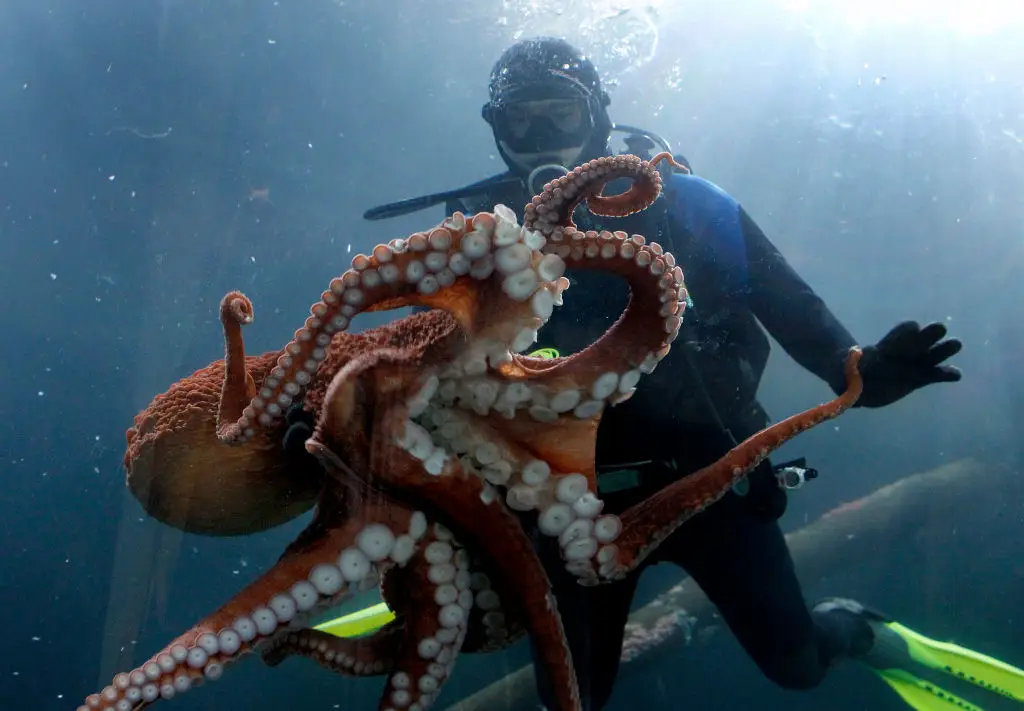
For context, the largest octopus alive today, the Giant Pacific Octopus, maxes out at around 16 feet and mostly eats shrimp and clams. The ancient kraken was essentially in a league of its own entirely.
The team used AI alongside a 3D imaging technique called grinding tomography to analyze the fossils, and say the combination could unlock a whole new era of palaeontology, potentially revealing entire hidden ecosystems buried in rock that we never knew existed.
Which raises an equal parts scary, equal parts fascinating question - what else is down there we haven't found yet?
 Thomas Bamford