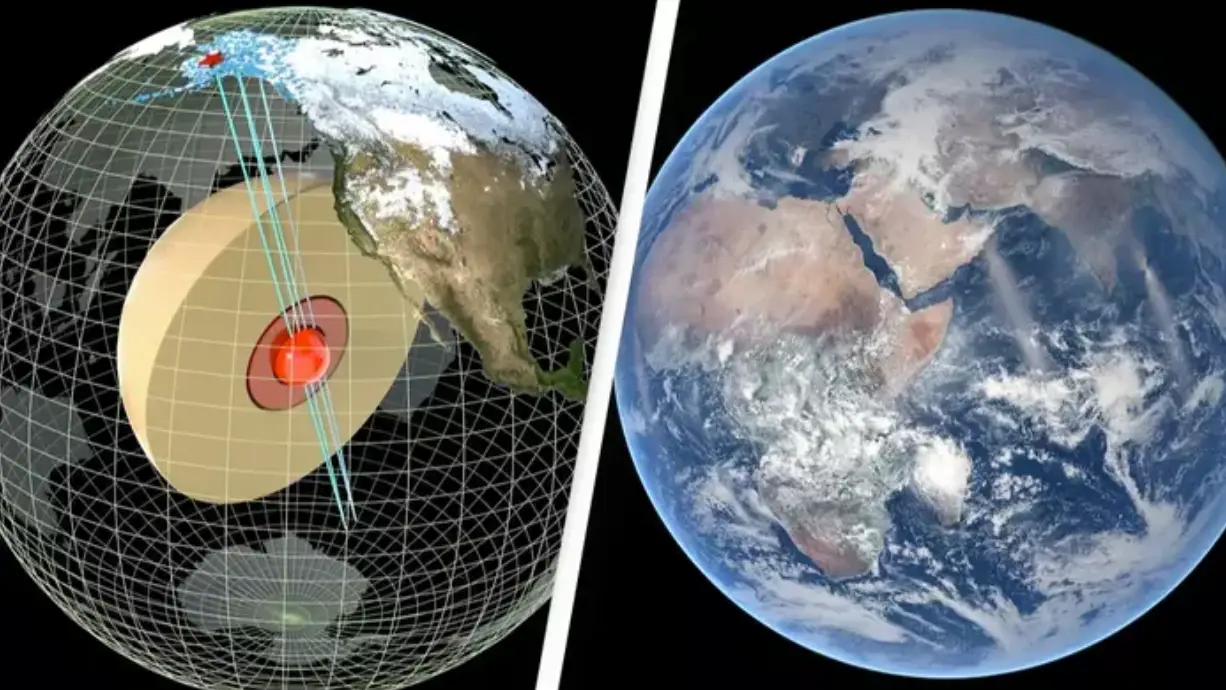
Featured Image Credit: Drew Whitehouse, Son Phạm and Hrvoje Tkalčic / NASA

Topics: Space, News, World News, Science
 Britt Jones
Topics: Space, News, World News, Science
Earth has always been just a round ball of… well, earth, right? But you’d be wrong if you assumed that, as scientists have discovered a solid metal ball at the centre!
The term ‘the glass had shattered’ is quite fitting for this new piece of information, as now billions of people are going to be questioning everything they know.
After years of debates in the scientific community about what really lies inside the inner core of the Earth, now we know that a solid ball exists.
This comes as seismologists at the Australian National University believe that this new core happened after a ‘significant global event from the past’.
Advert
Through their studies in specific earthquakes and monitoring 'seismic waves reverberating through the entire planet', Thanh-Son Phạm and Hrvoje Tkalčić found the solid metal core which then led to them spotting new details about the core which hadn’t been noticed before.
This is because they were able to study the core in a new way than previously done.
So, not only were they able confirm the existence of a solid metal core, also known as an ‘innermost inner core’ or IMIC, they were also able to make another discovery by chance.
The pair are now estimating that the inner metal core is approximately 800 miles in diameter, which makes up nearly one per cent of the Earth’s volume.
This is far bigger than other scientists had previously predicted in other studies conducted on the Earth’s core.
Thanh-Son Phạm, later told The Washington Post: “Clearly, the innermost inner core has something different from the outer layer," after publishing their findings in Nature.
But despite the core being made of the same materials as the molten core, this solid metal inner core may also have different properties, the scientist explained.
He said: “We think that the way the atoms are [packed] in these two regions are slightly different.”
He went on to add that this means seismic waves travel through it at a different rate.
But that’s not all, researchers also believe that this solid metal core could be a key component to understanding how life evolved on planet earth and the theory of evolution.
Due to their study, they believe that the metal inner core could be a ‘fossilised record’ of a significant tectonic event, with the core solidifying shortly afterwards.

The researchers wrote in The Conversation: “Studying Earth’s center is not just a topic of academic curiosity, but something that sheds light on the very evolution of life on our planet’s surface."
This isn't the only 'seismic' recent discovery made by seismologists though, as a research group posit that the earth’s core may have briefly stopped spinning and reversed direction.
The team found this out after noticing 'anomalies' between the core and the mantle, which dated back to the early 1970s.
This new tidbit led to scientists theorising that this change may happen every 70 years or so, in what they describe as a ‘tug of war’ within the Earth’s core.
Creepy right?