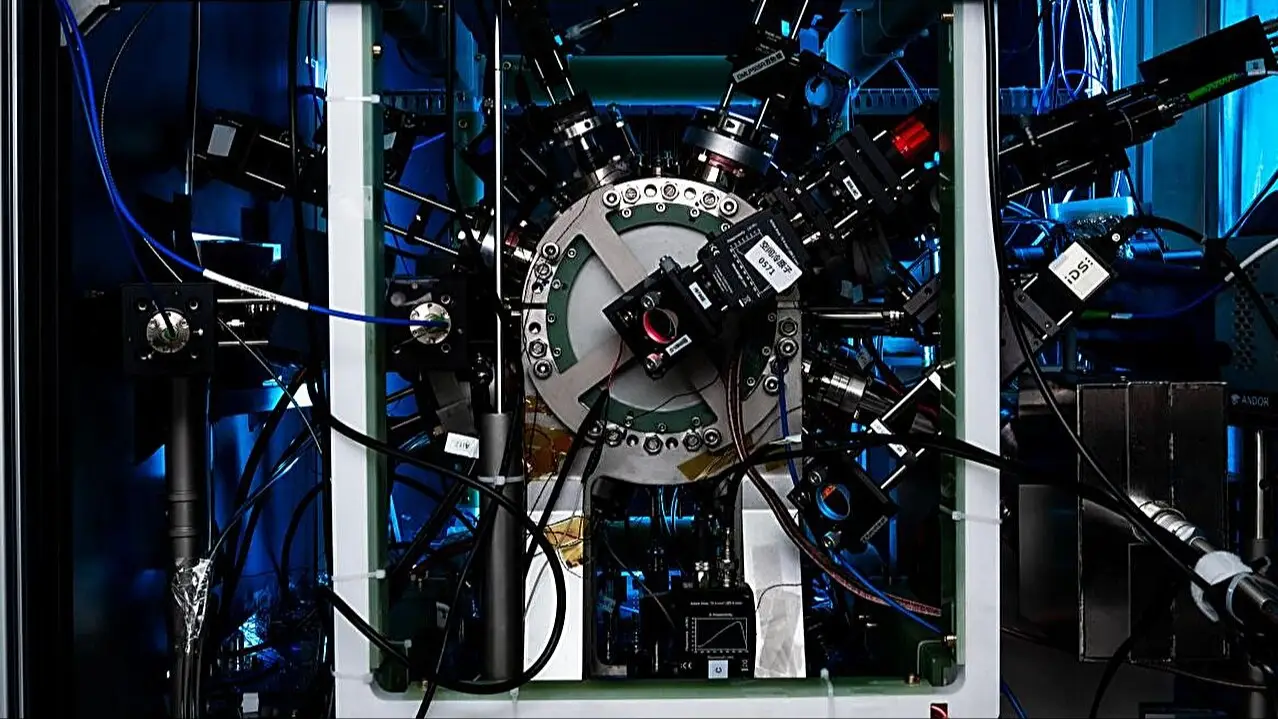
Scientists create a clock so precise it could actually change time forever

A team of researchers have created a clock that they believe is so precise it could redefine the second.
A team of scientists and researchers in China have really been going above and beyond when it comes to time and precision.
The team are responsible for creating one of the most precise clocks ever made, known as the strontium optical lattice clock.
It is so precise it is able to measure seconds to 19 decimal places...
Advert
Just for clarification and context, if this clock was to run for the next 30 billion years... which is more than twice as old as the universe, it would only be off by one second, give or take.
Now admittedly, this likely won’t change your day to day, but is a major milestone in the communtiy that has only been possible due to advancements in technology and breakthroughs in optical clock technology.
It can also act as a major step forward towards changing the definition of a second within the next 10 years.
However, there are a few steps that need to be met before this becomes a reality. For one, at least three optical clocks based on the same type of 'tick', and with a certain level of precision and stability, need to be in use at different institutions.
Writing in the journal Metrologia, the research team said their clock 'achieves accuracy at the level required for the roadmap of the redefinition of the second'.
The scientists also explained that beyond changing the definition of a second, it could aid the search for dark matter and even for specific measurements of Earth's gravitational field.
How we measure time has changed over the years, it used to be defined as a fraction of a day, with one second representing a 86,400th of 24 hours.

However, due to the variations in the Earth’s rotational speed, this isn’t a very accurate way of measuring it.
The creation of atomic clocks allowed scientists to measure the second independently, based on unchanging features of nature. So, since 1967 the second has been defined in the International System of Units (SI) as exactly 9,192,631,770 oscillations of the cesium-133 atom.
The more you know, eh.
While this is considerably more precise, there is still room for improvement and is what you can expect over the next years, if researchers continue to take such big leaps forward.
Topics: News, World News, Science
 Gerrard Kaonga