• News
  • Film and TV
  • Music
  • Tech
  • Features
  • Celebrity
  • Politics
  • Weird
  • Community
  • Advertise
  • Terms
  • Privacy & Cookies
  • LADbible Group
  • LADbible
  • SPORTbible
  • GAMINGbible
  • Tyla
  • UNILAD Tech
  • FOODbible
  • License Our Content
  • About Us & Contact
  • Jobs
  • Latest
  • Topics A-Z
  • Authors
Facebook
Instagram
X
Threads
TikTok
YouTube
Submit Your Content
Mystery surrounding Earth's 'heartbeat' that shakes every 26 seconds has scientists baffled

Home> News> World News

Published 19:58 2 Aug 2024 GMT+1

Mystery surrounding Earth's 'heartbeat' that shakes every 26 seconds has scientists baffled

Scientists can't seem to agree on where the source of the heartbeat is - let alone its cause

Gerrard Kaonga

Gerrard Kaonga

google discoverFollow us on Google Discover

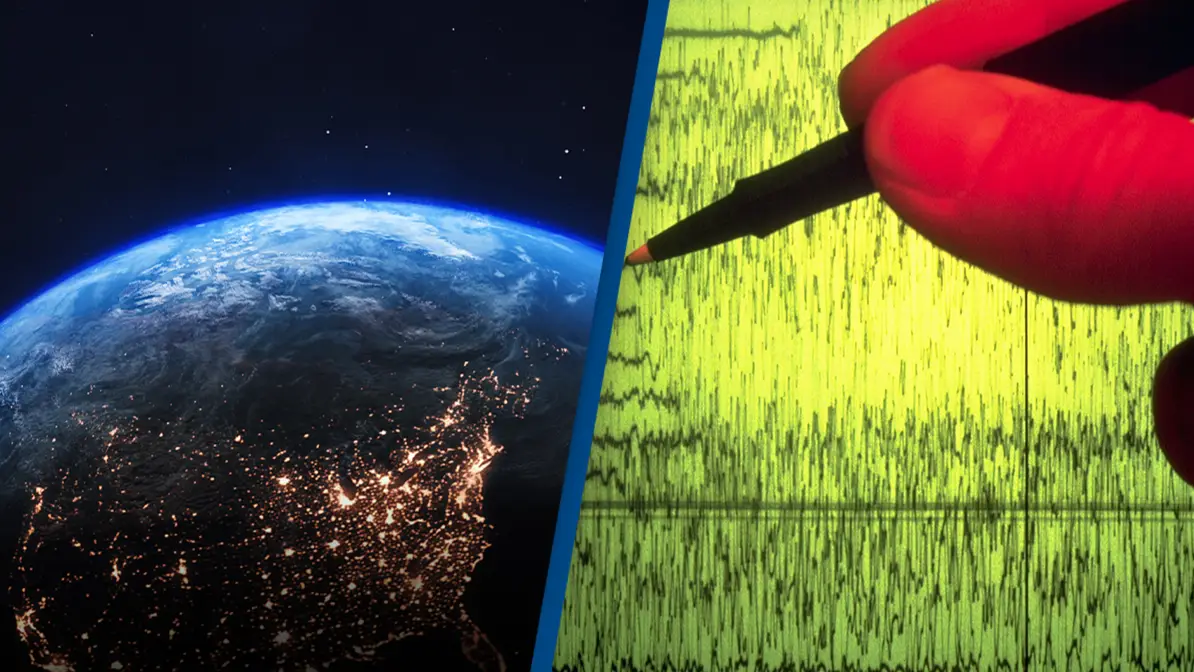
Scientists have multiple theories and can’t seem to agree on what causes the earth to have small seismic activity every 26 seconds.

There are a lot of curious things about this big blue ball we call Earth and some of the most fascinating things often leaves us, and scientists alike, puzzled.

Or if not puzzled at least has them debating and questioning each other.

That is what good science is all about, right?

Advert

Well, one mystery about the Earth has had scientists at each other's throats for years (thankfully not literally).

Every 26 seconds, their is an essential pulse that can be measured.

A type of 'heartbeat' from the planet that seismologists have known about for decades.

The pulse, or ‘microseism’ - if you want to get geological about it - was first documented in the early 1960s by researcher, Jack Oliver.

Some scientists believe waves are the reason for the small seismic activity. (Getty Stock Image)

Oliver figured out that the pulse was coming from somewhere ‘in the southern or equatorial Atlantic Ocean’ and that it was stronger in the Northern Hemisphere's summer months.

However, it seems Oliver was limited by the technology of his time, as future generations of scientists were able to find out more about this pulse.

Speaking at the Seismological Society of America conference in 2013, Garrett Euler explained his findings and narrowed down the source of the pulse even more to a part of the Gulf of Guinea called the Bight of Bonny.

He also claimed that waves were the culprit.

Damn those pesky waves.

He said when waves travel across the ocean, the pressure difference in the water might not have much effect on the ocean floor but when it hits the continental shelf — where the solid ground is much closer to the surface — the pressure deforms the ocean floor.
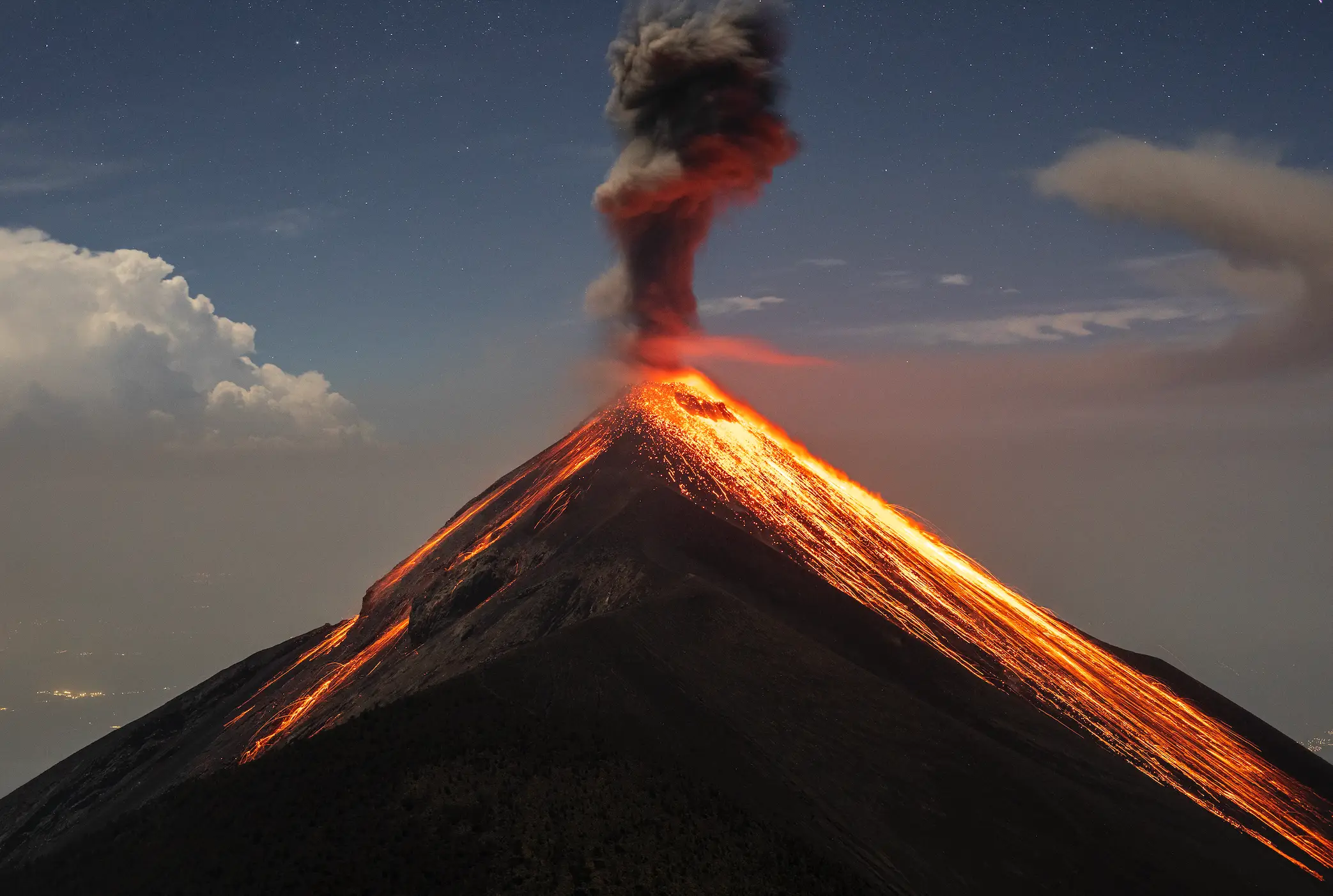
Other scientists have argued volcanoes are the cause. (Getty Stock Image)

This, in turn, causes seismic pulses that reflect the wave action.

However, in a paper later that year, Yingjie Xia from the Institute of Geodesy and Geophysics in Wuhan, suggested the cause was actually volcanoes, not waves. Those pesky volcanoes?

He said the reasoning was because the pulse’s origin was suspiciously close to a volcano on the island of São Tomé in the Bight of Bonny.

He also said that there was another place where a volcano causes a microseism similar to this one, the Aso Volcano in Japan.

Personally, I’m not too sure either way.... seeing as I’m not a geologist and I get my earthquake knowledge from Roland Emmerich films.

But it’s an interesting thought to know there are still wonders of the world we can’t fully explain yet.

Featured Image Credit: Getty Stock Photo

Topics: Earth, Science, World News

Gerrard Kaonga
Gerrard Kaonga

Gerrard is a Journalist at UNILAD and has dived headfirst into covering everything from breaking global stories to trending entertainment news. He has a bachelors in English Literature from Brunel University and has written across a number of different national and international publications. Most notably the Financial Times, Daily Express, Evening Standard and Newsweek.

Advert

Advert

Advert

Choose your content:

an hour ago
2 hours ago
  • John Shearer/98th Oscars/Getty Images The Academy via Getty Images
    an hour ago

    Lipreader 'reveals' Timothée Chalamet's 'warning' he said to his sister about Kylie Jenner

    Chalamet lost out to Michael B Jordan in the Best Actor category

    Celebrity
  • Getty stock image
    an hour ago

    Study reveals easy exercise that can boost your brain and reduce risk of dementia

    Might be worth adding this exercise into your fitness routine

    News
  • Getty stock image
    2 hours ago

    Difference between bacterial and viral meningitis as 2 people die in outbreak

    More than ten people have been taken seriously ill

    News
  • Getty stock image
    2 hours ago

    Dentist breaks down 4 causes of 'gym mouth' to look out for when working out

    Going to the gym is good for your overall health, but a dentist has warned of some things there which could affect your oral health

    News
  • Scientists baffled after discovering Earth has a 'heartbeat' every 26 seconds with no explanation
  • Earth's 'space battery' that stops the Sun from destroying the planet as we know it
  • Scientists say length of days on Earth is increasing at an 'unprecedented' rate
  • Scientists discovered huge 'ocean' beneath Earth's surface bigger than all the seas above land