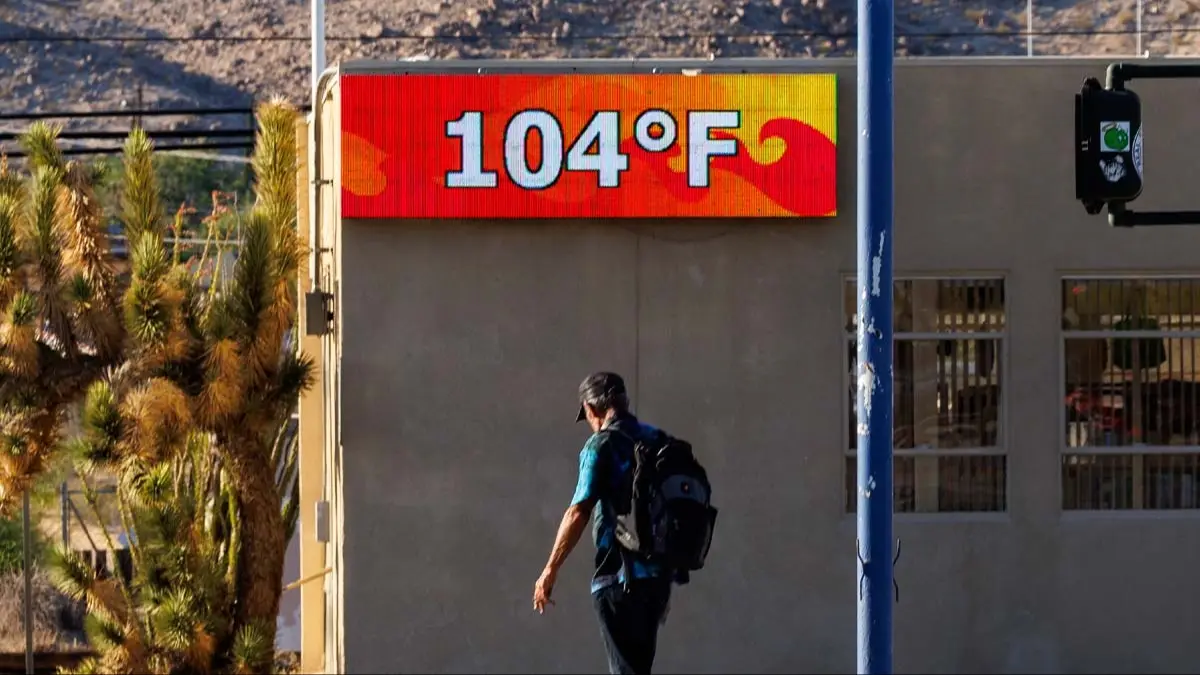
Scientists make new prediction 'Super El Niño’ could cause hottest summer ever with scorching temperatures

Weather forecasters have warned of a 'super El Niño' resulting in one of the hottest summers on record.
Temperatures across the US and around the world are set to soar amid the phenomenon.
El Niño happens when surfaces waters on the Pacific Ocean disrupt weather patterns around the world, including resulting in a more active hurricane season in the Atlantic Ocean as well.
El Niño is a naturally occurring phenomenon, but scientific study is ongoing as to whether there is a link between it and climate change.
Advert
While it occurs by itself and is not caused by climate change, scientists are theorizing that climate change could result in more intense El Niño, in turn causing more extreme weather when the natural phenomenon occurs.
This is because increased global temperatures are already associated with more extreme weather, so when El Niño and climae change coincide this has a duel impact on extreme weather.

The last time that there was a very strong El Niño was back in 2015 and 2016, in an event which caused massive destruction both to the natural environment and to humans, including wildfires, floods, droughts, and disruption to agriculture.
These events may have affected the lives of some 60 million people according to Imperial College London.
Now, some scientists are predicting that the coming summer could be the hottest on record, and there is a 25 percent chance of a 'super El Niño'.
Meanwhile, a report from the National Oceanic and Atmospheric Administration’s Climate Prediction Center said that there is also a 62 percent chance of El Niño beginning between June and August which could last until the end of the year.
But what makes something a 'super' El Niño?

This is when water temperatures are at least four degrees higher than they would be on average.
And at present, Fox Weather has reported that surface temperatures in the Pacific are now approximately two to three degrees higher than average.
In a new paper, Columbia climatologist Dr. James Hansen has said that '2026 will be the warmest year in the period of instrumental temperature measurements'.
The previous hottest year on record was 2024.
Dr Hansen added that '2027 will be still hotter'.
El Niño and La Niña are the warm and cool parts of the climate pattern in the tropical Pacific ocean, with the formal name being the El Niño-Southern Oscillation, abbreviated to the ENSO cycle.
Because the ocean and atmosphere are linked together, the impact of higher ocean temperatures can have a profound impact on global weather patterns.
Topics: World News, Weather, US News, Science
 Kit Roberts