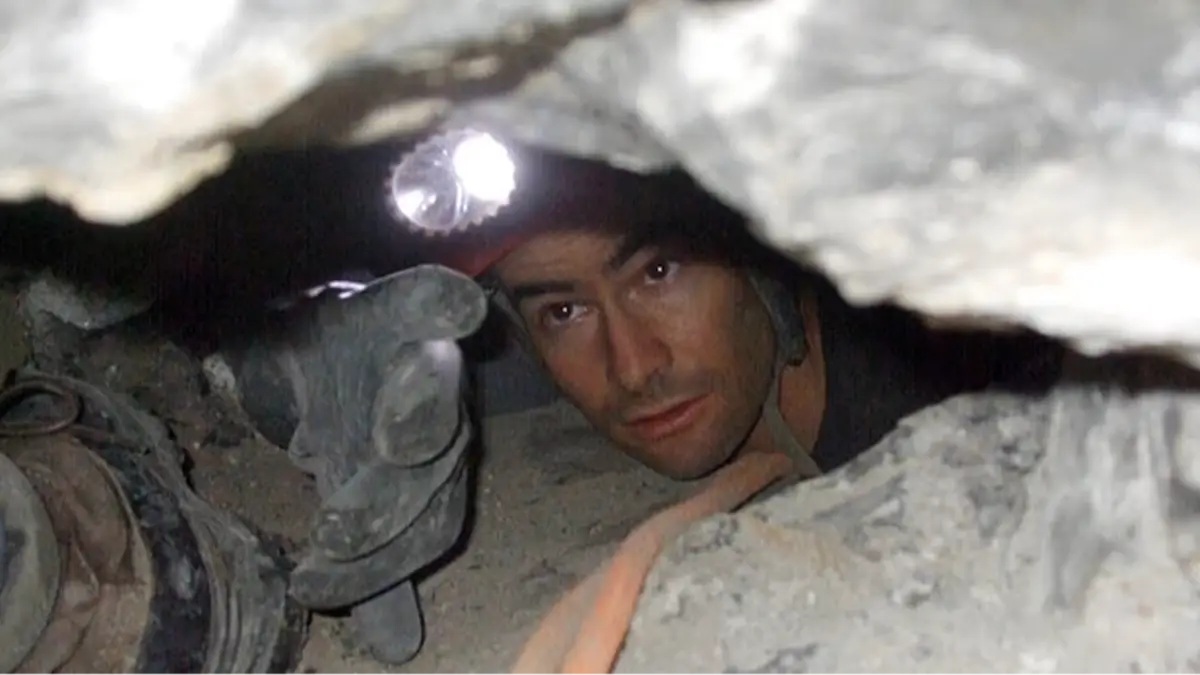
Nutty Putty cave name explained after man suffered 'worst death imaginable' inside

Just the name Nutty Putty is enough to send a chill up the spine of anyone aware of the horrible circumstances surrounding the death of John Edward Jones.
In November 2009, he became wedged headfirst in a narrow crevice, which began a desperate 27-hour rescue attempt.
The 26-year-old medical student and new father took a wrong turn down the 'birth canal' section of the notoriously tricky cave network, and ended up stuck in a position that left him unable to move.
Ultimately, John suffered what people to this day still call 'the worst death imaginable' and died in the cave after being stuck in there for over a day.
Advert
"I'm going to die right here. I'm not going to come out of here, am I?" he reportedly told rescuers.

Throughout the following day, teams of rescuers attempted to save him, but he soon started to lose consciousness because of the position he was in. John's heart was under increased strain to pump blood from his brain, a process that is usually aided by gravity.
The arduous rescue effort was ultimately unsuccessful.
The cave remains permanently sealed with John's body inside. A plaque was later erected by the entrance commemorating his life.
While many are familiar with the cave's gruesome chapter, a lot of people are less familiar with why it's called 'Nutty Putty'.
Nutty Putty cave name explained
The cave system is located near Pleasant Grove, Utah. It was first discovered and explored in the 1960s.
But why is it called Nutty Putty? Nutty Putty Cave is named after the soft, brown clay found oozing through its underground passages.
The caver who discovered it noticed the clay could change from a solid to an elastic, flexible fluid when gently squeezed, much like the popular children's toy, Silly Putty (originally named Nutty Putty).
This takes on an extra level of sinister, because the clay is so flexible, it could have contributed to the reason John got stuck.
The clay is composed of tiny particles of silicon dioxide, or silica as it is often known, which is commonly found in nature in the form of quartz.
It's not the only unique aspect of the cave. Instead of being formed by water that goes down through the ground (epidemic cave), Nutty Putty is an example of a hypogenic cave. This means the water came up from below, as superheated groundwater rose to the surface.
This also might suggest how the water in the caves became acidic, subsequently creating a complex network of passages, with chilling names like 'The Helmet Eater', 'The Maze' and 'Scout Trap Passage'.
Who was the last person to see John Edward Jones alive?

The last person to see John alive was cave explorer and YouTuber Brandon Kowallis, who explained in a blog post that despite his best efforts, the rescue mission was doomed from the start.
Before Brandon’s arrival, rescuers had already been working on trying to get John out, with them giving him a radio so he could talk to his family.
So by the time Brandon arrived, John's condition was rapidly deteriorating.
Excruciatingly, the inverted position that John was in meant that the blood that usually should be rushing to his feet was instead rushing right to his head. It also meant he had trouble breathing and the pace of his heart was double the usual pace to counteract the gravity to push the continuous flow of blood out of his brain.
'There was no way to tilt him to a horizontal position'
Explaining how John was in his last living moments, Brandon said: "He was in and out of consciousness and had started talking about seeing angels and demons around him."
He reported hearing a gurgling sound, which pointed to fluid building up in John's lungs, and his legs had begun to violently twitch.
It was clear rescuers were fighting a losing battle.
"It looked like he could only be lifted another foot or two in his current position because of where the webbing was anchored around his knees," the explorer explained.
"After a foot or two his feet would hit the ceiling. And then once he reached the ceiling, there was no way to tilt him to a horizontal position."
If you're curious to see what happened for yourself, a YouTuber has uploaded a chilling VR simulation of what Jones would have likely experienced.
 Thomas Bamford