
Organisers of the Enhanced Games red-faced after athletes only smash a single world record

Imagine spending millions of dollars, kickstarting a global debate on the ethics of performance-enhancing drugs, and giving athletes the green light to take whatever they want—only to deliver a total snooze-fest that failed to live up to the hype.
The Enhanced Games promised to render the traditional Olympics obsolete, but its historic debut on Sunday evening instead ended in near-total mockery with just one world record broken.
Throughout the marketing in the lead-up to the event, and indeed during the broadcast itself, commentators repeatedly promised a 'world-record-shattering' spectacle.
Yet despite the aggressive hard sell, the so-called "Olympics on steroids" barely managed more than a handful of personal bests, falling spectacularly short of the plethora of records viewers were promised.
Advert
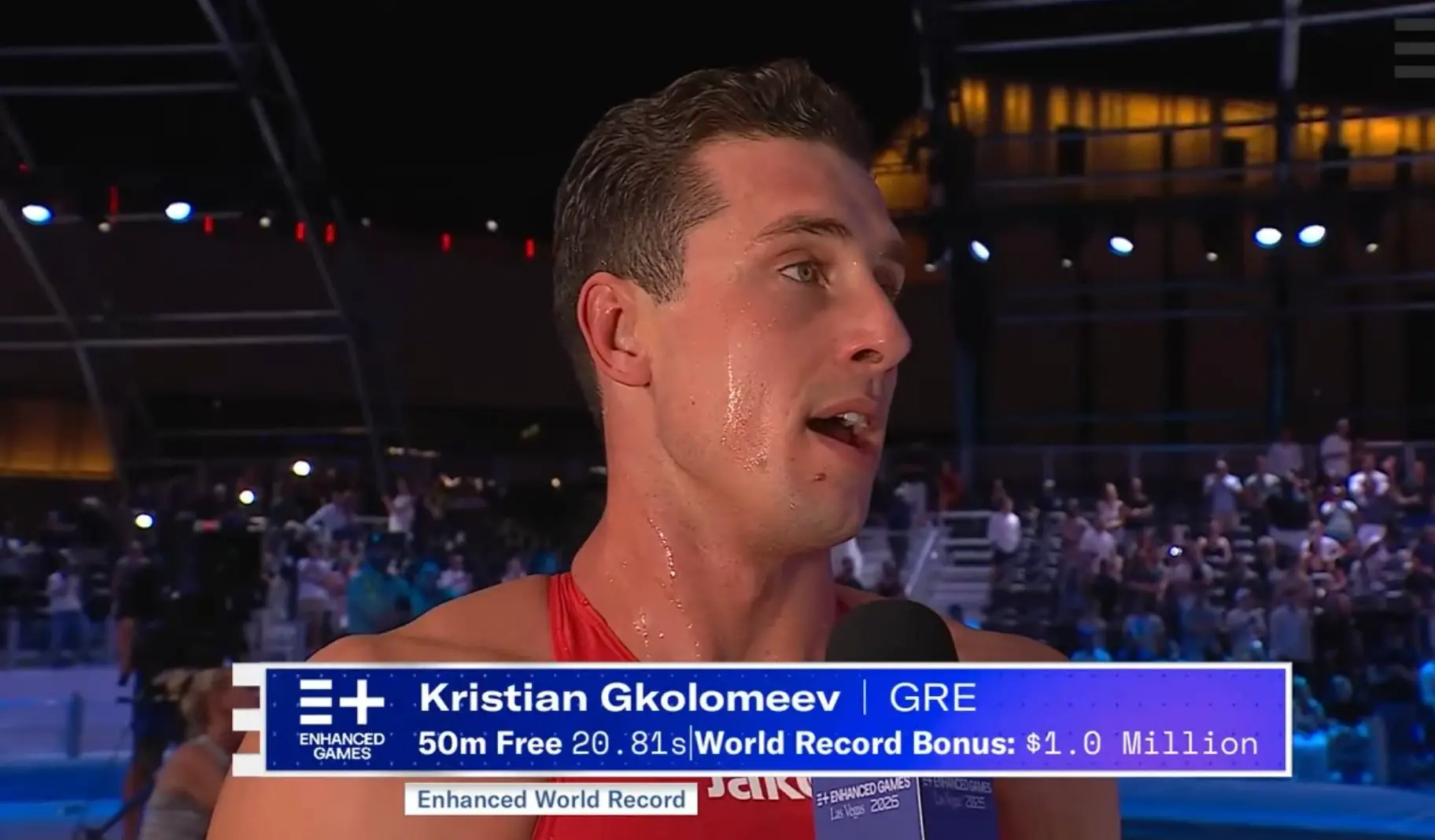
It was only during the very last event of the night that the long-promised world record breaking feat was finally delivered when Greek swimmer Kristian Gkolomeev, broke the Men’s 50m free race, with a time of 20.81 seconds, beating the existing record of 20.88seconds.
The unexpected and isolated victory meant the event could end on a high, but not without many fans expressing their frustrations on social media about how lacklustre the event had been and how underwhelmed they were with the performance of the supposedly 'enhanced' athletes,
Biohacker Bryan Johnson attempted to shed some light on the underwhelming outcome, explaining: “Many people have tuned in expecting world records to drop, but let me explain something. These athletes have been training for four months, they’ve been able to enhance for two months. This is a baby step into the new world to say ‘we’re going to allow these performance-enhancing drugs into a protocol’."
"So it’s not a defeat, it’s an example of a venture into a protocol, with enhancement, with clinical oversight. I wouldn’t be discouraged. I think we’ll see some performances tonight that will set world records, but it’s opening up the possibility that you can have performance-enhancing drugs, in a measured way, in sport.”
But for many fans tuning in, the lacklustre reality was a far cry from expectations. Audiences tuned in expecting chemically enhanced athletes to drastically and dramatically shatter the established world records held by traditional sporting events like the Olympics or World Championships.
The lacklustre performance was a far cry from what many fans tuning in had expected, with many viewers expecting the chemically enhanced performances to drastically and dramatically shatter the established world records from other global sporting events such as the Olympics or World Championships.
However, as the games went on to prove, with so many world records remaining unsmashed, genetics and natural talent were far more formidable than even the most pharmaceutically enhanced competitors.
What are the rules on doping at the Enhanced Games?
Though the Enhanced Games allows athletes to use performance-enhancing substances to compete - such as testosterone, anabolic steroids, hormones and growth factors (including HGH and EPO), metabolic modulators and stimulants - there are still rules for them to follow.
And it certainly isn't a free-for-all when it comes to using substances.
Competitors are limited to only using substances that are approved by the Food and Drug Administration (FDA), meaning drugs such as cocaine, heroin and other illicit, non-prescription drugs are strictly prohibited.
However, there will be medical supervision for the athletes using performance-enhancing substances, which will see them undergo continuous physiological monitoring and medical profiling to prevent dangerous over-use
And it's important to note that athletes don't have to use these substances to compete - 'un-enhanced' athletes are also welcome to compete, which helps to establish a format that tests both medically augmented and entirely natural physical limits.
 Phoebe Tonks