First ‘co-sex’ lab was created to study sexual arousal for important reason

The world's first 'co-sex' lab was created to study sexual arousal in 2019 with the project coming to fruition for a very important reason.
Sexologist Marieke Dewitte, from Maastricht University in the Netherlands, has long been interested in studying the finer details of sexual behavior, and the 'co-sex' research which started at the university in 2019 was the beginning of that.
"I think it’s really important to talk about sex. That still doesn’t happen enough," she explained in a press release.
"We know that most sexual problems do not play out at the individual level, but in a partner relationship. Nevertheless, research into that interaction is rarely done."
Advert
Dewitte has noticed that in the Netherlands in particular, sex is not so much of a taboo subject and described the situation in the country regarding the matter as 'quite progressive'.

"Genital arousal has been measured here for about seven years and, as a result, the ethics committee has less difficulty approving a research design than what I would see in my home country, for instance," the sexologist added.
Following the work of fellow sexologists such as Ellen Laan and Jacques van Lankveld, Dewitt decided it was time to create the first ‘dyadic sex lab’.
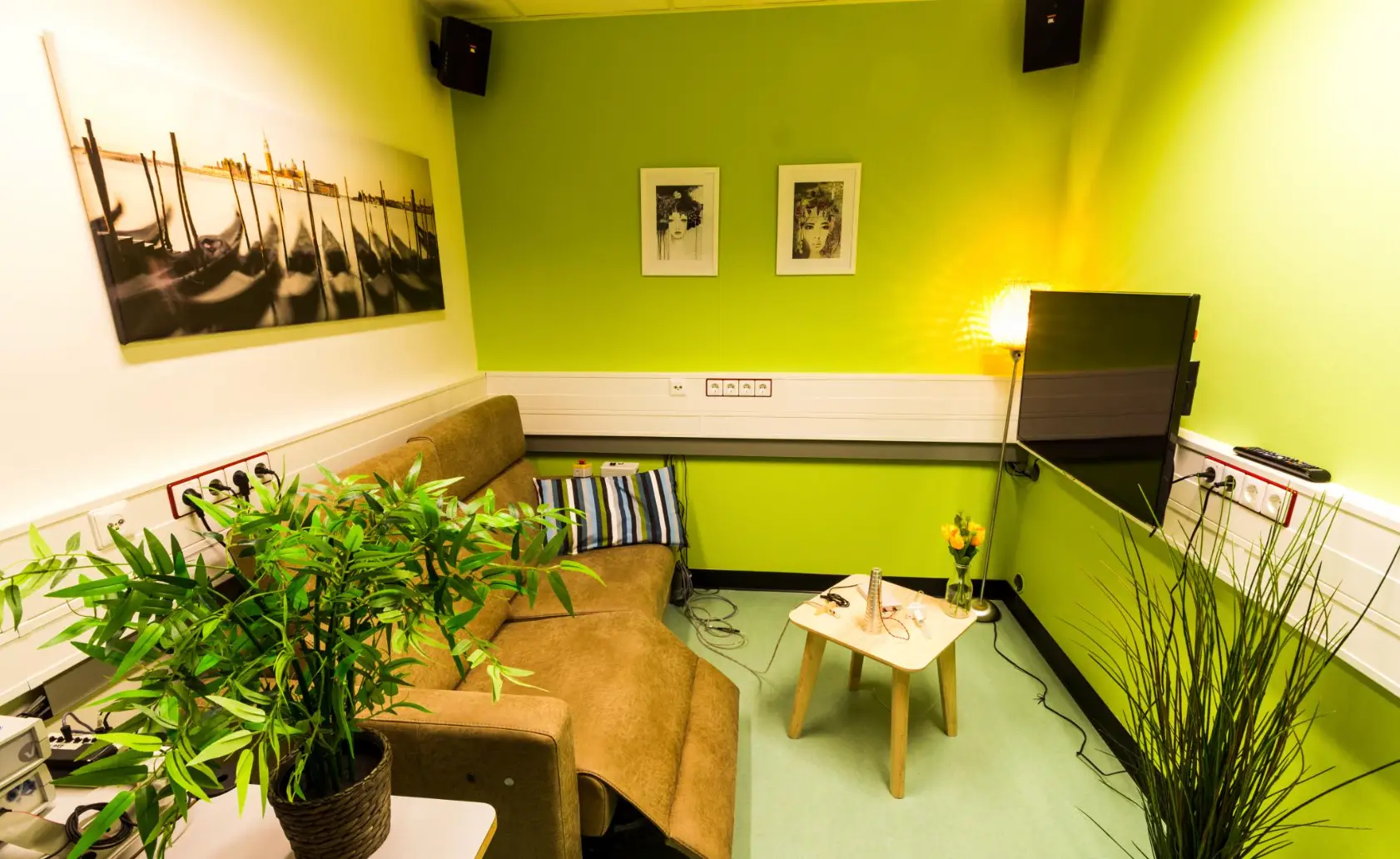
Described as a 'cosy room with dim lighting and plants', the living room area allows researchers to analyse couples during sexual simulation.
It mostly consists of students, with the press release adding: "That does not make the group representative of an average population, but you have to start somewhere."
The team have looked into a number of questions, including how partners align their sexual arousal, how long it takes couples to find that perfect 'sexual balance', as well as if there is a thing of an immediate sexual click.
The press release states: "In the current study—which was set up in collaboration with the University of Leuven—partners have a kind of Skype call from separate rooms, during which they stimulate themselves and focus their attention alternately on themselves or on their partner.
"Their physical and subjective arousal is measured during the conversation and afterwards they listen to the audio fragment again to make an assessment of their own and their partner’s level of arousal. In a follow-up study, the intention is also to have them stimulate each other physically."
Dewitte decided to embark on the study as she believes that sexual wellbeing is 'essential for our quality of life'.
Topics: Sex and Relationships, Netherlands
 Callum Jones