unilad homepage
unilad homepage
  • News
    • UK News
    • US News
    • World News
    • Crime
    • Health
    • Money
    • Sport
    • Travel
  • Music
  • Technology
  • Film and TV
    • News
    • DC Comics
    • Disney
    • Marvel
    • Netflix
  • Celebrity
  • Politics
  • Advertise
  • Terms
  • Privacy & Cookies
  • LADbible Group
  • LADbible
  • SPORTbible
  • GAMINGbible
  • Tyla
  • UNILAD Tech
  • FOODbible
  • License Our Content
  • About Us & Contact
  • Jobs
  • Latest
  • Archive
  • Topics A-Z
  • Authors
Facebook
Instagram
X
Threads
TikTok
YouTube
Submit Your Content
James Webb Telescope Pic Zoomed Out Shows How Incredible An Image It Is
Home>News
Published 16:12 12 Jul 2022 GMT+1

James Webb Telescope Pic Zoomed Out Shows How Incredible An Image It Is

NASA has released the sharpest image of the distant universe ever following the launch of the James Webb telescope

Emily Brown

Emily Brown

google discoverFollow us on Google Discover
Featured Image Credit: NASA

Topics: Joe Biden, NASA, Space, Twitter

Emily Brown
Emily Brown

Emily Brown is UNILAD Editorial Lead at LADbible Group. She first began delivering news when she was just 11 years old - with a paper route - before graduating with a BA Hons in English Language in the Media from Lancaster University. Emily joined UNILAD in 2018 to cover breaking news, trending stories and longer form features. She went on to become Community Desk Lead, commissioning and writing human interest stories from across the globe, before moving to the role of Editorial Lead. Emily now works alongside the UNILAD Editor to ensure the page delivers accurate, interesting and high quality content.

Advert

Advert

Advert

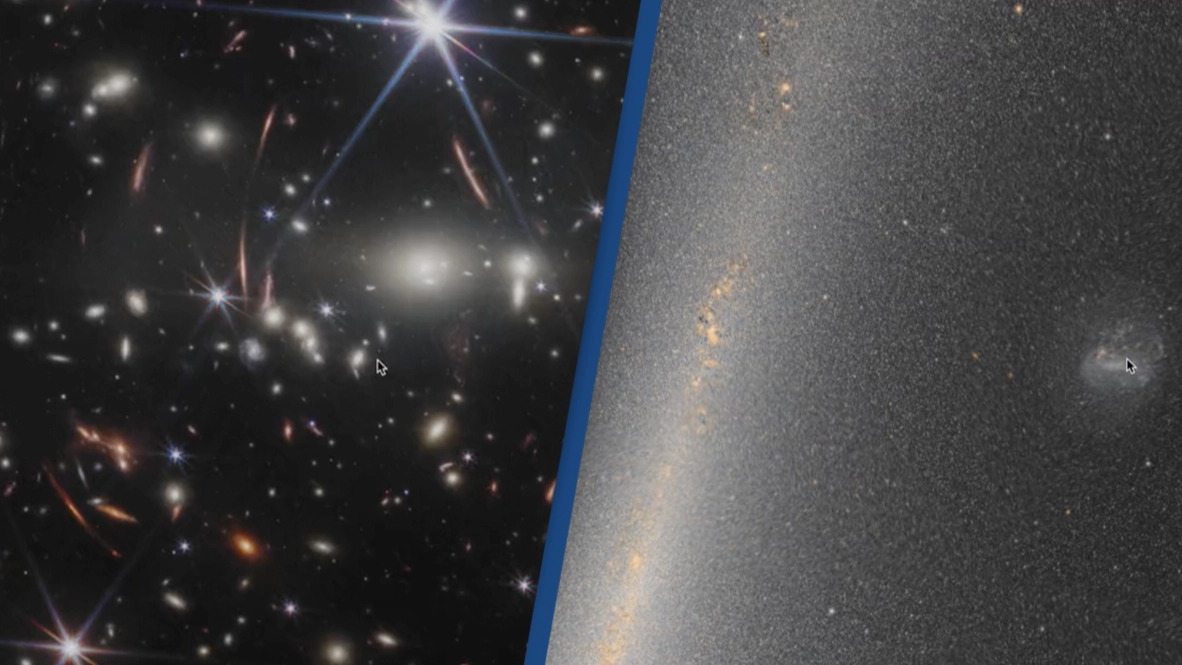
A video which contextualises an image of space snapped by the James Webb space telescope shows just how remarkable the detailed picture really is.

This week, NASA released the deepest and sharpest infrared image of the distant universe ever taken following the launch of the James Webb telescope in last December.

The first image encapsulates thousands of galaxies which can be found in our universe, including some of the faintest objects ever observed in the infrared, according to NASA. Its arrival is truly historical, but until you see it in relation to the rest of the universe it's hard to truly appreciate what the image displays.

See the image in context below:

Advert

The video, made possible by the American Astronomical Society’s WorldWide Telescope and shared online by Harvard astronomy professor Alyssa A. Goodman, places the image snapped by the James Webb telescope and compares it to images of the universe around it.

As well as zooming in on the detailed image to give a closer look at galaxies it captures, the video zooms out to show just how small a section it is, and what that same section might look like without the focus and detail made possible with the telescope.

Alongside the video, Goodman wrote: "Here's a 1-minute video showing - in the words of visualization hero @EdwardTufte - the 'compared to what' factor for today's amazing @NASAWebb image."

Explore JWST’s first image in full resolution! https://t.co/YITbzrBQux #jwst #wwt #unfoldtheuniverse

— AAS WorldWide Telescope (@WWTelescope) July 12, 2022

Goodman went on to thank those who had made the scenes possible, and expressed her wishes that NASA and US President Joe Biden had presented the image in a similar way to give viewers a better understanding of its significance.

Biden released the image, which captures a point in space dubbed SMACS 0723, with a post on Twitter in which he described it as a 'historic moment for science and technology', as well as for 'astronomy and space exploration', 'America and all humanity'.

Alongside the release of the picture yesterday (11 July), NASA explained it is made up of images captured at different wavelengths which represent the galaxy cluster as it appeared 4.6 billion years ago.

The first image from the Webb Space Telescope represents a historic moment for science and technology. For astronomy and space exploration.

And for America and all humanity. pic.twitter.com/cI2UUQcQXj

— President Biden (@POTUS) July 11, 2022

"Webb’s NIRCam has brought those distant galaxies into sharp focus – they have tiny, faint structures that have never been seen before, including star clusters and diffuse features," NASA explains. As the James Webb telescope continues to capture images and seek 'the earliest galaxies' in the universe, researchers will be able to learn more about their 'masses, ages, histories, and compositions', according to the space agency.

If you have a story you want to tell, send it to UNILAD via [email protected] 

Choose your content:

2 hours ago
20 hours ago
21 hours ago
  • Andrew Leyden/Getty Images
    2 hours ago

    Gunman killed by Secret Service outside White House identified as Nasire Best

    The 21-year-old was already known to the Secret Service

    News
  • James Gilbert/Getty Images
    20 hours ago

    Kyle Busch's cause of death confirmed as sepsis after NASCAR driver died aged 41

    The family confirmed that Busch died after complications of sepsis progressing from severe pneumonia

    News

    breaking

  • Allen J. Schaben/Los Angeles Times via Getty Images
    20 hours ago

    California toxic chemical leak sparks explosion fears as 40,000 evacuated in 'crisis situation'

    Officials have warned that the tank leak in Orange County may 'spill or explode'

    News
  • Maldives President Press Office
    21 hours ago

    Expert says Maldives diving accident victims were just minutes away from reaching surface

    Finnish rescue diver Sami Paakkarinen has said the group lacked 'basic cave diving equipment'

    News
  • James Webb Space Telescope's stunning image of 'Sombrero Galaxy' has people saying 'we can't be alone in the universe'
  • NASA's James Webb telescope captures earliest stage of planet formation that we've never seen before
  • NASA's James Webb telescope's discovery about universe shows humanity got something 'seriously wrong'
  • Scientists studying NASA’s James Webb Space Telescope discover black hole 300 million times bigger than the sun