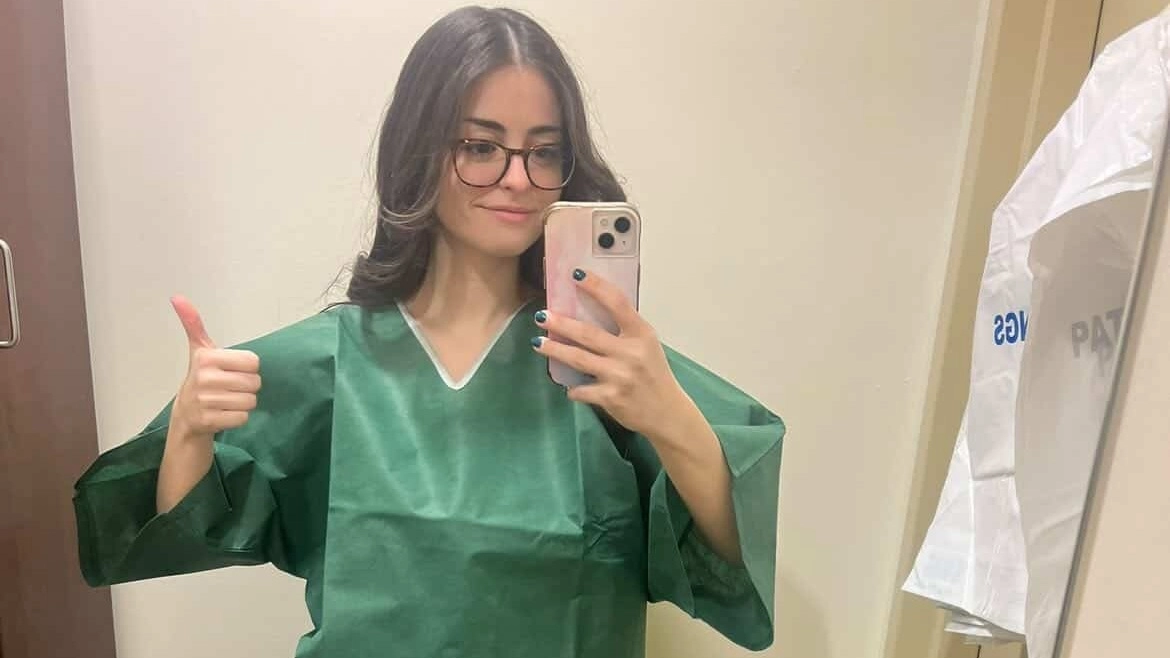
Woman, 26, diagnosed with rare cancer after infrequent pain that she ‘didn’t think much about’

Warning: This article contains discussion of cancer which some readers may find distressing.
Allison Dashow has opened up about being diagnosed with 'a five in one million cancer' at the age of 26.
Now 30 years old, Allison Dashow has been speaking out about her experience of being diagnosed with a rare form of cancer four years ago to raise awareness.
Dashow opened up about an early symptom she developed in April 2022 which she initially dismissed.
Advert
She told the Mail Online she presumed it was 'probably nothing serious' and it would 'go away,' particularly given it 'wasn't that uncomfortable'.
However, two months later she mentioned her pain to her therapist who urged her to 'take that seriously' and go to see a doctor.
Dashow had been experiencing a 'very intermittent shooting pain in [her] left eye,' she told People.
Dashow went into her local optometrist and the doctor found fluid behind her retina.

After being referred to a specialist and undergoing several scans, Dashow was asked for her other symptoms alongside her family history.
She was allegedly told the 'good news' was it wasn't 'eye cancer' and diagnosed with chorodial neovascularization (CNV).
However, a second opinion revealed she had ocular melanoma in her left eye.
She recalled to People: "I still remember that moment of being told that. This feels like another life, right? It feels like, 'This can't really be my life.' Hearing the word cancer, hearing the word melanoma — it's everyone's worst fear and at the same time, you never think you're going to be that person."
Ocular melanoma 'is an extremely rare type of cancer that occurs in about five out of every million adults,' National Organization for Rare Disorders explains. However, 'despite its rarity, it is the most common primary cancer of the eye in adults'.
It's not clear what causes eye melanoma, however, increased risk factors include having a lighter eye color, being white, being older, certain inherited skin conditions, certain genetic changes and exposure to ultraviolet light, Mayo Clinic explains.
It adds eye melanoma occurs when cells in the eye 'develop changes to their DNA' which tells the cells 'what to do'.
"In healthy cells, the DNA tells the cells to grow and multiply at a set rate. The DNA also tells the cells to die at a set time," it continues. "In cancer cells, the DNA changes give different instructions."
The cancer cells multiply while healthy ones die and the cancer cells may form a mass called a tumor which can grow, invade and destroy healthy tissue. Cancer cells can even break away and spread to other areas of the body.
Thankfully, eye melanomas can be treated and Dashow's hadn't spread.
She underwent surgery which left the tumor still in her eye 'but dead' with 'a very low chance of recurring'.
However, she still goes for scans to check on other areas of her body and has to receive an injection every five weeks to counteract a rare, progressive loss of vision she experiences caused by the radiation she was exposed through to treat her tumor.
Dashow is now speaking out about her experiences in the hopes of raising important awareness.
Indeed, Mayo Clinic reveals 'most eye melanomas form in parts of the eye you can't see when looking in a mirror' which makes many 'hard to notice'.
What's more, eye melanomas don't typically 'cause symptoms at first'.
Alongside Dashow's 'intermittent shooting pain' in her left eye, Mayo Clinic details other symptoms as including 'flashes of light or what look like specks of dust in a person's vision, a growing dart spot in the colored part of the eye, a change in the shape of the pupil, poor vision or blurry vision in one eye' and 'not being able to see when looking to the side'.
If you’ve been affected by any of these issues and want to speak to someone in confidence, contact the American Cancer Society on 1-800-227-2345 or via their live chat feature, available 24/7 every day of the year.
 Poppy Bilderbeck