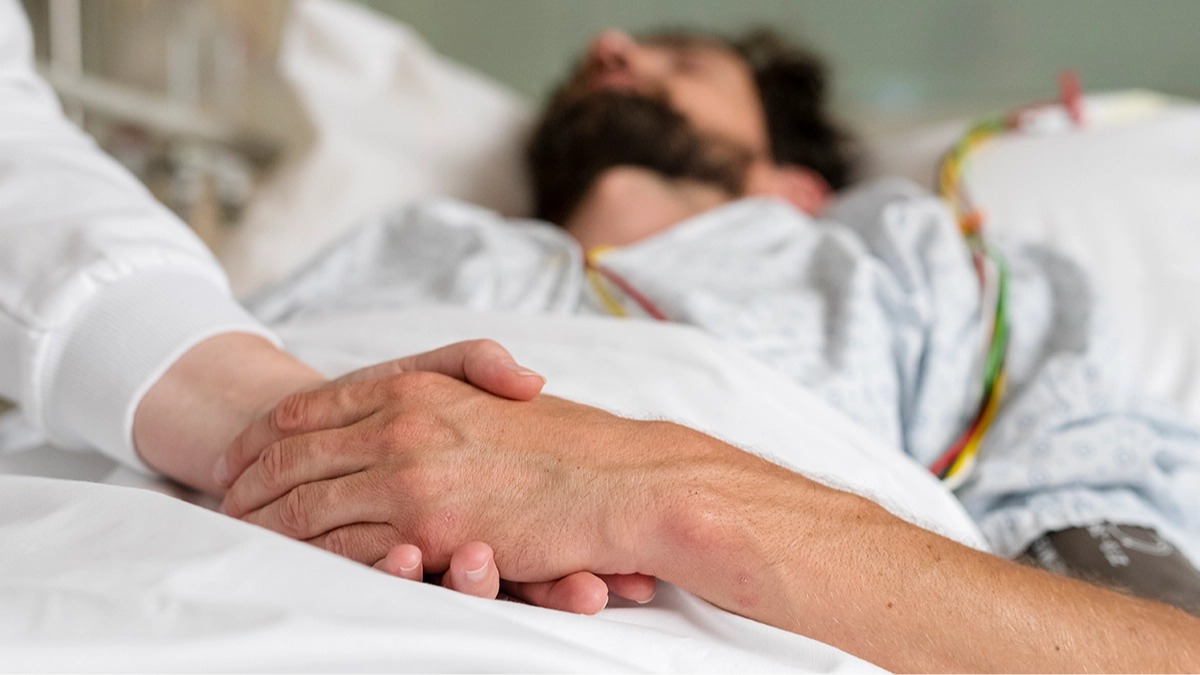
Scientists break down exactly what happens to your body after you die

A new research suggests that death may occur in 'stages' as evidence has been found that consciousness may persist for several hours after the heart has stopped pumping and the brain has ceased to send electrical impulses.
Researcher Anna Fowler at Arizona State University analysed more than 20 studies on people's near-death experiences, as well as studies conducted in animals to determine what happens in the brain after death.
According to the study, it is possible for people to remain conscious for hours after heart and brain stop, with Fowler calling for an update of the scientific definition of death.
Fowler's research highlights that some human patients who experienced 'complete circulatory standstill', which means that their hearts had stopped beating, were later able to recall what was happening around them.
Advert
According to her study results, Fowler likened death to 'a shifting landscape' rather than a clear threshold.
"Death, once believed to be a final and immediate boundary, reveals itself instead as a process – a shifting landscape where consciousness, biology and meaning persist longer than we once imagined," she wrote.
“Consciousness may not vanish the moment the brain falls silent. Cells may not die the moment the heart stops," she continued.
Fowler's study may have an impact on the ethics of organ donations, which often take place within minutes of the heart ceasing to operate and a person is declared dead.
The American Society of Transplantation (AST) provides some more information about the protocols in place to ensure the organ donation process is done safely and ethically. Organ donation can follow two possible pathways, with organ harvested after a patient has been declared brain dead and several tests have been performed to confirm this (DBD), and after circulatory death, when a critically injured patient, or his family, may decide to withdraw life support (DCD).
Back to Fowler's study, the research aims to propose a new understanding of death not as 'the sudden extinguishing of life, but the beginning of a transformation', with the researcher hoping that medicine, philosophy and ethics could converge to approach the subject 'with deeper humility and renewed clarity'.
“What does happen when we die? Nobody really knows,” Fowler added. “I really want people to think and consider what it means to truly die.”
According to the researcher, the definition of death in the US, which dates back to the 1980s, should be updated to reflect that death occurs in stages and isn't a singular event.
“It should be considered in phases,” she said. “If you have cancer, you could have stage three cancer, stage two cancer. Well, there are stages of death.”
Topics: Science
 Stefania Sarrubba