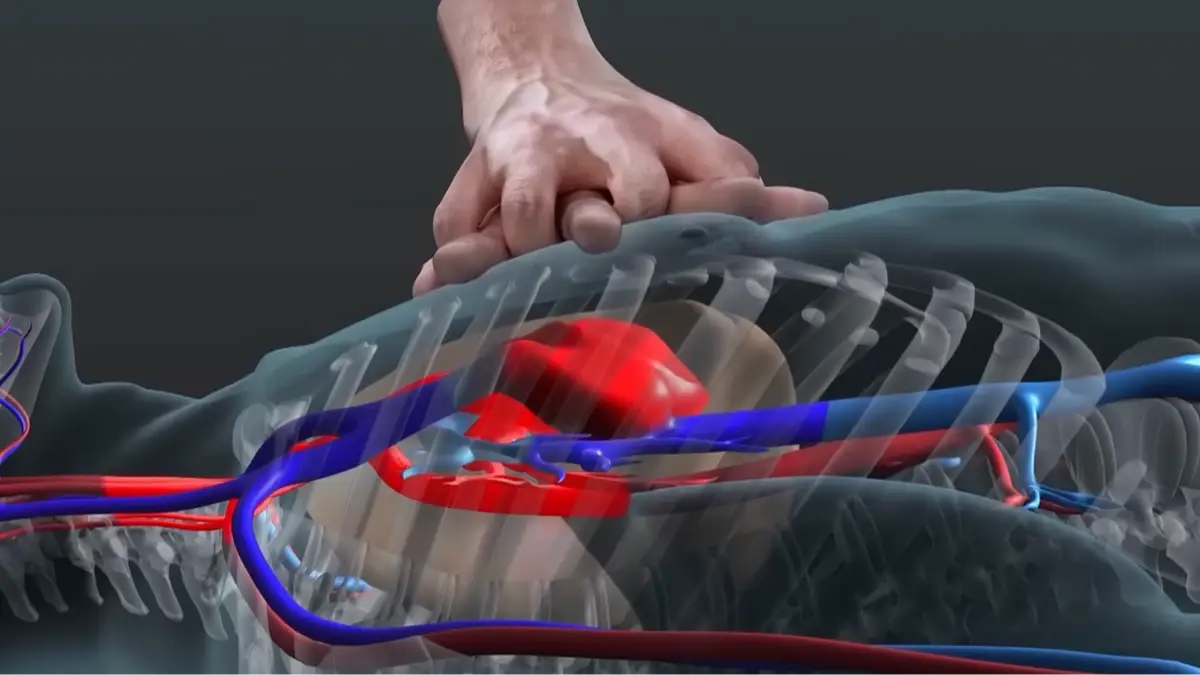
Simulation shows exactly what happens to your body when undergoing CPR

When someone experiences a sudden medical emergency and becomes unconscious or unresponsive, performing CPR is often the only way to keep someone alive until further help arrives.
Crouching down next to someone in this situation and performing regular chest compressions can help them to continue breathing and keep oxygenated blood flowing around the heart to other vital organs.
But doing cardiopulmonary resuscitation (CPR) wrong can have the opposite impact on their health. If CPR is done properly, you will probably end up breaking some ribs but saving their life, if done improperly, you could cause brain damage and do nothing to keep them alive.
An informative simulation by Action First Aid of what happens to the body during CPR reveals why compressing their chest too quickly, or slowly, can cause brain damage and do little to save the life of someone in the midst of an extreme medical emergency.
Advert

While resuscitating someone incorrectly will do little to save them, CPR remains the only way to ensure someone survives until further medical assistance, or a defibrillator, can restore their cardiac or respiratory processes.
A person remaining unresponsive for four minutes will begin to suffer brain damage, which will become irreversible after 10 minutes without proper breathing or blood flow.
This is why CPR remains important in emergency situations, even though studies suggest it is only effective in between 20 and 40 percent of cases of CPR carried out in hospital by a medical professional.
Action First Aid says that CPR puts 'the power to save a life in your hands' as it achieves two 'critical' functions.
"One, compressions move oxygenated blood to the brain to keep [it] alive, and two, compressions keep blood and oxygen moving to the heart muscle itself so that it has the best chance of resuming a normal electrical rhythm," the experts stated.
Each proper downward compression creates an 'artificial pump' that pushes oxygenated blood from the heart to vital organs like the brain, while the upwards movement draws de-oxygenated blood away.
Each compression should push into the chest by around two inches to ensure that the blood goes to the extremities, with a regular rhythm that gives the blood time to travel. As the simulation shows, not doing this can cause oxygen deprivation.
To properly oxygenate the blood and to ensure that it reaches the brain, you should carry out between 100 and 120 compressions per minute, which can be extremely physically demanding for both patient and first aider.
These compressions will keep blood 'moving within the heart and up to the brain', allowing the chest to recoil enough so that the next compression will pump blood out of the heart and all the way to the command center in our skulls.
While this can be a daunting task that even breaks their bones, Action First Aid says" "If ribs break, that's ok. What's not OK is allowing the brain to die from lack of oxygen."
Keeping up these compressions, roughly to the beat of Stayin' Alive by the Bee Gees, will keep the person stable until an ambulance crew arrives and are often the difference between life and death.
Topics: Health
 William Morgan