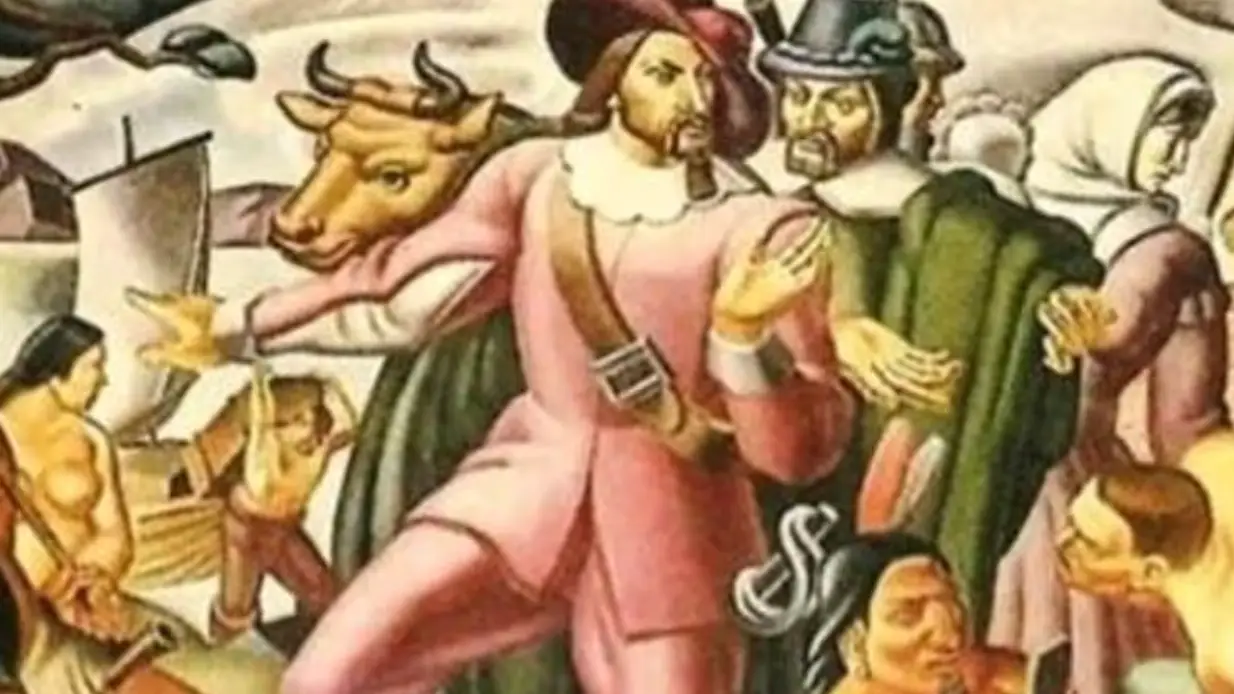
Mysterious 1937 painting sparks time travel theories as people claim they’ve spotted smartphone

 Niamh Shackleton
A 1937 painting has left people scratching their heads after a man in the artwork was seemingly holding a smartphone...
The painting, titled 'Mr Pynchon and the Settling of Springfield', was painted Italian artist Umberto Romano and depicts the arrival of settlers arriving in the town during the 1620s.
Romano was born in Italy and moved to the States at the age of nine. He was then raised in Springfield, Massachusetts, says National Postal Museum.
There are some white men in the painting (one being William Pynchon), and several Native Americans – and one of them is holding a peculiar object.
Advert
In the bottom right of the piece of art, a Native American man is sat holding a small, rectangular item up to his face that almost looks as if he's taking a selfie on a modern-day smartphone.
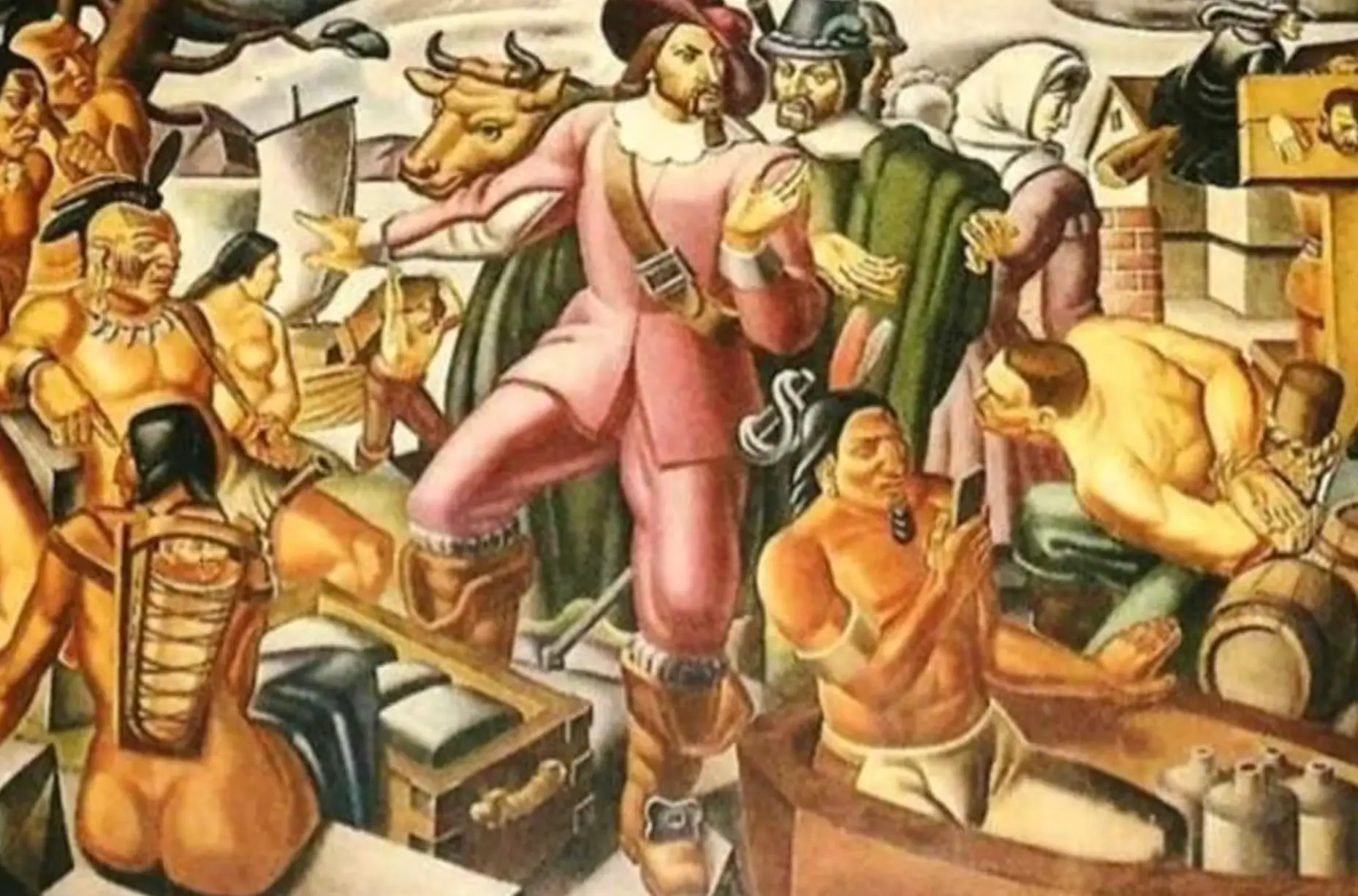
Understandably this has left people perplexed as, obviously, technology such as iPhones weren't around either at the time the painting was set or when it was actually made by Romano.
Sharing their thoughts online, one person joked that the man was posting on social media when the settlers arrived.
"Dude on 1937's 'Mr. Pynchon and the Settling of Springfield' by Umberto Romano casually posting on his social media what's happening around him," they said.
Somebody else wrote: "Check out this painting from 1937! Spot anything weird? There's a man using an iPhone. There's also another guy tied up, like they're goin thru his phone or somethin [sic].
"This picture depicts the founding of Springfield Massachusetts in 1636. Could it be a phone or something simpler?"
"The painting shows Pynchon in a pink suit and to his left, below him is a Native American looking as if he's taking a selfie. Time travel?" said someone else on Twitter.
But Brian Anderson thinks that time travel is unlikely.
Giving a more realistic explanation, Anderson wrote on Motherboard: "There's reason to believe, then, that what the man is examining is not an Indigenous object, but rather of European origin, like mirrors, which were presented often in such exchanges."
He continued: "The way the man holds it up, if indeed he's looking at his own face reflecting back at him, would certainly make sense."
People online have agreed with Anderson's suggestion, while others said it could have been a small Bible or prayer book that the Native American was looking at.
What do you think it is?